Austen Adapted: Which Film Version Is Your Favorite?
Austen aficionados know that even the film adaptations of the acclaimed novelist’s beloved books are analyzed repeatedly.

Editor’s Note: This story is part of literary special content. Find related stories here.
Austen aficionados know that even the film adaptations of the acclaimed novelist’s beloved books are analyzed repeatedly, perhaps none more than Pride and Prejudice.
Looking back at the resurgence of Jane Austen’s popularity in the mid-’90s, Belmont Abbey professor Emily Williams pointed out that Austen’s “rules and regulations” spoke to a culture that was very much moving away from propriety.
That time saw 1995’s Sense and Sensibility film directed by Ang Lee — that’s Williams’ favorite Austen film based on her favorite Austen novel.
Williams said that there is a reason, amid modern dating, that Austen endures — especially as a counter to such TV series as Bridgerton, marked by licentiousness.
“There’s always a reason we as a modern society want to latch on to the innocent past.”
She added: “Admittedly, I’d say thanks to film and TV adaptations, that simpler time has had a glow-up: We love looking at it, and readers want to be part of it,” referencing it as a decidedly “countryside vs. smartphones” phenomenon.
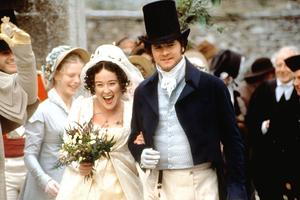
Catholic writer Emily Stimpson Chapman recommends the 1995 Andrew Davies version of Pride and Prejudice from the BBC, starring Colin Firth and Jennifer Ehle.
“It was absolutely worth the six hours,” she said in a Substack post, as “it gets Jane Austen so perfectly right, taking its time with the storytelling and letting the drama unfold (for the most part) in the midst of quiet ordinary life.”
She contrasted this version to the 2005 film starring Keira Knightley and Matthew Macfadyen, which she said, took the “drama to Gothic-level proportions,” adding: “It felt like the producers let one of the Brontë sisters write the screenplay. Jane Austen is not overwrought. She delights in subtleties. And that’s what the 1995 version gets so perfectly right.”
For her part, avid reader Sarah Reinhard, a Catholic author and speaker from Ohio, who posts about her love of reading on Instagram @booksandsarah, is not keen on movie adaptations: “I don’t want to ruin what I’ve pictured. A book does something that a movie can’t.”
She, however, appreciates You’ve Got Mail as a retelling of Pride and Prejudice.
Citing all of the Austen film adaptations, from Clueless (Emma retold) to the BBC’s Pride and Prejudice, Pepperdine professor Jessica Hooten Wilson observed, “Jane Austen is just like Shakespeare. She centers characters and human nature at the heart of her stories, just like Shakespeare. The stories always reflect human character. They are worthy to read universally.”
And adaptations extend to the theater.
British journalist and EWTN host Joanna Bogle recalled to the Register by email, “When I first read Jane Austen’s books, I struggled a bit: The Britain in which I was growing up simply didn’t include young women staying at home all day with nothing in particular to do. When our drama group at school presented Pride and Prejudice — and I was Charlotte Lucas! — it all came alive as, week after week at rehearsals, we came to know and relish the sparkling text.
“We all came to understand that this wasn’t just a piece of drama that was fun; we were sharing in a timeless contribution to the world’s literature.”
Postscript: Hear senior editor Amy Smith discuss film versions on an episode of Register Radio. (She also recommends the PBS Masterpiece versions of Sense and Sensibility and Persuasion.)
- Keywords:
- jane austen

Amy Smith Amy Smith is a Register senior editor who edits devotions and features for print and online. Fueled by prayer and coffee, she enjoys writing about everything from Jane Austen to saints for the Register. She is the author of The Plans God Has for You: Hopeful Lessons for Young Women (Emmaus Road Publishing). Her writing has also appeared in various other Catholic publications. She has a master’s degree in journalism and a B.A. in English.