What Are Catholics Reading This Summer?
Catholic writers, leaders and prominent figures share their reading lists for the warmest months of 2026.
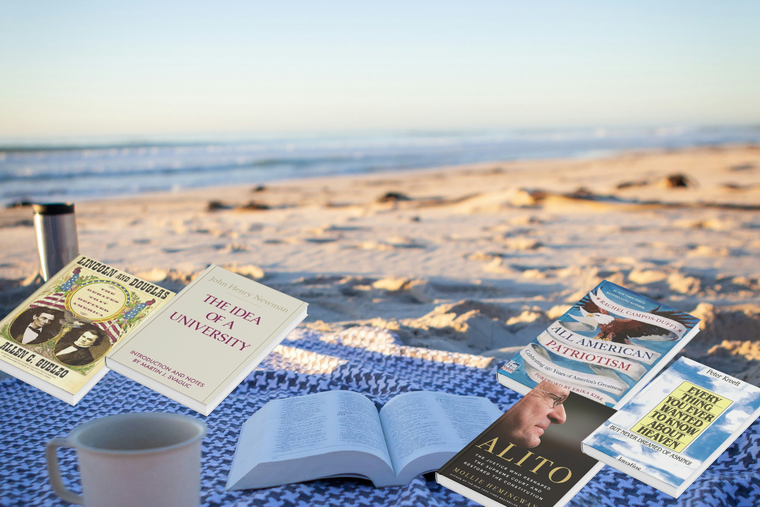
It seems like only yesterday that we published our Lenten reading recommendations, but here we are unrolling our 2026 summer reading list, which is altogether a very different animal than the books we recommended for the Season of Penance.
Summer books shouldn’t necessarily be unchallenging. In fact, it’s a perfect time for books that require the uninterrupted lounging-around time that summer affords, whether at the beach or pool, or in a hammock in the back yard. It’s the perfect time to get truly lost in a book — so lost that upon putting it down you feel a bit dazed, the way you might feel stumbling out of a movie theater into the blazing sun.
Those potentially-out-of-body-experience reads ought to be chosen carefully. To that end, we’ve asked a few Catholic writers, leaders and prominent figures what they are reading this summer. Here’s what they told us:
Alberto Fernandez, former diplomat and contributor to EWTN News:
I just devoured University of Chicago professor Anthony Kaldellis’ new 1453: The Conquest and Tragedy of Constantinople (Oxford University Press, 2026), a bracing, much-needed retelling of the fall of the Queen of Cities to the Ottoman Turks, one of the great sieges of history and a deeply consequential date in world history, in Muslim-Christian relations and in relations between Western and Eastern Christians. We forget all too often that the last two emperors of what we now call the Byzantine Empire (they called themselves Romans) were Catholics in communion with the Roman Pontiff.
Kaldellis provides a fresh perspective: that the fall of Constantinople was not a foregone conclusion or lost cause and that the Ottomans could have easily failed if a couple of things had turned out differently. If just a few hundred more Western troops had arrived, if a key commander had not been mortally wounded at a fateful moment, it could have made all the difference. The work replaces the much-liked (including by me) but quite-dated 1965 history of the same event by the legendary Sir Steven Runciman.
I am just starting and benefiting from Ross McCullough’s epistolary dystopian novel The Body of This Death: Letters from the Last Archbishop of Lancaster (Word on Fire Academic, 2025). McCullough is a Catholic academic at George Fox University in Oregon. Not quite The Screwtape Letters, as one of the blurbs on the cover trumpets, but still a worthy, very rewarding Catholic read, deftly touching on our transhuman, technologically convulsive moment and on much more.
Carrie Gress, author of Something Wicked: Why Feminism Can’t Be Fused with Christianity:
I just read Mollie Hemingway’s Alito: The Justice Who Reshaped the Supreme Court and Restored the Constitution and found it deeply insightful about both Justice Samuel Alito but also about the Supreme Court more generally. This led me to Justice Clarence Thomas’ My Grandfather’s Son: A Memoir. I wasn’t able to put it down. The book is a deeply personal reflection of the quietest judge on the court; it is touching, surprising, and simply great storytelling. The Church and Thomas’ faith are beautifully woven throughout.
Two new releases are set for mid-June that are on my list. Luke Burgis’ The One and the Ninety-Nine: Forging Identity in the Age of Social Contagion. I enjoyed Burgis’ previous offering, Wanting: The Power of Mimetic Desire in Everyday Life, based on the work of philosopher René Girard. This follow-up promises to be just as insightful in how to break the mimetic spell that has a hold on contemporary culture. Delano Squires also has a book that I’m anxious to read: The Vanishing Black Family: How Welfare and Feminism Made Marriage Optional and Children Vulnerable. Squires is tackling a huge problem that affects the whole country, not just black families, that no amount of money has been able to repair. I look forward to his insights.
And in view of America 250, I have three books on my list. Matthew Mehan’s The American Book Fables, which I can’t wait to read and share with my family. It looks like it will be a sweeping look at the United States, including layers of meaning, important and beautiful locations, and rich history and storytelling that will become a classic for generations to come. Eric Metaxas’ Revolution: The Birth of the Greatest Nation in the History of the World and Rachel Campos-Duffy’s All American Patriotism: Celebrating 250 Years of America’s Greatness seem appropriate ways to mark the country's significant milestone.
Ralph Martin, founder and president of Renewal Ministries:
Pete Burak’s Man on Purpose: Ten Rules of Life From a Faithful Father: Pete is a colleague of mine at Renewal Ministries, but we really like his book. My wife, Anne, liked it so much she bought eight copies to send to all the men in our family, son, sons-in-law and older grandsons!
Father Donald Haggerty, The Hour of Testing: Spiritual Depth and Insight in a Time of Ecclesial Uncertainty: Like all of Father Haggerty’s writings, this is a very deep and insightful book. He perceives the depths of crisis in the Church in the most fundamental ways, acknowledging their possible eschatological meanings, and draws us into a deeper participation in the passion of Christ as the direction in which redemption and rescue await us. Spiritually challenging and wonderful.
Jesuit Anthony Lusvardi, Baptism of Desire and Christian Salvation: I believe this is truly a groundbreaking book. It looks at the actual historical and theological basis of the doctrine of salvation by baptism of desire and shows clearly its limited scope, emphasizing the supreme importance of faith and the sacrament of baptism.
Msgr. Charles Pope, The Hell There Is: An Exploration of an Often-Rejected Doctrine of the Church. Msgr. Pope is the best daily and weekly Bible commentator that I know of. In this important book he expertly and convincingly answers every conceivable objection to believing in the truth about hell so that as few as possible go there!
R.R. Reno, theologian, philosopher and the editor of First Things magazine:
I have a stack of mountaineering and rock-climbing books on my bedside table. The sport has been a lifelong passion. But my motive this summer is more urgent and, in a certain sense, mercenary. I’m writing a memoir of my youthful climbing days, which requires feeding the imagination.
One of the books is Mount Analogue, an allegorical mountaineering expedition by René Daumal that’s about ascending to a higher consciousness. Another is a recent biography of Tobin Sorenson, Tobin, The Stonemasters, and Me 1970-1980 by Rick Accomazzo. Sorenson was one of the legendary climbers (as was Accomazzo) who defined the era in which I was first smitten by the sport of climbing. And then there’s a marvelous collection of intensely romantic essays about mountain climbing by Julius Evola, Meditations on the Peaks: Mountain Climbing as a Metaphor for the Spiritual Quest.
In addition to obscure climbing books, I’m rereading some of the books that were in my backpack during those youthful adventures to remind me of the state of my late adolescent soul: Thomas Mann, The Magic Mountain; D.H. Lawrence, The Rainbow; and Fyodor Dostoevsky, The Brothers Karamazov.
I still go rock climbing on occasion, but this summer’s expedition is an adventure of memory.
Sherry Weddell, author of Forming Intentional Disciples and president of the Catherine of Siena Institute:
This summer I’m reading a couple of classics. From Holy Communion to Blessed Trinity by MV Bernadot OP (I have a reprint of the original 1925 edition, but it is also available on Amazon). And Peter Kreeft’s Everything You Wanted to Know About Heaven: But Never Dreamed of Asking. I usually never have time to read things that are not work-related.
Dominican Father Patrick Mary Briscoe, promoter general for social communication of the Order of Preachers:
I’m reading The Lion the Witch and the Wardrobe by C.S. Lewis and The Spiritual Exercises of St. Ignatius of Loyola. When I was a boy, my father read aloud The Chronicles of Narnia to me as my bedtime stories. I have always loved them. They delighted me and now mean more than they ever have! As C.S. Lewis told his goddaughter Lucy, for whom the books were written, “One day, you will be old enough to start reading fairy tales again.”
As essential as fiction is to my spiritual life, the writings of saints matter too. I confess, I have never read the entire Spiritual Exercises. So that needed to change! I look forward to getting to know St. Ignatius of Loyola a bit better.
Erika Bachiochi, professor of practice, School of Civic and Economic Thought and Leadership at Arizona State University; and fellow, Ethics and Public Policy Center
I read St. John Henry Newman’s Idea of the University as a college student, now three decades ago. It was of great influence on how I thought about my own university education and no doubt influenced my conversion — though to this day I don’t remember quite how. Now that the learned saint has been named a doctor of the Church, I am eager to revisit that text, both to recall the contours of its influence on me, but also to help me better teach university students today.
The best way I’ve found to really enter into the thought of a particular thinker is to read as much of them as I can. So, this summer, I am also reading his Essay on Development of Doctrine and An Essay in Aid of Grammar of Assent, both of which I have familiarity with from secondary literature but have never actually read! Additionally, I’ll be studying deeply his “Letter Addressed to the Duke of Norfolk” for an academic paper on the proper relationship between rights and duties in the religious-liberty context. Call it my Newman summer — a true delight!
Tod Worner, a practicing internal medicine physician and editor-in-chief of Evangelization & Culture, the journal of the Word on Fire Institute
“Why are you reading (or plan to read) this summer and why?” Ah ... one of my all-time favorite questions! Let me tell you what is in my satchel and on my nightstand.
Scoop by Evelyn Waugh: Everyone who knows Waugh immediately cites his novel Brideshead Revisited, which is properly deemed one of the greatest Catholic novels of the 20th century. But Waugh was more than a lyrical novelist; he was also an incredible wit. Scoop, Waugh’s story of an eccentric, reclusive nature writer who is mistakenly drafted as a foreign correspondent to cover an unfolding African war, is peak Wauvian humor. If you can hardly take the modern media seriously, Scoop will help you understand why.
Maurice Bowra: A Life by Leslie Mitchell: For some reason, I am fascinated with mid-20th century Oxford dons who are two parts unmatched genius, one part unapologetic egotist, and one part irrepressible character. Maurice Bowra exemplifies that heady mix. A classics scholar and literary critic, wit and raconteur, Bowra reminds me of a time when authentic genius was rewarded and incompetent fools were not suffered. Sometimes, you won’t like him. Sometimes, you will love him. But, forever, you’ll respect Maurice Bowra.
My Early Life by Winston Churchill: The only thing better than reading about Churchill is reading Churchill himself. When Winston quipped, “History will be kind to me, for I intend to write it,” he meant the story of his early life as well. Having read Gibbon and Macaulay and learning how to tell the sweep of history (as well as the “unseriousness” to be found everywhere), Churchill writes with a racing heart and captivating pen. Buckle up for a master at the craft.
Salt of the Earth: The Church at the End of the Millennium by Joseph Cardinal Ratzinger and Peter Seewald: It is striking to read Cardinal Joseph Ratzinger (the future Pope Benedict XVI) as he is interviewed by an atheist-soon-to-become-Catholic journalist Peter Seewald. The warmth of Ratzinger’s style, the clarity of his thought, and the love for his God is palpable in every paragraph. I’ve read all four of these book-length interviews with Peter Seewald, and I am thrilled to return to them. If you don’t know or love Benedict XVI, then read these books and see how quickly that will change.
Lincoln and Douglas: The Debates That Defined America by Allen Guelzo: Who were Stephen Douglas and Abraham Lincoln? And what is the enduring significance of their 1858 senatorial debates? Allen Guelzo does a marvelous job crafting portraits of these two political giants and the philosophical pugilism that led to the rise of Abraham Lincoln, the mind that won the Civil War, and the heart that preserved the Union. This is intellectual history at its best.
Happy reading!
- Keywords:
- book picks
- summer
- summer reading