Archbishop Paglia’s ‘Paradigm Shift’ in Moral Theology Comes Into Focus
COMMENTARY: The former head of the John Paul II Institute says his reforms were meant to rethink natural law and replace ‘armchair theology’ with one rooted in ‘history and people’s lives.’

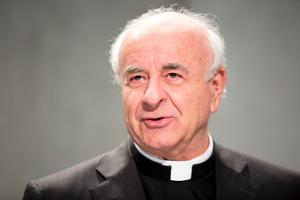
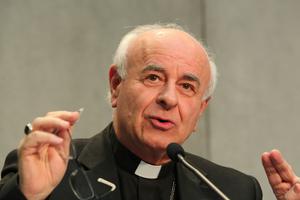
Archbishop Vincenzo Paglia — the former head of the Pontifical John Paul II Institute for Studies on Marriage and Family in Rome, as well as the former head of the Pontifical Academy for Life — recently granted an interview in which he openly admitted that one of his goals was to change the Catholic Church’s moral theology.
Archbishop Paglia said that he wanted to move away from “armchair theology” grounded in natural law theory and toward a new paradigm that focuses on the lived experiences of real people in their concrete circumstances.
His comment about “armchair theology” was a criticism of moral theology that he thought had become too academic and detached from the real world of real people. It was directed primarily at the former theologians of the John Paul II Institute, whom he dismissed without proper academic due process after taking charge, replacing them with theologians who would ground their approach in the social sciences as much as in theology.
In this latest interview, he is brutally honest about his ultimate aims. And he has elicited a profound and important response from the Institute’s former president, Msgr. Livio Melina, who was also among the professors Archbishop Paglia fired.
“He … made clear that these interventions were intended to bring about a profound paradigm shift, which — for the first time — he explicitly acknowledged as affecting not only the pastoral sphere but the doctrinal one as well,” Msgr. Melina stated.
“According to Paglia, this ‘very profound’ reform entailed, above all, a rethinking of the very concept of natural law. Paglia accused the John Paul II Institute of advancing a conception of natural law understood as a set of immutable principles from which moral norms are deduced. He proposed, instead, that natural law must be grounded in an ongoing historical discernment of subjective and cultural experience. In this perspective, a ‘theology within history and within people’s lives’ must replace what he characterized as the late Institute’s ‘armchair theology.’”
Nothing in this “new” debate surprises me. In 2022, I published an article in the Register making the point that the key to understanding the Francis pontificate was to focus on proposed changes in moral theology. In particular, my claim was that Pope Francis seemed to show a clear preference for a kind of moral theology that many refer to as “proportionalism.”
As evidence for this, I cited his praise in 2017 for the proportionalist moral theologian Bernard Häring, whom the Pope held up as a “model” for the development of moral theology. He also made a series of appointments to high offices of priests and prelates who were public dissenters from Church teaching in the area of human sexuality in particular, and who argued for a “paradigm shift” in moral theology.
And the Pope’s own ambiguous statements about the relationship between conscience and the moral law in Chapter 8 of Amoris Laetitia add further weight to the argument that he was at least testing the waters for making significant changes to the Church’s moral theological approach.
In many ways the umbrella term “proportionalism” does not do justice to the paradigm shift that more liberal Catholic theologians are seeking. The term “proportionalism” implies that this was a monolithic system of thought, with clearly agreed-upon principles, shared by all those who fell under its descriptive umbrella. I don’t think that is true, and I further think the reasons for this are instructive in the current debate.
It is better to describe the moral theology involved as an attempt to move away from natural law forms of moral reasoning, with its focus on the moral object of the act as such, and toward a model that takes into greater consideration the motive of the person involved, the affective sphere, the realm of our subjective desires and dispositions, human psychology and sociology, and the limits placed upon our efforts to live the Gospel by the concrete circumstances in which we live.
Indeed, the entire notion of an objective “moral object” for any action is called radically into question. The shift from an analysis of the various purposes and ends of human nature toward a focus on affective dispositions and concrete circumstances signals more than a mere change in pastoral sensitivity and gradualness. As Msgr. Melina notes, it signals a desire to change the Church’s doctrines at their root and to argue for a new vision of human nature as well.
All of this is part of what thinkers like Archbishop Paglia refer to as a “turn to experience” as the new foundation for doing moral theology from the “ground up” rather than the “top down.” The latter approach is criticized for being too abstract, deductive and focused on “unbending” principles. Underneath this criticism is the not-so-latent assertion that the reason we should not rely upon unbending and unchanging moral laws is that human nature changes over time, and therefore so should our moral calculations.
It is a move away from an allegedly static and essentialized Aristotelian/Thomistic concept of nature — including human nature — and toward an allegedly more dynamic philosophy of nature grounded in the ubiquity of fluidity, change and historicity, which is then held up as an entirely new metaphysical vision as well.
The problem for Archbishop Paglia, as Msgr. Melina makes clear, is that such criticisms of natural-law theory are cartoonish and superficial. Archbishop Paglia and his allies begin by making a gross caricature of traditional Thomistic natural-law principles as grounded in outdated classical views of nature as unchanging, which is then translated into static moral laws nobody can live up to. Archbishop Paglia then alleges, wrongly, that modern natural-law theorists in the line of John Paul’s intellectual lineage, like Msgr. Melina and others at the JPII Institute, are stuck in this outdated paradigm of an airless changelessness.
Indeed, one of the major advances in natural-law moral theology has been the expansion of its categories to include considerations of subjectivity and historicity, while also taking into account the findings of the modern social sciences. What this shows is that Archbishop Paglia’s preferred changes in moral theology have nothing to do with nuancing natural-law moral theory and everything to do with a tout court repudiation of its underlying principles.
And that, my friends, is not a “paradigm shift.” It is instead a postmodern wrecking ball designed to demolish the Church’s moral norms and replace them with a mishmash of therapeutic bromides. It is, as well, the destruction of the realm of the humanum insofar as it represents a cynical and almost nihilistic conception of human moral agency as little more than a pastiche of passing impressions glued together by sentimental feelings.
This might seem like a lot of academic hair-splitting, but it is actually of immense significance. In a post on the social platform X, Bishop Robert Barron made a very strong and trenchant critique of Archbishop Paglia’s interview, stating that Archbishop Paglia has now made clear what it is most of us have suspected all along:
In a recent interview, Archbishop Vincenzo Paglia, former grand chancellor of the John Paul II Institute on Marriage and Family Life, confirmed the worst suspicions that many of us had. He admitted that the changes he made at the Institute during the Pope Francis years were designed to initiate a ‘very profound’ reform of the idea of the natural law. Instead of absolute moral norms grounded in a keen understanding of the basic goods, he and his colleagues were proposing a moral theory rooted in historical discernment of subjective and cultural experience — not an ‘armchair theology’ but one operating ‘within history and within people's lives.’ This, of course, is the language of trendy postmodernism, and it is dangerous indeed.
It is indeed dangerous. Bishop Barron goes on to point out that if there is no such thing as intrinsically evil acts, then perhaps someday slavery can be “rehabilitated” as something morally allowable in certain concrete circumstances. I think this is a good point, since nobody wants to admit that their preferred moral theory might open the door to things like slavery and genocide.
The fear, of course, is that the moral revisionism of Archbishop Paglia and his allies opens the door to a dangerous relativism. However, I think it is clear that whatever relativism they have in mind has to do with issues relating to sex, and not much else. What they want is the moral legitimation of divorce and remarriage, contraception, cohabitation and homosexual marriage.
And in the end, there is nothing new about this at all. It is simply one more Gnostic attempt to trivialize our bodies as bearers of sacramental meaning.