This Is the Real Divide Between Rome and the SSPX
COMMENTARY: The central issue between Rome and the SSPX is not primarily liturgical or doctrinal, but the ecclesial unity and charity that bind Catholics to Peter and to one another.
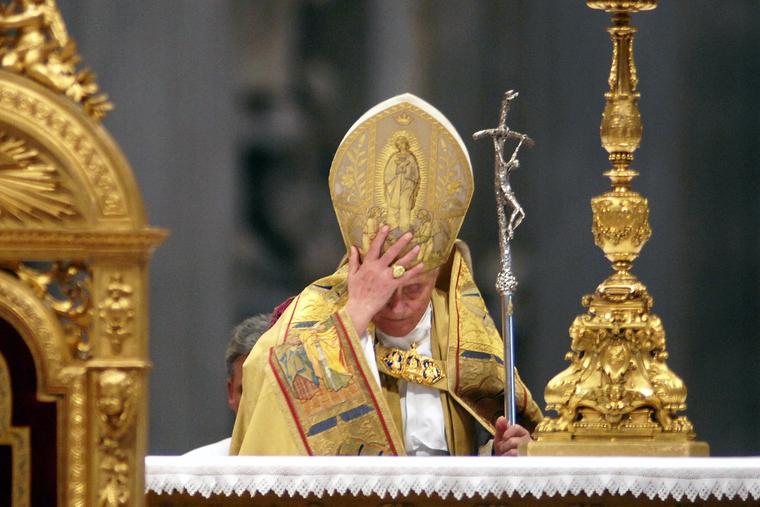
Pope Benedict XVI’s 2007 motu proprio Summorum Pontificum was about the liturgy. Except it wasn’t.
You see, the Holy Father had a burning desire to repair the rift between the Society of St. Pius X (SSPX) and the Catholic Church, and to repair it, he decided to turn his attention to an issue that, in a way, had nothing to do with it.
In a letter accompanying Summorum Pontificum, Benedict explained that the 1962 Missal “was never juridically abrogated and, consequently, in principle, was always permitted.” In short, even though it was rarely offered in most parts of the world, the form of the Mass as celebrated prior to Vatican II was never an issue because it was always allowed. So, Summorum Pontificum was just clarifying two forms of the one Roman Rite.
Except it was doing much more. By issuing Summorum Pontificum, Benedict XVI made it abundantly clear that, from his point of view, the chasm between the SSPX and Rome was no longer about the liturgy, for — at least in theory if not in practice — any member of the faithful could attend either form of the Rite.
So, what was the schism about?
To distill an answer even further, Benedict, two years later, through a decree issued by the Congregation for Bishops, remitted the excommunication incurred by four bishops upon their consecration by Archbishop Marcel Lefebvre in 1988. The decree expressed the Holy See’s ardent hope that “this step will be followed by the prompt attainment of full communion with the Church on the part of the whole Society of St. Pius X, which will thus bear witness to its genuine fidelity and genuine recognition of the Magisterium and authority of the Pope by the proof of visible unity.”
The fact that this never happened broke Benedict’s heart. It broke his heart even more that many of his brother bishops bitterly attacked him for even trying to mend the tear. As he wrote in a personal letter to all bishops following the remission of the excommunications, “At times one gets the impression that our society needs to have at least one group to which no tolerance may be shown; which one can easily attack and hate. And should someone dare to approach them — in this case the Pope — he too loses any right to tolerance; he too can be treated hatefully, without misgiving or restraint.”
I was there, and I personally witnessed the deep grief the whole affair caused the humble German Pontiff.
So, is the schism dogmatic in nature?
Strictly speaking, that would be incoherent. For if we’re dealing with dogma, the split between the SSPX and Rome would be heretical in nature, not schismatic. That’s not to deny that there are critical doctrinal points that need to be clarified on both sides, but, with all due respect to my friend George Weigel, I’m not yet convinced that the SSPX “does not share the faith of the Catholic Church.”
I may be naïve, but I think the leaders of the SSPX could still sit down with authorities from the Holy See and continue pursuing vigorous, authentic dialogue on whether Christ renders the Old Covenant “definitively null and void” and whether “every man must be a member of the Catholic Church in order to save his soul.”
I know it’s a big stretch, but I still harbor hope that there are ways of interpreting those statements in the SSPX’s Declaration of Catholic Faith Addressed to Pope Leo XIV as compatible with the teaching of the Second Vatican Council. I dare say that I think Pope Benedict would have thought so, too. It would take me too long to explain why such compatibility may be achievable, but for the sake of argument, let us assume that it is.
What then is the issue of the schism?
The issue is just that: It’s a schism, which the Code of Canon Law defines as “the refusal of submission to the Supreme Pontiff or of communion with the members of the Church subject to him” (Canon 751). Nowhere is the issue of how the ordination of bishops without a papal mandate incurs a latae sententiae excommunication clearer than in Ecclesia Dei, the apostolic letter by which Pope St. John Paul II explained why Archbishop Marcel Lefebvre was wrong to ordain four men to the episcopate.
The act, John Paul explained, “was one of disobedience to the Roman Pontiff in a very grave matter and of supreme importance for the unity of the Church.” Such disobedience implies “in practice the rejection of the Roman primacy” and, more gravely, “an incomplete and contradictory notion of Tradition” — incomplete “because it does not take sufficiently into account the living character of Tradition,” and contradictory because it presumes “a notion of Tradition which opposes the universal Magisterium of the Church possessed by the Bishop of Rome and the Body of Bishops.”
John Paul forcefully concludes that “it is impossible to remain faithful to the Tradition while breaking the ecclesial bond with him to whom, in the person of the Apostle Peter, Christ himself entrusted the ministry of unity in his Church.”
The impending schism, therefore, is about unity; a unity that, in the personal letter quoted above, Pope Benedict XVI explained could be broken only with the gravest of consequences. Benedict had recourse to Galatians 5:13-15 to prove it:
Do not use your freedom as an opportunity for the flesh, but through love be servants of one another. For the whole law is fulfilled in one word: ‘You shall love your neighbor as yourself.’ But if you bite and devour one another, take heed that you are not consumed by one another.
Commenting on the passage, Benedict said that “this ‘biting and devouring’ also exists in the Church today, as an expression of a poorly understood freedom. Should we be surprised that we, too, are no better than the Galatians? That at the very least we are threatened by the same temptations? That we must always learn anew the proper use of freedom? And that we must always learn anew the supreme priority, which is love?”
So, the issue is about unity, but it is about much more.
It is about the charity that binds us as the body of Christ. It is about the charity that impelled Pope Benedict to persevere — first as prefect of the Congregation for the Doctrine of the Faith and then as the Successor of Peter — in a painstaking, frustrating and often convoluted dialogue with the SSPX. It is about the charity that impels all of us to better understand the concerns of the SSPX.
But most of all, it is about the charity that should make the SSPX stop and think twice before putting themselves into schism once again.
Daniel B. Gallagher is a lecturer in philosophy and literature at Ralston College. He worked for a decade at the Vatican’s Secretariat of State under Popes Benedict XVI and Francis.