Jane Austen at 250: Why the Pastor’s Daughter Still Captivates the Modern Heart
Reflect on the author’s timeless virtue and witty brilliance just ahead of her birthday this month.
Editor’s Note: This story is part of literary special content. Find related stories here.
Picture English country villages, bonnets and gentility — and relatable heroines and heroes.
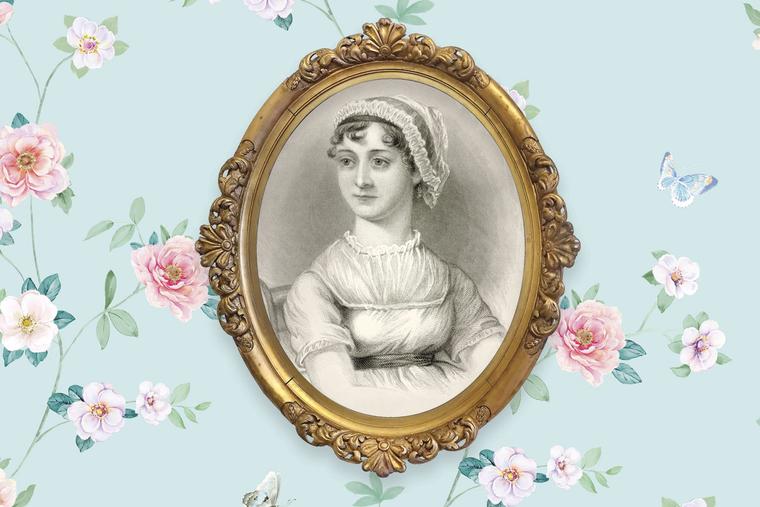
These are hallmarks of Jane Austen novels, the literary masterpieces of the beloved English novelist born on Dec. 16, 1775 — and the world is rightly celebrating her 250th birthday.
But why is the Register marking the momentous occasion? Austen was the daughter of an Anglican clergyman, after all. (Though, of note, Catholic scholar Joseph Pearce writes in Classical Literature Made Simple that Austen was “sympathetic to Catholicism at a time when anti-Catholic bigotry and sectarianism was the default position in English culture.”)
As a devout believer, Austen imbued her novels with Christian themes, most notably virtue. And avid readers and scholars alike note her novels’ place in the classical canon. Consequently, the Register places Austen as a centerpiece to introduce other literary content in this issue. Readers will find pieces on why quality literature is good for us, why real men read poetry (and Austen novels), a dystopian novel referenced by the last three popes, literary characters of hope and movie adaptations from Austen to Tolkien, plus how Diary of a Country Priest was inspired by St. Thérèse.
But back to Miss Austen.
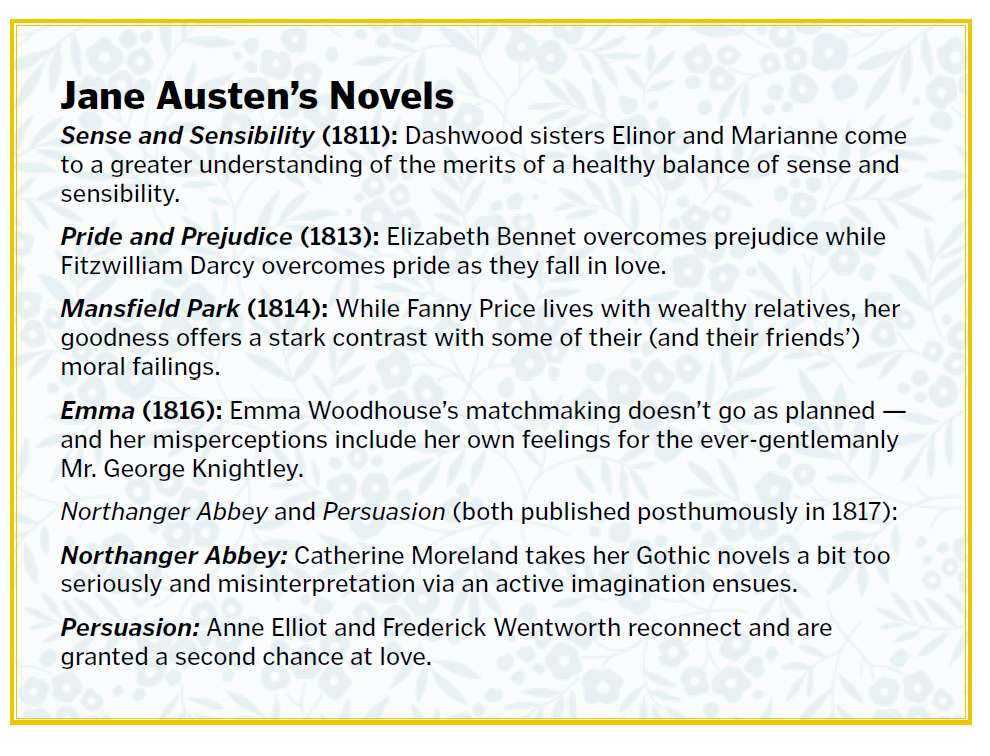
The author of Sense and Sensibility (1811), Pride and Prejudice (1813), Mansfield Park (1814), Emma (1816), Northanger Abbey and Persuasion (published posthumously in 1817) has been called “a giantess among giants” by Pearce. Pearce expounds on why Sense and Sensibility and Pride and Prejudice are considered classics in Classical Literature Made Simple. “[H]er heroines attain the fullness of human dignity, subjecting themselves as eminently rational creatures to the goodness of virtue and the objectivity of truth.”
Pearce, editor of the Ignatius Critical Editions of Austen’s novels, also writes, “Indeed, it is through Jane Austen’s heroines that we perceive the virtue and brilliance of the author herself, who always allowed her own sense and sensibility to be governed by her deep Christian faith.”
Those who are Austenian at heart are quick to explain why, in 2025, long after Austen’s death at age 41 in 1817, the beloved novelist’s writing endures.
“She was a great observer of human nature and behavior,” Emily Williams, an adjunct professor of English at Belmont Abbey College, told the Register.
“We all can recognize someone in our own lives — and in our own selves, too — by reading her characters,” observed the North Carolina-based professor. “We all know an Elizabeth Bennet or Mr. Knightley.” Elizabeth is the independent and intelligent heroine of Pride and Prejudice who is a worthy match for the initially aloof Mr. Fitzwilliam Darcy, and Mr. George Knightley is the gentlemanly hero of Emma.
‘Knows Our Hearts’
Austen’s memorable characters are memorable for a reason. “Women are interested in the female characters because we can relate to them, root for them, and empathize with them,” Williams said.
And Miss Austen’s Christian upbringing is evident.
“She was a woman of faith, a pastor’s daughter. Her faith was not on her sleeve, but looking deeply enough, you find it,” Williams said of Austen’s “beautiful, precious gems.”
She continued, “She speaks directly to women’s hearts; she knows us. She wrote about what she knew best: relationships, personalities, country life. She knows how to get in touch with her audience, and we get her.”
“She knows deep down the heart of a woman in the way God created us,” Williams emphasized.
Witty Writing
Austen’s stories include much humor — to highlight what is both right and wrong amid the novels’ societal conventions.
Jessica Hooten Wilson, the Fletcher Jones Chair of Great Books at Pepperdine University, shares an appreciation for Jane Austen’s wisdom — and wit. “She’s funny. That’s No. 1,” the professor said.
“She’s hilarious, relatable, and a joy,” observed Ann Burns, a wife, mother and founder of The Feminine Project, where she writes about Austenian and other themes.
In modern society — with much comedy marked by coarse, mean jokes — the hilarity of the Regency era is refreshing, Burns said.
And it’s not just women who appreciate such wit. Burns recounted how she was talking to one of her parish’s priests, who said he didn’t want to read Austen but thoroughly enjoyed Pride and Prejudice.
Father Daniel Nolan admitted he was skeptical — why would he read Austen? “My sisters loved those books and movies growing up and were always talking about who the main characters are, virtue, and who they would like to be married to,” Father Nolan, of the Priestly Fraternity of St. Peter and a parochial vicar at Holy Ghost parish, in Bethlehem, Pennsylvania, told the Register.
His sisters’ continued insights as young adults have resonated with their priest brother.
Recently, he was talking with one of his sisters about classical education — and virtue in Austen’s novels.
And that led Father Nolan to listen to an audio version of Pride and Prejudice. “In Chapter 1, I started laughing my head off; it was so witty,” he observed to the Register, highlighting the humorous Mr. and Mrs. Bennet and their banter — and all the insights, page by page, into human nature. “Jane Austen is teaching about virtue in a story, as entertainment,” he added.
Catholic Ethos
Professor Hooten Wilson delineated why Austen resonates so well with Catholics. “Catholics believe in the divine comedy, and that’s typical Jane Austen; hindrances always end happily. It resonates because there is a happy ending.”
But it’s not just about happily ever after, of course, she continued. Noting what the University of Notre Dame’s esteemed late philosopher Alasdair MacIntyre observed in his scholarship of virtue ethics and striving for excellence, she said, “Communities function best when we submit to virtue, which is what Jane Austen’s novels reflect.” In sum, Austen resonates due to humor, happy endings, virtue — and family. “You’re not made to be alone; we experience community first in the home, then neighborhood or village, and then outward,” Hooten Wilson said. Austen’s novels illustrate “morality taking place within the miniature world,” the sphere of the family, she underlined.
Persuasion is the novel she always teaches because it is her favorite (she first read it in one sitting). “I couldn’t put it down,” she recalled of the timeless story of second chances marked by “moments of hope and morals.”
Sarah Reinhard, an Ohio-based Catholic author and speaker, wife, and mother of four children, chronicles her bookworm pastime @booksandsarah on Instagram.
“What’s not to love?” she told the Register about Austen’s novels. “The characters hold up. It’s why we read Bible stories; they still resonate,” she said, citing an example from Pride and Prejudice: “Elizabeth’s scathing response to Darcy is still scathing.”
“When you look at the enduring stories, the underlying theme of love is what we are still seeking — what is more Catholic?”
Father Nolan agrees about Austen’s “bright and brilliant” wordcraft.
“Perception is key — with deep thoughts and feelings, that book’s impactful,” he said of Pride and Prejudice. “What I perceived was that the noble way of life is what everyone should aspire to because it makes you a more excellent person.”
‘Theological Mind’
Burns assessed Austen in the context of the cultural climate in which Austen lived and wrote.
For books based on country society in 19th-century England, Austen exceeded the norm, Burns explained, in terms of character development. For example, in Mansfield Park, “Fanny is a character without any social charms — just virtue,” outlining how the “novels uphold constancy in virtue; she does not confuse goodness with the affectation of goodness.” Referencing Fanny Price’s opposition to a salacious theatrical performance in the novel, Burns said, “Propriety saves us from scandal and the near occasion of sin.”
“Austen has a heroine who is ultimately good — goodness is attractive,” Burns stressed. “She shows us through her villains what it means to be too attracted to the world, to maybe admire goodness but not be willing to sacrifice for it. Austen was my guide while dating, seeking a man who has virtue, not just the affectation of goodness.” As much as Austen understands Regency society, her insights go much deeper.
“She has such a theological mind,” Burns said. This can be seen in Elizabeth’s sister Mary Bennet, who is musically minded but socially awkward, and Mr. Collins the obsequious clergyman, in Pride and Prejudice, who exhibit “morality in theory but in no way apply it,” Burns explained.
For example, consider Mary’s response after Lydia Bennet elopes with Mr. Wickham (promoting Mr. Darcy to save Lydia from ruin out of his love for Elizabeth, which prompts Elizabeth and Darcy’s reconciliation). “After Lydia’s ‘great fall,’ Mary shows no compassion, but haughtily warns her sisters of the downfall of a woman. Her response is devoid of charity. She may understand morals but doesn’t know how to apply them.”
British journalist and EWTN host Joanna Bogle also highlights the morality present in Austen’s “sparkling text.”
“Part of the success is that she actually explores profound moral truths, concerning issues like, well, pride and prejudice!” Bogle told the Register via email.
“Her stories reveal unchanging Christian-based common sense and wisdom as the solution to life’s challenges.” Bogle continued, “Selfishness, greed and uncharitable behavior are wrong, and sexual immorality carries tragic consequences. ... A good marriage is something worth achieving — and even coping loyally with a marriage that is not totally fulfilling can be a good and noble way to live. Private choices can have wider consequences. Kindness and good humor can make difficult things much easier.”
Pearce highlighted Austen’s faith in a related observation in Classical Literature Made Simple about Pride and Prejudice.
“Perhaps the final words on this most popular of novels should be left to Miss Austen herself. In an evening prayer that she is believed to have composed, she beseeches the most merciful God to ‘save us from deceiving ourselves by Pride or Vanity.’ In the case of Miss Elizabeth Bennet and Mr. Darcy, this prayer is answered.”
Characters Like Us
Reinhard most enjoys reading Pride and Prejudice — which, she deems, is “delightful.”
But she connects with other novels, too. “I love reading through Emma and seeing Emma and Mr. Knightley’s relationship. You see, the whole time, he’s patiently waiting for her to catch up. The more I read it, the more I appreciate how much she grows — and that awkwardness!” (in reference to Emma Woodhouse’s meddlesome matchmaking). Plus, there’s that novel’s hero. “Mr. Knightley reminds me of my husband,” she said.
She also loves Persuasion — for its capable heroine, Anne Elliot.
For the record, Pearce believes Sense and Sensibility’s sense-minded Elinor Dashwood “bears a remarkable likeness” to the authoress.
Austen will indeed endure.
As Bogle underscored, “Time spent introducing new generations to Jane Austen’s novels is time well spent.”
- Keywords:
- classic literature
- jane austen

Amy Smith Amy Smith is a Register senior editor who edits devotions and features for print and online. Fueled by prayer and coffee, she enjoys writing about everything from Jane Austen to saints for the Register. She is the author of The Plans God Has for You: Hopeful Lessons for Young Women (Emmaus Road Publishing). Her writing has also appeared in various other Catholic publications. She has a master’s degree in journalism and a B.A. in English.