Vatican Diary: Reflections on ‘America Week’ at the Vatican
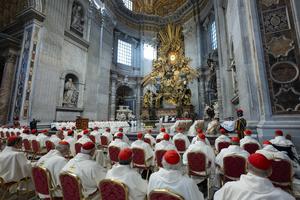
Last week was “America Week” at the Vatican. That’s the unofficial name for the second week after Easter, when bishops and laity from the U.S. flock to Rome for a series of events culminating in the Rector’s Dinner, a fundraiser at the Pontifical North American College (PNAC), the U.S. bishops’ seminary on the Janiculum Hill.
The dinner was canceled last year in mourning for Pope Francis, who had died on Easter Monday, and other events took on a suitably muted tone. This time, the general mood was lively, buoyed by Rome’s typically balmy spring weather, though punctuated midweek by a brief but torrential downpour.
The PNAC showcased the prominent U.S. presence at the Vatican by honoring Franciscan Sister Raffaella Petrini, who, as president of the Pontifical Commission and Governorate of Vatican City State, is roughly the mayor of Vatican City. Sister Raffaella is Italian but belongs to a Connecticut-based religious congregation, the Institute of the Franciscan Sisters of the Eucharist, and holds a business degree from the University of Hartford.
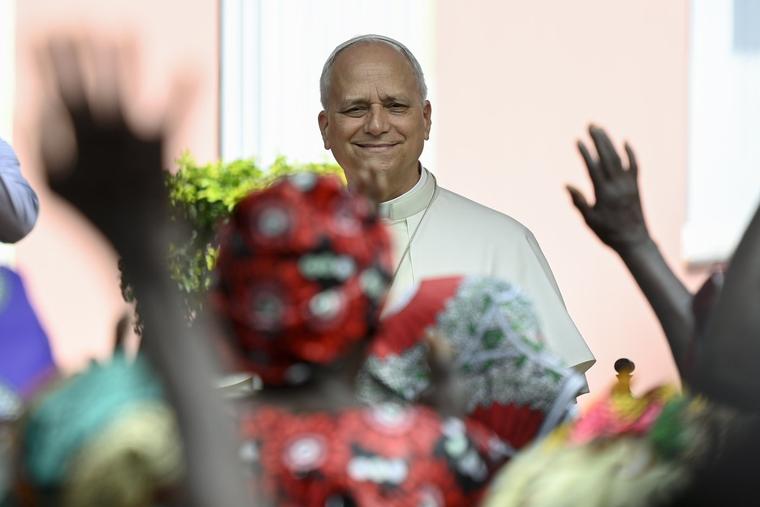
The most important American at the Vatican was not in Rome last week, but thousands of miles away, on a pastoral visit to Africa scheduled to last until Thursday, April 23. Pope Leo XIV could not set aside U.S. affairs, however, thanks to comments by President Donald Trump a few hours before his departure last Monday. In a social-media post, Trump slammed the Pope as “WEAK on Crime, and terrible for Foreign Policy,” including for his criticism of the war against Iran.
Leo told reporters accompanying him on his outbound flight from Rome that he had “no fear” of the Trump administration and pledged to continue calling for peace. True to his word, at a prayer meeting for peace in Cameroon on Thursday, he repeated his frequent denunciation of religiously justified violence, saying: “Woe to those who manipulate religion and the very name of God for their own military, economic, and political gain, dragging that which is sacred into darkness and filth.” He added in the same speech: “The world is being ravaged by a handful of tyrants.”
Leo later said that his speech in Cameroon had been written two weeks earlier and was not a response to Trump’s criticism. Debating the president “is not in my interest at all,” the Pope said.
Whatever the impact of papal-presidential friction on U.S. politics, a notable side effect has been the intensified media attention on Catholic theology. The last time something like this happened was in January 2025, when Vice President JD Vance, a Catholic, cited the concept of the ordo amoris in connection to the immigration debate. Vance argued that Christianity teaches people have stronger obligations to their families and neighbors than to foreigners, drawing a rebuttal from none other than Pope Francis.
Vance weighed in again last week, saying that “it’s very, very important for the Pope to be careful when he talks about matters of theology,” in this case, the Church’s tradition of distinguishing between just and unjust wars.
Pope Leo has described the conflict with Iran as “a war which many people have said is an unjust war,” but he has made other statements recently that sound like blanket repudiations of military force, including that Jesus “does not listen to the prayers of those who wage war” and that a Christian “is never on the side of those who once wielded the sword and today drop bombs.”
Bishop James Massa, chairman of the U.S. Conference of Catholic Bishops’ Committee on Doctrine, argued last week that the Pope’s words did not rule out the use of force in self-defense, as permitted by Church teaching. But many would like Leo himself to elaborate on the subject. Hopefully one of the reporters on the papal flight will raise it during the expected news conference this Thursday afternoon.
Just-war theory, like the ordo amoris, is a concept closely associated with St. Augustine, and Pope Leo is himself an Augustinian, so he surely has a lot to say about it. In this case, theologians won’t be the only ones hanging on his every word.
♦
Norah O’Donnell of CBS News has said Trump told her he decided to write his April 12 Truth Social post against Pope Leo after watching her 60 Minutes interview with three cardinals — Blase Cupich of Chicago, Robert McElroy of Washington and Joseph Tobin of Newark — who criticized Trump’s policies on immigration enforcement as well as the Iran war. This is perfectly credible, since the president is known to watch a lot of television but probably spends little time reading papal homilies.
The three cardinals were logical choices for a segment on “Pope Leo’s Church,” because they are the only cardinals currently leading U.S. archdioceses, and are therefore the American ordinaries with the closest ties to Rome. But the sight of the three of them on camera together brought home that there is today no single U.S. bishop, with or without a red hat, who comes close to standing for the American hierarchy as did such legendary prelates of the past as Cardinals Spellman, Cushing, Bernardin and O’Connor.
However great their influence among their peers and at the Vatican, and however effective as administrators they may be at home, the current leaders of the Church in the U.S. include no one who has captured the attention and the imagination of the public like those historic figures.
One can speculate as to why. Certainly, the clerical sexual-abuse crisis has made bishops more cautious and humbler in their approach to their flocks and wider American society. But Cardinal Seán O’Malley of Boston, the bishop most closely identified with reform in response to the abuse crisis, who retired in 2024, emanated a quiet charisma that made him a national celebrity. And the quotable and witty Cardinal Timothy Dolan, who stepped down last year, was and remains a media favorite.
Of course, the Bishop of Rome, whose job automatically makes him larger than life, is currently an American, a status that makes his exchanges with the U.S. president especially significant and compelling. So maybe there is simply no need right now for an heir to Cardinal Spellman’s nickname of “American Pope.”
♦
Shortly after his return from Africa, Pope Leo is expected to meet with Anglican Archbishop Sarah Mullally of Canterbury, the first woman to hold the role of spiritual leader of the Church of England and hence of the worldwide Anglican Communion. Yet her election in October has thrown into even greater doubt the survival of the communion, which has grown increasingly fractious since the 1990s over disagreements about homosexuality and women’s ordination.
Differences over those issues have also obstructed ecumenical efforts between Canterbury and Rome, as Leo alluded to in his note of congratulations on Mullally’s installation in March. Their meeting this month will no doubt yield friendly and historic images and talk about common values such as peace. The archbishop issued a statement of support for Leo following Trump’s criticisms last week. But their meeting is unlikely to bring any real progress toward Christian unity.
On the other hand, the ecumenical dialogue that the two sides have pursued since the Second Vatican Council is here to stay, even if it remains more process than substance for the foreseeable future. The clearest sign of that will be the expected photos of the Pope and the archbishop, cordially smiling as they agree to disagree.
This column was updated after posting.