5 Heroes of American Catholicism
Charles and John Carroll, St. Junípero Serra, St. Frances Xavier Cabrini and Venerable Fulton Sheen profoundly affected the United States and its citizens.
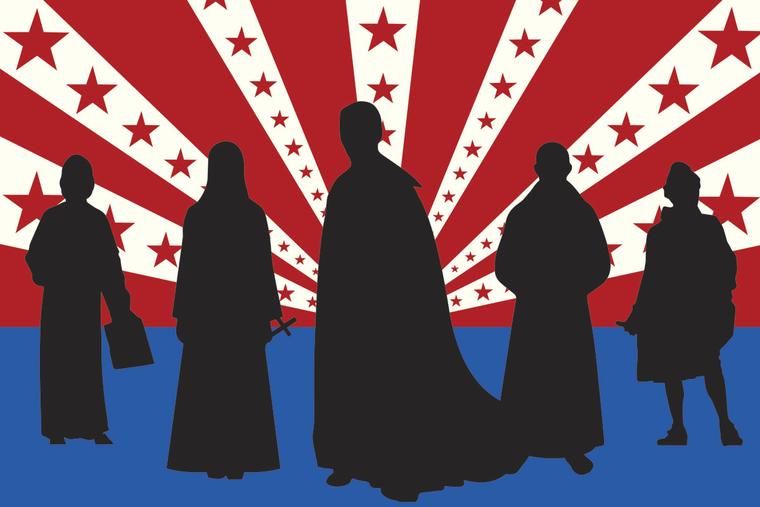
As the United States celebrates the 250th anniversary of the signing of the Declaration of Independence, American Catholics are able as well to reflect on an important truth: We live and pray and work as heirs — sons and daughters — inheritors of faith, successors to holy and extraordinary men and women who made timeless contributions to the life of the Church and of America. Here are five such great exemplars in American Catholic history: Charles Carroll of Carrollton, Archbishop John Carroll, St. Junípero Serra, St. Frances Xavier Cabrini, and Venerable and soon-to-be Blessed Fulton J. Sheen.
Charles and Archbishop John Carroll
In the British colonies in America, there was no more influential, wealthy and aristocratic Catholic family than the Carrolls. Established in Maryland by the Irish immigrant Charles Carroll in 1688, the Carrolls overcame every kind of prejudice to build an immense set of businesses and properties. The Carrolls overcame anti-Catholic persecution to produce not just the most prominent Catholic leaders in the colonies but some of the key figures in the founding of the American Republic. One worthy of our time was Charles Carroll of Carrollton.
Charles Carroll was born in 1737 and spent years of his youth in Europe. Upon his return, he inherited a massive estate — he was worth what would be today a fortune exceeding $100 million — making him perhaps the wealthiest figure in the colonies. His estate was a social center, hosting figures such as George Washington and the first organizers of what became the Revolutionary War. Banned by law from holding office due to his Catholic faith, he exercised great political temperance by first gaining public acclaim with published letters that embraced the principle that the people are the true foundation of government, under the name “First Citizen.”
While he was honored as a hero of the growing American independence movement despite being Catholic, his appearance at the Continental Congress irritated some Protestants. His wealth won the argument because the average American recognized that Charles was risking more than most to see America’s independence. He was the only Catholic signer of the Declaration. When warned that signing the Declaration might cost him everything, he reportedly added his address “of Carrollton” beside his name, saying, “There, they cannot mistake me now.’”
He died in 1832 as the last surviving signatory of the Declaration, and he was known forever after as one of the Fathers of the Nation.
Amazingly, in Catholic America, he was eclipsed by his cousin, John.
Like his cousin Charles, John Carroll came from a wealthy Catholic family in Maryland and studied abroad. Called to the priesthood, he was ordained in the Society of Jesus, and he made his profession as a Jesuit in 1771. In 1784, Father Carroll was named “Superior of the Missions,” thereby confirming the choice of the clergy of the young nation, and through the influence of his old friend, Benjamin Franklin, who openly took credit for the appointment. Franklin recorded in his Paris diary: “1784, July 1. The Pope’s Nuncio called and acquainted me that the Pope had on my recommendation appointed Mr. John Carroll Superior of the Catholic clergy in America, with many powers of a Bishop.”
Five years later, Pope Pius VI created the first United States diocese, Baltimore, and named John Carroll its first bishop. His new diocese stretched across 3 million square miles and with the Louisiana Purchase in 1803 temporarily doubled its size. Bishop Carroll navigated post-Revolutionary challenges, such as anti-Catholic prejudices and sparse clergy. Without Carroll’s prudent statesmanship as bishop and archbishop, the Church in America as we know it today might not have been possible.
St. Junípero Serra
Even as the English colonies were moving toward the War of Independence in the middle of the 18th century, on the other side of North America, the Catholic faith was establishing itself in what became California. The missions of California began officially in 1769 with the Franciscan mission at San Diego, the first stop along El Camino Real (the “Royal Road”), a chain of missions that extended from San Diego to San Francisco. The central figure in the California Missions was the Franciscan friar St. Junípero Serra.
St. Junípero Serra stands as one of the founding fathers of Catholicism in what would become the United States, a tireless Franciscan whose missionary fervor transformed vast frontiers into centers of Christian life. Born in Petra, Majorca, the 5-foot-2 Serra entered the Order of St. Francis in 1730, excelling in philosophy and theology before volunteering for the New World. Despite a leg injury sustained while traveling on foot from Veracruz to Mexico City — a lifelong wound — he pressed on and founded the Mission San Diego de Alcalá in 1769, the first of 21 missions stretching to Sonoma. These outposts converted and cared for coastal natives, laying the groundwork for California’s Catholic heritage. His approach was embodied by his motto, “Siempre Adelante!” — always forward!
The legacy of St. Junípero Serra has been subjected to harsh attacks by those who call him a plague upon the Indigenous peoples. Authentic historical scholarship, of course, paints a more complex but also more accurate picture of a holy priest who defended Indigenous dignity against colonizers’ abuses in an era of shattering change for California and the Southwest.
Mother Cabrini
By the end of the 19th century, one of the last great waves of immigration from Europe came from Italy. Sadly, the Italians did not receive a warm welcome and were viewed as true “foreigners” in the eyes of many Americans. The great exception was St. Frances Xavier Cabrini, the first U.S. citizen to be canonized. A native of Lombardy, Italy, she entered religious life and later established the Missionary Sisters of the Sacred Heart, taking the name Frances Xavier.
In 1889, Mother Cabrini visited Pope Leo XIII, who had been watching her and her religious order, and asked the Holy Father for permission to fulfill her dream of serving in the missions of Asia. To her surprise, Pope Leo asked her to become a missionary — not to Asia but to America. Despite her dread of water, she set sail in March 1889, landing in New York. She faced poverty, prejudice, and even her archbishop’s suggestion to return to Italy. Undeterred, she declared, “The Pope sent me here, and here I must stay.” She made foundations in eight cities, also opening houses in Central and South America. She became a naturalized citizen in 1909. Despite the ever-present fear of sailing, she crossed the Atlantic 24 times, and in 1912, had she not had business in Chicago, she would have been aboard the Titanic. Thanks to her, generations of Italian and other immigrant families were able to find a permanent home in America.
Fulton Sheen
If Mother Cabrini was an influential figure in Catholics attaining some measure of acceptance in America, Archbishop Fulton J. Sheen became the living embodiment of how the Church was directly shaping American culture.
Imagine a bishop winning an Emmy Award for the highest-rated television program in the country, with an audience reaching tens of millions of viewers every week. That was the achievement of Venerable Fulton J. Sheen, soon to be declared a “Blessed.” Writer, television and radio star, theologian and philosopher, missionary, and one of the most influential Catholics of the 20th century, Archbishop Sheen was also deeply holy and lived a life of heroic virtue.
Ordained in Peoria, Illinois, in 1919, Sheen first came to prominence through his Catholic Hour radio show that attracted millions of listeners. He soon acquired national acclaim for his television show Life Is Worth Living, starting in 1952. Accepting his Emmy Award for his show, he famously thanked his writers: Matthew, Mark, Luke and John. His preaching, most notably in St. Patrick’s Cathedral, New York, along with some 70 books and his own genuine holiness, brought a huge number of people into the Church.
On Dec. 9, 1979, Archbishop Sheen died in his private New York chapel while making his daily Holy Hour in front of the Blessed Sacrament.
Virtues for Today’s Catholics
These five extraordinary people shaped American history and tell us that the Catholic faith has truly left a legacy. Each of us, in our own way, is an heir.
But what are some practical takeaways for us?
Charles Carroll demonstrated that Catholics can be good Catholics and also good and patriotic citizens of the new American Republic. He shows us powerfully that in the face of prejudice we should not shrink away from public life.
Archbishop John Carroll shows us similarly that we must exercise prudence in navigating questions of faith and culture. His approach teaches Catholics today that authentic faith becomes more credible when lived confidently and charitably in culture.
Like Junípero Serra, we must have a true missionary heart. We can ask ourselves, what are we doing in our daily lives to aid our parishes, our priests, and our dioceses in the work of evangelization?
Like Frances Cabrini, we must see the plight of the poor, the immigrant, and especially the most vulnerable, particularly the unborn.
And, finally, like Fulton Sheen, we must foster effective communication of the Truth with charity to a world that is starving spiritually.
St. Junípero’s trails, Charles Carroll’s writings and political skill, John Carroll’s foundations, St. Frances’ shelters and Venerable Fulton’s broadcasts wove a tapestry of American Catholicism resilient against seemingly impossible odds. Their legacies urge us: “Siempre Adelante!” Forward in mission, charity and holiness.
Adapted from a talk given to the Diocese of Arlington Men’s Conference in March.
- Keywords:
- america 250
- u.s. history
- american catholics