Argentinians Join in Prayer for Earthquake-Shattered Venezuelans
In his homily during a Mass offered for the earthquake's victims, Archbishop Jorge Scheinig urged the faithful to reexamine their priorities in life, realizing one can lose everything in an instant.
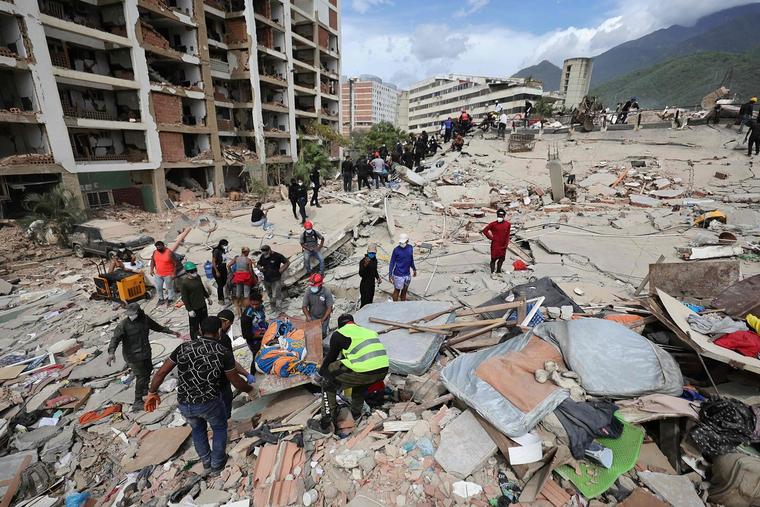
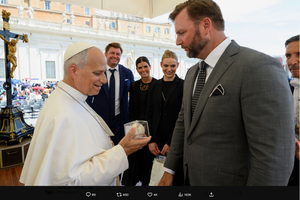
With thousands dead, injured, and missing in the wake of last week’s devastating earthquakes in Venezuela, Argentinians gathered in prayer for the Venezuelan people on June 28 at the basilica and national shrine of Our Lady of Luján. There, the archbishop of Mercedes-Luján, Jorge Eduardo Scheinig, offered Mass for the Venezuelan people.
“Let us think of those who have died and their families,” Archbishop Scheinig said in his homily. “In a single minute, so many people were left with nothing, absolutely nothing,” he noted.
“Let us pray for the rescue workers and for all those who are working [on the ground]. Let us stand in solidarity with them through prayer,” said Archbishop Scheinig, who proceeded to lead a moment of silence to pray to God and the Virgin for the people of Venezuela.
The archbishop dedicated the rest of his homily to examining priorities, those things that “carry more weight than others” and “have the power to bring order to our lives.”
“If you have the right priorities, you are at peace. But if you choose your priorities poorly, it causes confusion and anguish for you; it doesn’t help you live well. So, from time to time, we need to have the courage to reexamine our priorities,” he noted.
In this regard, he said that “Jesus helps us order our priorities,” and elaborated: “What is Jesus’ priority? God. What comes first for Jesus? God. And what does he advise us? Put God first, and you won’t regret it,” he explained.
He therefore urged people to ask themselves: “What place does God hold? What place does Mass hold?” he continued.
“If you put God’s love first, if you love God in your life — that love is so good, so pure, and so radiant that it brings order to your entire life and helps you understand your whole life. Because God takes nothing away from you; he fills your life with love,” he pointed out.
“Putting God first means taking a stand, taking a risk, and filling your heart with love; that helps you love everyone and everything in a different way, to love better,” he emphasized.
Referring to the situation in Venezuela, Archbishop Scheinig reflected: “Just look at how strange the world is. Today, television shows harrowing scenes. I was watching the news and saw a little boy crying — he had been left all alone after the earthquake, and it breaks your heart. Yet, a short while later, we’re watching the Argentina [World Cup] match.”
“And notice, too, that we see scenes of war, of migrants who have nothing and live in a small tent. That’s the world. It happens to us in a family as well: You might be celebrating the 15th birthday of one of your children and then a close relative dies or someone comes down with an illness. That’s life. Life is that strange mix of very beautiful things and deeply painful things,” he noted.
“But when your heart has priorities, you don’t get confused. And so, yes, we can cheer for the national team, but my priority isn’t soccer; my priority is life, it’s what happens to other people. I don’t let the things of life desensitize me,” he cautioned.
That is why, “if God is your priority, you are able to not get desensitized to pain. You have your life on track. You can watch the World Cup, but you realize that it isn’t the priority. Your life is in order. You know where you stand, what you want, and what you don’t want,” he continued.
In that context, he added, the need arises to stand with Venezuelans in prayer: “God, strengthen so many people whose lives changed in an instant.”
“We also feel moved to show solidarity, to give money and goods, and to share what we have with those in need because your heart is rightly ordered; it is with God.”
“Life presents us with complex, difficult moments in the world,” Scheinig acknowledged, while expressing the hope that “God holds first place on our list of priorities, so that we may remain good people.”
This story was first published by ACI Prensa, the Spanish-language sister service of EWTN News. It has been translated and adapted by EWTN News English.