Does Pope Leo Reject Just-War Teaching? Theologians Push Back on Criticism of Pontiff
Pope Leo’s insistence that war offends God should be understood as a prohibition against all but legitimate defensive actions, a view that is consistent with the pleas for peace issued by recent popes such as Francis, Benedict XVI and St. John Paul II.
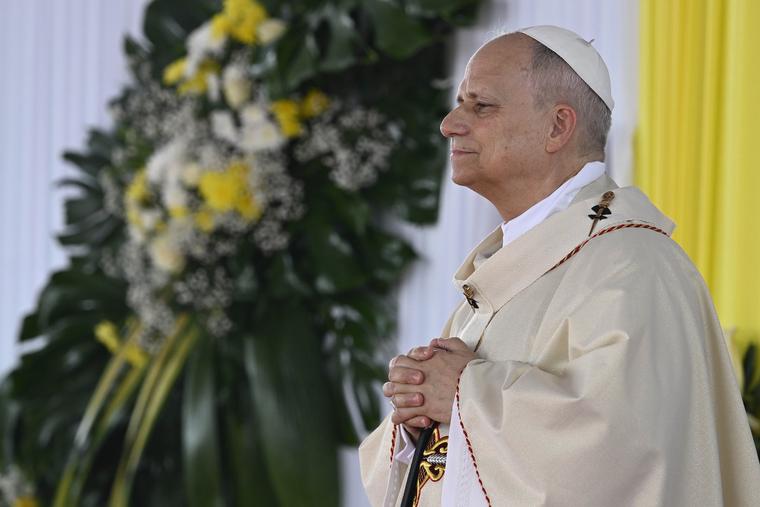
Several Catholic theologians and scholars this week rejected the idea that Pope Leo XIV’s recent calls against war amid the U.S. conflict with Iran depart from the Church’s teaching on “just war” — the moral conditions under which military action can be justified.
Instead, the scholars underscored that Pope Leo’s insistence that war offends God should be understood as a prohibition against all but legitimate defensive actions, a view that is consistent with the pleas for peace issued by recent popes such as Francis, Benedict XVI and St. John Paul II.
“The Pope’s thinking is clearly in line with the just-war tradition according to which defensive military action is justifiable,” said Ed Feser, a professor of philosophy at Pasadena City College.
Theologians also urged Catholics to approach the Pope when he teaches as a pastor, not a politician, acknowledging that over-politicized American discourse can make this prospect difficult.
The defense of Pope Leo’s teaching on war comes after several commentators criticized the Pope for implying that all forms of military action are against God’s will, with some asking whether Pope Leo had begun “calling for pacifism.”
Others, such as Vice President JD Vance, a Catholic convert, have raised questions about the Pope’s role in commenting on major geopolitical events. For his part, Pope Leo has clarified that he does not see his role as one of a politician, but also that he has “no fear of the Trump administration” and will continue to proclaim the Gospel.
Is Leo Changing Just-War Teaching?
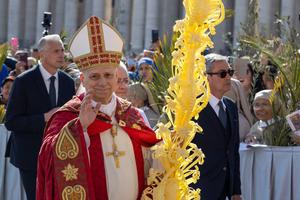
Pope Leo's strongest statement against war so far came on March 29, Palm Sunday, when he said during Mass in St. Peter’s Square that God “does not listen to the prayers of those who wage war.”
Later on, the Pope posted on social media saying that that “anyone who is a disciple of Christ” is “never on the side of those who once wielded the sword and today drop bombs.” The comment garnered criticism from Vance and others.
“How do you say that God is never on the side of those who wield the sword?” said Vance at a Turning Point USA event on April 14, citing the role of military action in liberating France and freeing Holocaust survivors from Nazi concentration camps during World War II as a justified use of force.
Greg Reichberg, a member of the Pontifical Academy of Social Sciences who specializes in philosophy and its application to military ethics, told the Register that accusations of a lack of nuance on Pope Leo’s part when he appeared to denounce “war” in general and not merely “unjust war” are unfounded.
“When Pope Leo and his predecessors use the word ‘war’ alone, with no qualification, they’re referring to unjust war. In particular, they’re referring to wars of choice,” said Reichberg, who teaches at the Peace Research Institute Oslo. He added that St. Thomas Aquinas described war as a sin; in light of that fact, it makes sense for Pope Leo to say that God does not “listen to the prayers” of one who has egregiously sinned.
Furthermore, Reichberg pointed out that no pope in 75 years has used the term “just war” in an approving manner but rather has denounced almost all conflicts unless there appears to be a case for legitimate defense.
Pius XI, for instance, in his 1932 encyclical Caritate Christi Compulsi, written amid the militant atheism of the Soviet Union, defended the right of Catholics to resist violent persecution, which implied some right of defensive armed resistance using “all the legitimate human arms which are ready to our hands.” Much more recently, in 2022, Pope Francis said it was morally legitimate for nations to supply weapons to Ukraine to help the country defend itself from Russian aggression.
The Church’s teaching on legitimate defense can be found in Paragraph 2309 of the Catechism, which lays out rigorous conditions, all of which must be met for military action to be justified. Because of the high bar to meet, accusations of pacificism against the papacy are nothing new. For instance, St. John Paul II faced similar charges for his criticism of the U.S. invasion of Iraq in 2003.
Feser pointed out that Pope Leo is clearly not a pacificist by virtue of a speech he gave just last month to Italian military ordinaries. The Pope said: “The mission of the Christian soldier is … defending the weak … [and] operating in international missions to preserve peace and restore order.”
Pope Leo’s remarks criticizing those who “wage war” must necessarily be understood in light of those remarks, Feser said, which clearly show that the Pope was criticizing those who show aggression by initiating wars, not those who defend themselves or others against aggression.
On the other hand, many popes — especially in the 20th century — have issued loud cries for war to end, noted Daniel Philpott, a professor of political science at the University of Notre Dame. Pope Pius XI called war a “ghastly scourge”; Pope Paul VI shouted “war no more” at the United Nations; and “virtually every pope has followed suit,” he said.
Francis, in particular, in his 2020 encyclical Fratelli Tutti sharply criticized what he described as the “allegedly humanitarian, defensive or precautionary excuses” used to justify war.
“We can no longer think of war as a solution, because its risks will probably always be greater than its supposed benefits. In view of this, it is very difficult nowadays to invoke the rational criteria elaborated in earlier centuries to speak of the possibility of a ‘just war.’ Never again war!” Pope Francis wrote, quoting with that last exclamation his predecessor St. John Paul II.
Even though both Francis and Leo have made statements that “sound as if they are calling into question the possibility of a just war,” the magisterium, in its dogmatic moral teaching, still allows war if it is just, Philpott said. “We cannot say that a development has taken place in magisterial teaching,” he continued.
Rather, what appears to have shifted are the circumstances in which contemporary popes are applying the Church’s principles of just war, which were first developed under Augustine and Aquinas centuries ago.
Messaging from the popes on war shifted in the early 20th century because that was the point at which aerial warfare — and with it the danger of massive civilian casualties — became a feature of modern war, making armed conflict far more difficult to justify in practice, explained Joseph Capizzi, dean and ordinary professor of moral theology at The Catholic University of America. Pope Leo’s words are consistent with the messaging of every pope since then, he said.
“I hear him as being concerned about Trump administration language that spoke of ‘raining death and destruction’ and ‘domination’ and ‘mercilessness,’” Capizzi commented.
“All such language is foreign to Christ: We don't seek to dominate; indeed, as a good Augustinian, Pope Leo XIV is no doubt thinking of Augustine’s concern about the libido dominandi, a desire in the human heart to dominate, utterly alien to Christ and his mode of victory by dying on the cross.”
Receiving Pope Leo’s Words
While the debate that has arisen over the Pope’s words suggests that the Vatican’s use of the term “war” to mean unjust conflicts might be a potential barrier to his message of peace being received, theologians and pastors nevertheless noted the importance of Catholics receiving what the Pope has to say with openness to letting it shape their consciences.
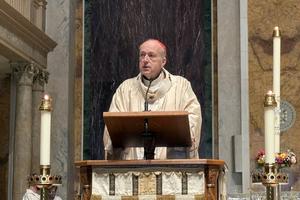
Brooklyn Auxiliary Bishop James Massa, the U.S. bishops’ doctrine chair, made a statement April 15 clarifying that Pope Leo’s words should not be treated like comments from a politician or pundit.
“When Pope Leo XIV speaks as supreme pastor of the universal Church, he is not merely offering opinions on theology, he is preaching the Gospel and exercising his ministry as the vicar of Christ,” said Bishop Massa.
For his part, Philpott said he thinks the fact that Leo is an American and is seen as a foil to President Donald Trump by many in the media doesn’t help the situation. Other popes have spoken out against American presidents, particularly in matters of war, and Pope Leo is following in that tradition — though Trump’s direct and blunt criticism of the Pope makes this situation unusual.
“When the Pope issues such statements, he is not aiming to exercise the president’s temporal powers or to make policy judgments,” said Philpott. “He speaks out against clear injustices and does so out of the Church’s rightful mission towards justice and towards the salvation of souls, which entails right relationship in the political order,” he explained, adding that the U.S. bishops do likewise.
Capizzi and others reiterated that Catholics must allow the Pope’s words — even in his regular, daily teaching, which is considered magisterial — to inform their consciences.
“Pope Leo's words about war, or immigration, or abortion, or euthanasia, express the deepest truths of our tradition and must be received as such,” Capizzi said. “Nothing that he said departs from the Gospel. He has said that is his point: to preach the Gospel of peace, one that counsels us to concern for the poorest and weakest among us.”
This story was updated April 20, 2026, to clarify papal use of the term “just war” in the last 75 years and the events surrounding Caritate Christi Compulsi.
- Keywords:
- just war doctrine
- just war
- church teaching