Catholic Admiration for George Washington Has Nothing to Do With His Purported ‘Conversion’
As the nation celebrates its semiquincentennial, Catholic historians remember the father of our country as a central figure in the story of religious liberty in early America.
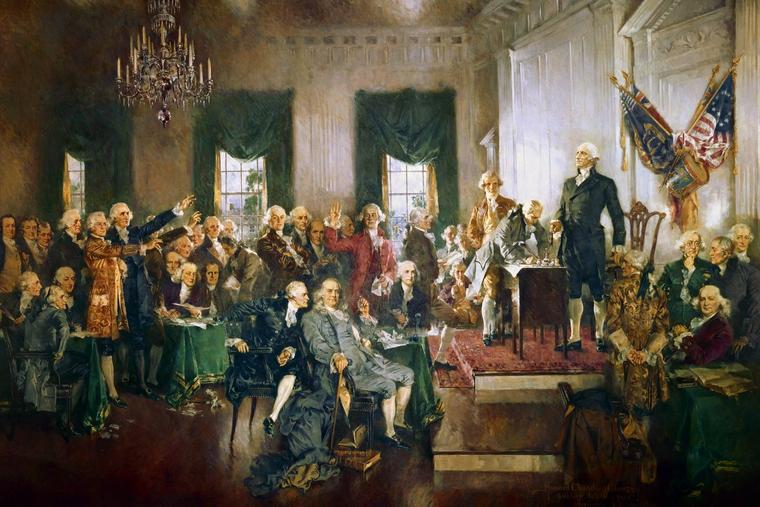
As the United States marks the 250th anniversary of its founding, George Washington has once again become a familiar point of reference for American Catholics. The connection is, at first glance, an unexpected one.
Washington was an Anglican, and there is no serious historical evidence that he ever sought reception into the Catholic Church (more on his supposed deathbed conversion later). Yet among American Catholics, no Founding Father has been more consistently admired — or more closely associated with the political conditions that made Catholic life possible in the early republic.
Before independence, Catholic life in much of the 13 colonies often remained hidden due to religious persecution. In many regions, the faith mostly survived through private devotion, household worship and the ministry of priests traveling between scattered communities.
Even where the law permitted restricted freedom of worship, Catholics were barred from holding public office and often viewed with suspicion inherited from England’s religious turmoil, where allegiance to Rome was frequently treated as incompatible with political loyalty. In colonies such as Pennsylvania, that limited permission allowed Mass at Old St. Joseph’s in Philadelphia but did not extend to full civic equality.
Michael Breidenbach, associate professor of history at Ave Maria University and author of Our Dear-Bought Liberty: Catholics and Religious Toleration in Early America, described that reality plainly, noting that “Masses had to take place secretly in people’s homes.”
Against that backdrop, the American Revolution represented more than political independence. It opened the possibility of a nation in which Catholics could worship publicly and participate fully in civic life.
This shift was later anchored in the constitutional order by the First Amendment’s protection of religious liberty and Article VI, Clause 3’s prohibition of religious tests for federal office.
For Washington, religious liberty did not mean excluding religion from public life. Rather, it created the conditions in which religion could flourish freely, helping cultivate the morals necessary for republican government.
Jerome Foss, professor of politics at St. Vincent College in Latrobe, Pennsylvania, and author of the Law & Liberty essay “The Catholic Case for George Washington,” said Washington acted from conviction rather than necessity.
“He wouldn’t take any practical step that he wasn’t committed to in principle,” he told the Register. “It was part of what the founding needed to become.”
Foss also emphasized Washington’s instinct for unity as a governing principle. He described him as “the most unideological president we’ve ever had,” noting that Washington resisted reducing politics to competing ideological camps and instead treated civic harmony as essential to the nation’s survival.
That concern for unity shaped his 1796 “Farewell Address,” where Washington described religion and morality as the “indispensable supports” of political prosperity. “Reason and experience both forbid us to expect that national morality can prevail in exclusion of religious principle,” he wrote.
Ending Old Hostilities
Washington’s principles were not confined to speeches or political philosophy; rather, they also shaped how the new nation would leave behind older religious prejudices inherited from England.
In 1775, Washington prohibited Guy Fawkes Day celebrations within the Continental Army, an annual observance that included burning effigies of the pope in rowdy street demonstrations.
Susan Hanssen, associate professor of history at the University of Dallas, explained the historical background.
“Guy Fawkes was a Catholic involved in a plot to blow up the English Parliament in 1605,” she said. “Washington stopped the celebrations because he thought they were ridiculous and would have offended our Catholic allies, especially the French.”
But Hanssen said the decision reflected more than military diplomacy.
“There was a sense that these inherited antagonisms were not going to define the identity of the new nation,” she said. “For Washington, the Guy Fawkes celebration was not just a bad idea strategically, but a bad idea morally.”
The Continental Army depended heavily upon Catholic France and Spain, but it also confronted a larger question of whether colonial America’s inherited religious suspicions would continue shaping the republic.
Catholics themselves increasingly became participants in that republic. They served throughout the Continental Army without formal religious exclusion, marking a significant departure from earlier standards.
Their ranks included Irish American figures such as Col. John Fitzgerald, one of George Washington’s aides-de-camp, and Commodore John Barry, who was appointed by Washington as the first commissioned officer in the newly established U.S. Navy.
“The Continental Army didn’t track religious affiliation at all,” said Father Charles Connor, a retired priest of the Diocese of Scranton, Pennsylvania, and author of Pioneer Priests and Makeshift Altars: A History of Catholicism in the Thirteen Colonies. “This was a significant change from Washington’s time as a soldier in Virginia’s militia when he had to make an oath swearing there was no transubstantiation.”
That broader commitment to unity also shaped Washington's understanding of political power itself.
Near the end of the war in 1783, unpaid Continental Army officers gathered in New York amid growing frustration with Congress, contemplating taking action against the civilian government in what became known as the Newburgh Conspiracy. Washington entered the meeting and personally appealed to the officers’ sense of honor and duty.
As he began reading prepared remarks, he paused, reached into his pocket and put on a pair of spectacles — a sight few officers had ever witnessed of him. At that time, glasses were commonly associated with aging and physical frailty, making the display an unusually vulnerable one for a commander whose authority rested in part on his public image.
“Gentlemen,” he said, “you must pardon me. I have grown gray in your service and now find myself growing blind.”
The gesture, according to Foss, “transformed the room.” Officers abandoned thoughts of confrontation, and the Newburgh Conspiracy dissolved without violence, preserving civilian authority over the military at one of the republic’s “most precarious moments.”
“Washington rose above the situation,” Foss said. “When you have somebody with that type of character, it’s hard to imagine that type of virtue without grace.”
‘Genuine Mutual Respect’
Washington’s vision of civic friendship continued after independence in his relationship with Archbishop John Carroll of Baltimore, the first Catholic bishop in the United States.
Carroll belonged to Maryland’s leading Catholic family, which included his cousin Charles Carroll, the only Catholic signer of the Declaration of Independence. Few individuals were more closely connected to both colonial Catholicism and the emerging American republic.
“Washington and Carroll had not just a professional relationship, but also a personal one,” Breidenbach said. “There was genuine mutual respect there.”
That relationship found perhaps its clearest expression in Washington’s 1790 letter to Carroll and American Catholics.
Thanking Catholics for the “patriotic part” they had played during the Revolution, Washington expressed hope that the United States would become among the “foremost nations in examples of justice and liberality” where Catholics, “as the faithful subjects of our free government,” could “enjoy every temporal and spiritual felicity.”
Catholics, in turn, came to remember Washington with remarkable admiration.
Less than a year after the president’s death, Carroll’s 1800 eulogy described Washington as a man “as clear from lawless ambition, and as undefiled by injustice or oppression,” whose life appeared uniquely suited to the nation’s founding.
Carroll suggested that divine Providence had guided the American Revolution through Washington’s leadership and concluded that his life had shed “a lustre on all around him.”
“What we take from the relationship between Washington and Carroll is this civic friendship,” Breidenbach said, “where there can be a trust and respect for people who don’t share even your deepest convictions about God or Church doctrine.”
Not every aspect of Washington’s legacy, however, has been embraced without reservation by Catholics.
Some have questioned his membership in Freemasonry, which the Church had already condemned beginning with Pope Clement XII’s 1738 bull In Eminenti Apostolatus Specula.
Those condemnations, however, had not yet been fully received in America, where Freemasonry often functioned differently than it did in Europe. “It’s hard to know what membership in Freemasonry meant to people like Washington who joined at that time,” Breidenbach said.
According to Breidenbach, John Carroll wrote to a Catholic layman discouraging him from joining the Freemasons, citing In Eminenti and Pope Benedict XIV’s 1751 bull Providas Romanorum, while also acknowledging that the papal decrees did not “have full authority in this diocese [of Baltimore].”
Father Connor said that Washington’s Masonic affiliation should be understood in that historical context. “It was much of a fraternal experience among Protestants,” he said. “You would look long and hard to find Washington acting against Catholics because of his being a Freemason.”
The Man Behind the Legend
Beyond his Masonic ties, Washington’s religious identity also became the subject of later legend, most notably the claim that he converted to Catholicism on his deathbed.
Passed down through descendants of enslaved people at Mount Vernon, the story recounts a Jesuit priest visiting Washington during his final illness and remaining with him privately for several hours.
Historians, however, note that no contemporary evidence supports the story.
“I don’t take that claim seriously as a historian,” Hanssen said. “There are no primary sources even speculating on the legend until after the Civil War, nearly 70 years after Washington’s death.”
“It’s almost as silly as the stories that circulated of Martin Luther having a deathbed conversion,” Father Connor added. “I’m convinced Washington died an Anglican all the way.”
Breidenbach, meanwhile, argued that the legend itself is unnecessary.
“We don’t need legends to make [the history] compelling,” Breidenbach said. “The actual history of Catholics moving from suspected subjects of a Protestant king to trusted citizens of the New Republic is thrilling enough on its own.”
Foss believes Catholics are naturally drawn to Washington because he was, in his words, “a man of great nature and principle.”
“Washington cooperated with Providence, and good things happened around him,” he said. “Catholics have an innate sense of the way God works in the world through human nature.”
Washington’s legacy is often measured through military victories or the institutions he helped establish. Yet for many Catholics, his enduring significance lies elsewhere.
He rejected inherited religious hostility when it would have been politically easy to preserve it. He restrained military power when it threatened civilian government. He consistently argued that liberty and religion belonged together in the life of the nation.
Those choices did not erase every tension facing Catholics in the United States, nor did they establish full religious equality overnight. But they helped create a political order in which Catholics could increasingly move from tolerated outsiders to trusted citizens.
“We live in a time where Americans are so divided,” Foss said. “Washington’s example of unity and inspiring patriotism is just as significant today as it was during his time.”
Two hundred and fifty years after the nation’s founding, Washington remains present in Catholic memory — not as a Catholic hero or a figure without complexity, but as one of the principal architects of a republic in which Catholics could gradually come to recognize themselves as fully belonging.
- Keywords:
- america 250
- george washington