Presidents and Popes Haven’t Always Agreed, but It’s Never Been Like This
President Trump’s personal attacks on Pope Leo are unprecedented.
In 1867 the U.S. Congress ended diplomatic relations with the Papal States over misleading reports that the Pope’s government restricted American Protestant services in Rome. Some members of Congress criticized the Pope, and Catholicism itself, during floor debates.
President Donald Trump’s recent criticism of Pope Leo XIV doesn’t rise to that level.
But the personal nature of Trump’s initial attack on Pope Leo on social media (“WEAK on Crime”; “terrible for Foreign Policy”; “thinks it’s OK for Iran to have a Nuclear Weapon”; “hurting the Catholic Church”) earlier this week and the president’s follow-up statements are unheard of in American history. Most American officials have offered elaborate displays of respect for the pope even when they disagree with him.
While presidents and popes have had their differences, several of those disputes amounted to “relatively minor points of protocol,” said Father James Garneau, a historian and author of an academic journal article called “Presidents and Popes, Face to Face: From Benedict XV to John Paul II,” published in U.S. Catholic Historian in 2008, in an interview with the Register.
“Trump is unique. He is the first president to go public with his anger at the Pope,” C.J. Doyle, executive director of the Catholic Action League of Massachusetts, told the Register.
Mostly Beneath the Surface
From the late 19th century through the early 21st century, it’s difficult to find public strains in the relationship between the two heads of state.
In April 1910, Theodore Roosevelt agreed to meet Pope Pius X in Rome while on a foreign trip, but canceled the meeting when the Vatican’s secretary of state, Cardinal Rafael Merry del Val, insisted that the then former president promise not to meet with the Methodist mission there, according to Charles G. Washburn’s 1916 book Theodore Roosevelt: The Logic of His Career. Vatican officials said that the Methodist mission had made “diabolical” attacks on the Pope in the past and that meeting with its members while in Rome would be insulting to the Pope.
Roosevelt issued a public statement saying he could not accept a limit on meeting with fellow Americans. He refrained from criticizing the Pope or even mentioning him, but said in the written statement: “Among my best and closest friends are many Catholics.”
In a private letter to a fellow politician not made public at the time, Roosevelt described the Vatican’s actions as “folly,” but also said he subsequently canceled a meeting with the Methodists of Rome when they “promptly issued an address of exultation which can only he called scurrilous.” He described the incident as “an elegant row.”
In January 1919, Pope Benedict XV pressed for and got a meeting with President Woodrow Wilson to discuss peace arrangements after World War I while Wilson was visiting Rome, the first time a reigning pope met with a current president of the United States. The meeting was a plus for the Pope, who had been excluded from peace talks at Versailles because Wilson was riding high as victor and putative peacemaker.
Wilson didn’t see it the same way. Before the meeting, Wilson “was tortured by the prospect of having to call on the Pope,” according to John Dos Passos’ 1962 book Mr. Wilson’s War.
“All the President’s Presbyterian hackles rose at the thought,” Dos Passos wrote.
Official statements issued afterward described the meeting as cordial. But Wilson insisted on meeting afterward for the exact same amount of time with the Protestant mission in Rome, perhaps mindful of the Roosevelt incident.
War Divides Presidents and Popes
Later presidents have tended to see the pope as a source of information and influence internationally and as a potential popularity booster at home, as the Register reported in April 2025.
President Franklin Roosevelt pursued contacts with Pope Pius XII during World War II, using then-Archbishop Francis Spellman of New York as a conduit and establishing a “personal representative” in Rome in lieu of formal diplomatic relations, which could not be achieved because of anti-Catholic suspicions in America.
The Vatican quietly assisted the Allies during World War II. Pope Pius XII condemned aggression and sympathized with victims of it, without explicitly saying which side was the aggressor and which wasn’t.
But flashpoints in relations between popes and presidents have occasionally developed over subsequent American wars, which popes have opposed in the interests of peace.
Pope Paul VI opposed the Vietnam War, for instance, and in October 1965 he delivered a pro-peace speech (“never again war!”) at the United Nations in New York. President Lyndon Johnson, who promulgated and escalated the Vietnam war, pressed for and was granted a meeting with the Pope on the 35th floor of the Waldorf Astoria while Paul VI was in the city.
The two also met in December 1967 in Rome. While they disagreed on the war, Johnson’s public statements made it seem like they agreed on peace. Johnson never criticized the Pope and often went out of his way to praise him, saying at one point in a written statement, “We shall keep closely in touch with His Holiness in the days ahead.”
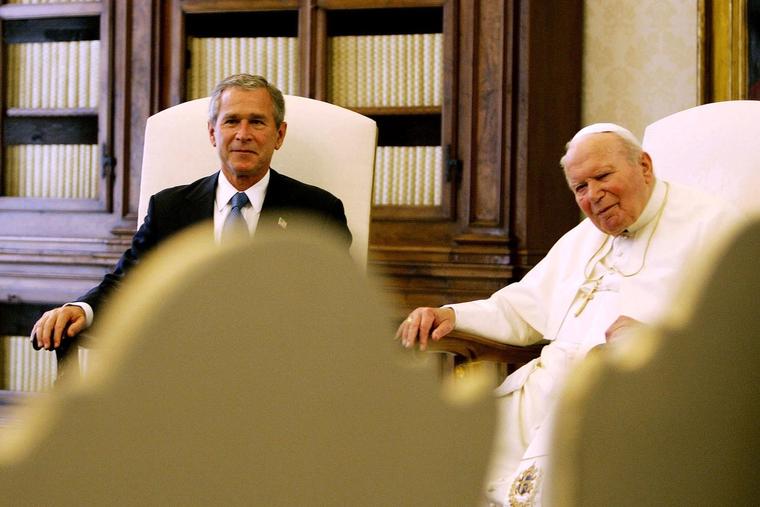
In March 2003, Pope John Paul II spoke publicly and repeatedly against President George W. Bush’s plans to invade Iraq. He also sent an emissary to the White House who called the then-forthcoming war “unjust and illegal.”
In response, President Bush met personally with the Pope’s envoy, and administration officials emphasized respect for the Pope while calling the war necessary.
Some press reports of the meeting between Cardinal Pio Laghi and President Bush in March 2003 before the second Iraq War described it as tense.
“But nothing rose to the level of acrimony we have seen with Trump. It’s a very different approach,” said author and historian Matthew Bunson, vice president and editorial director of EWTN News, which includes the Register.
“It speaks to an awareness of the Bush administration of the Pope’s moral status and also that he was acting out of his conscience and what he saw as his duty,” Bunson said.
“Trump does not see that,” he added.
A Different Kind of Target
President Trump has criticized hundreds of people on social media during his time in office, so what makes this episode different?
For one thing, the Pope is in a different category.
In temporal political terms, Pope Leo had a favorability rating in the United States of plus-34 percentage points (42% to 8%) as of last month, while President Trump’s was minus-12 (44% to 56%), according to an NBC poll published in early March 2026, before the recent conflict between the two.
Trump is also under water in his Iran policy. Several recent polls have found that a sizable majority of Americans (by 19 percentage points, according to Pew Research in mid-March) oppose the Iran war, which a poll released last week found has helped drive down Trump’s favorability among Catholics.
But more to the point, say experts consulted by the Register, is that Pope Leo comes across as soft-spoken, measured and driven by otherworldly concerns, refusing to debate Trump or make personal criticisms. While Trump sees the dispute in political categories, Bunson said, Leo sees it “from his role as a shepherd and universal pastor.”
Also, while Pope Leo’s public opposition to the Iran war follows in the tradition of previous pontiffs, President Trump’s response to the Pope doesn’t follow in the tradition of previous presidents.
“As with everything to do with DJT this is different because he refuses to follow normal diplomatic or interpersonal protocols,” said Karen Park, a historian of American Catholicism, by email.
Whereas previous presidents who disagreed with the pope ignored him, they didn’t insult him.
“So yes, this is unprecedented because of Trump's overt and personal attack on the pope. That is what he does,” Park said.
Park told the Register that President Trump “has really no leverage against” Pope Leo because “they are not speaking the same language” — while Trump speaks in terms of power and politics and personalities, Leo speaks in terms of religious principles.
“What is happening now is a president who has had almost total power is not getting power over this pope because the pope operates in a different register. He is both the leader of the Catholic church and the vicar of Christ, but also informed by the tradition — scriptural and theological. He isn't spouting opinions, he is preaching the Gospel,” Park said.
The conflict is frustrating for President Trump partly because of Pope Leo’s unique status as the first American to lead the Catholic Church.
“Trump is very aware of the influence of Pope Leo on American political life and culture,” said Bunson, who is the author of Leo XIV: Portrait of the First American Pope.
“That adds a layer of complexity, but it also adds a desire to win his support, or to complain when he doesn’t have it,” Bunson said.
As sharp as Trump’s rhetoric has at times been, it’s not clear whether the bitterness will last.
Trump and Leo’s predecessor, Pope Francis, for instance, criticized each other several times.
In February 2016, when Trump was a candidate for president for the first time, Pope Francis described Trump’s border wall proposal as “not Christian.” In September 2024, Pope Francis criticized Trump’s call for deportations as “against life,” and in January 2025 he called Trump’s planned immigration raids “a disgrace.”
As a candidate, Trump in February 2016 called Pope Francis a “pawn” and said it was “disgraceful” for Pope Francis to question his religious faith.
But as president, Trump changed his tone. He called meeting the Pope in Rome in May 2017 the “honor of a lifetime,” and when Francis died in April 2025, he went to his funeral, calling him “a good man” who “worked very hard” and “loved the world.”
In recent days, Trump has refused to apologize for his comments about Pope Leo — “There’s nothing to apologize for. He’s wrong,” Trump told reporters Monday.
But Trump’s tone has shifted toward argument and away from personal attack.
“Iran cannot have a nuclear weapon. If they did, every country, including Italy, where he’s stationed, every single country in the world would be in trouble,” Trump said during a press conference Thursday.
“I have nothing against the Pope,” Trump said later in the press conference.
“The Pope can say what he wants,” Trump said a short while later. “And I want him to say what he wants. But I can disagree.”
- Keywords:
- u.s.-holy see relations