Between a Pope and a President: Why Vance Faces a Complicated Catholic Candidacy
ANALYSIS: Vance’s engagement with Pope Leo highlights a challenge that the vice president faces as a Catholic politician — especially one attempting to make his faith a centerpiece of his political aspirations.
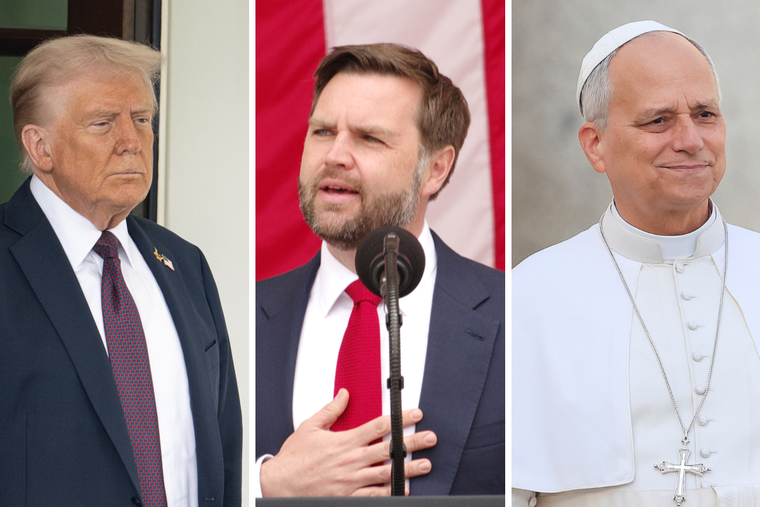
Ahead of a likely presidential run in 2028, JD Vance has seemed keen to position himself as a serious Catholic thinker whose faith informs his vision for the future of America. This past week has underscored why that may be a complicated endeavor in the current political-ecclesial moment.
Just two weeks after sharing that he will soon release a spiritual memoir that is likely meant to beef up his Bible-believing bona fides before the primary season kicks off, the vice president was pulled into President Donald Trump’s confrontation with Pope Leo XIV over the war in Iran. Judging by widespread reaction, Vance’s performance did not appear to boost his Catholic credentials.
For starters, Vance told Fox News on April 13 that the Holy Father should “stick to matters of morality” and not comment on foreign policy, as if war has no moral dimensions. Then, at a Turning Point USA event the next day, the vice president implied that the Holy Father’s insistence that waging war is against God’s will was inconsistent with Church teaching and then appeared to lecture the Pope on the need to “be careful” when speaking theologically.
For these latter remarks, Vance earned a rebuke from the U.S. Conference of Catholic Bishops’ doctrine head, Bishop James Massa, who took issue with his interpretation of both just-war theory and the role of the papacy. Meanwhile, a fresh wave of thought pieces and talk-show segments have questioned the very kind of Catholic intellectual credentials Vance’s pre-midterm book seems aimed at bolstering.
The vice president attempted to stem the fallout with an April 18 social-media post, saying he was “grateful” to Pope Leo for clarifying that he is not interested in an ongoing war of words with the U.S. administration.
“Pope Leo preaches the [G]ospel, as he should, and that will inevitably mean he offers his opinions on the moral issues of the day,” Vance wrote. “The President — and the entire administration — work to apply those moral principles in a messy world. He will be in our prayers, and I hope that we’ll be in his.”
But attempts at damage control aside, Vance’s engagement with Pope Leo highlights a challenge that the vice president faces as a Catholic politician — especially one attempting to make his faith a centerpiece of his political aspirations while still trying to be the apprentice Trump taps to be his MAGA successor.
Vance is an atypical Catholic politician. A convert who came into the Church largely via Catholic social teaching, his political vision is explicitly formed by interpretations of Catholic thinkers like St. Augustine. As vice president, he has interjected conversation of “a true Christian politics” into the national discourse and has sought out high-profile platforms on which to discuss his understanding of the political dimensions of Catholicism.
He has also sought to present himself as a different kind of Catholic politician than the likes of Joe Biden or Nancy Pelosi. His remarks on Pope Leo staying in his lane notwithstanding, the very next day at the TPUSA event, Vance repeated an idea he has promoted before: that, unlike other politicians, he invites Church leaders to get involved in politics, even when he disagrees with their conclusions, because the Gospel must be applied socially.
In other words, Vance isn’t content to flash his rosary beads in a cheap ploy for the Catholic vote. Instead, he wants to talk about Catholic teaching and its implications for society and wants to be seen as a serious Catholic political thinker. His forthcoming memoir promises to explore “how his faith guides his work in public life and how it shapes his thoughts about the future.” That, coupled with its title, Communion, suggests it may be a sort of popular explication of postliberalism, a Catholic-adjacent political theory that Vance subscribes to that prioritizes the communal good over individual liberty.
Of course, many of Vance’s political positions have earned serious pushback from Church leaders in recent years, including his rhetoric on immigration and his support for the Trump administration’s mass-deportation program. And Vance’s appeal to Catholic theology to justify his positions has led to high-profile confrontations in the past, such as when Pope Francis appeared to critique the vice president’s articulation of the ordo amoris (“order of love”) in a 2025 letter on U.S. immigration.
But that episode is no comparison to what has transpired with Pope Leo XIV this week.
Part of this is because Pope Leo is, of course, the first American Pontiff, who is overwhelmingly popular in his homeland. Another part of it is simply that Pope Leo is not Pope Francis, who American Catholic conservatives may have been hesitant to defend precisely because they felt like he was constantly attacking them.
Whatever the case, the takeaway is that when Vance is pitted against the first-ever American Pontiff, he is likely to lose that PR battle time and time again, alienating a fair share of American Catholics who otherwise might be favorable to the vice president in the process. Vance likely knows this now, hence his April 18 effort to smooth things over with the Pope.
But it’s also not unreasonable to think that highly public juxtapositions between Vance and Pope Leo XIV might continue to be a feature moving forward, media contrived or otherwise. Simply put, a Catholic vice president versus an American Pope makes for good news; expect national media to return to the theme whenever they can.
And with Vance seemingly committed to toeing the MAGA line in the lead-up to 2028 and serving as the president’s spokesman on all things Catholic, there are any number of issues where he could be drawn into a confrontation with the Pope, from AI restrictions to abortion, immigration to IVF. Keep in mind that before Vance was criticizing the Pope for speaking against war amid the U.S. campaign in Iran, he was reportedly advocating against the war inside the White House. In other words, he seems willingly to defend Trump’s decisions from Catholic critiques, even when Vance himself might harbor personal reservations.
Catholic politicians defy the Pope all the time. But it’s precisely because Vance has made his Catholic identity so central to his political brand that he has far more to lose in a dustup with a popular pope — and far more ammunition that can be used against him.
For instance, it’s unlikely that any other presidential contenders have ever publicly written that they think that “too many American Catholics have failed to show proper deference to the papacy, treating the pope as a political figure to be criticized or praised according to their whims,” as Vance did in 2020. Because Vance has, at times, seemed to grasp a Catholic sensibility far more deeply than the average politician, his apparent present-day departures from it are likely to land as greater disappointments to Catholic voters who might have previously seen him as a promising exception.
But politically speaking, what does Vance actually have to lose by appearing to be at odds with the popular American Pope? Would that disconnect translate, somehow, into losing the Catholic vote in a hypothetical 2028 election?
Not necessarily. Goodness knows that any candidate nominated by the Democrats will have his or her own host of shortcomings from a Catholic perspective, making it perfectly plausible that Catholics could still decide that Vance is the better of the two candidates.
But there is a world of other ways in which disappointing a key constituency, one that carried Trump to the White House in 2024, can come back to bite one politically.
First, consider the wider fallout of Trump’s attack on Pope Leo XIV (and his posting of an image that depicted him as a Christlike figure). The president has garnered public repudiations from Catholic lay groups with sizable memberships in the U.S., such as the Knights of Columbus (2 million) and the Ancient Order of Hibernians (30,000).
There are also anecdotal signs that Trump may have done real damage to himself among Catholics who have previously supported him. Poll numbers would have to confirm it, but this could be a real break with some Catholics from Trump’s coalition. If Vance is the heir apparent to MAGA, he may also be the heir to whatever kind of Catholic blowback the movement faces.
Secondly, if Trump-associated Republicans are beaten badly at the midterms (due to conservative Catholic alienation or otherwise), the final lame-duck term of the Trump administration will prove to be a difficult one. This matters to Vance, who, of all the possible presidential contenders, will be most associated with Trump’s performance.
But perhaps most significant is how a lack of enthusiasm for Vance among Catholic primary voters would likely benefit his main GOP contender: Marco Rubio. The secretary of state has been conspicuously silent during the drama around Trump’s papal criticism. This is emblematic of Rubio’s approach. He is a Catholic and has clearly established himself as such in his public persona; but unlike Vance, he is not as readily drawn into debates about papal pronouncements and Catholic theology.
Catholic voices are already lining up behind these two, leading Catholic GOP contenders ahead of primary season. Frank DeVito, legal counsel for the Napa Institute, has penned a pro-Vance proposal, while Peter Laffin, an editor for the Washington Examiner, has his pro-Rubio piece pinned to the top of his X profile. If Vance’s confrontation with Pope Leo has cooled any Catholic primary voters to his prospects, Rubio stands to benefit.
Of course, a more cynical take is that Vance’s criticism of the Holy Father will help him politically with the group that matters the most in GOP primaries: evangelical Christians. And indeed, there seems to be something of a rift emerging between Catholics and evangelicals following Trump’s papal attacks.
Still, Vance’s home, intellectually and otherwise, is among postliberal Catholics — a group that, ironically, has typically emphasized significant deference to the Pope in matters temporal.
Vance’s political career began with great potential to be a truly different kind of Catholic politician. Caught now between a popular American Pope and a papal-bashing commander-in-chief, the vice president faces great obstacles to fulfilling it.
In a great irony, Vance’s deference to Trump in the age of Leo runs the risk of defining him as no different than the kind of “the Church should stay out of politics,” cafeteria-Catholic politicians he has rightly criticized. And that’s a reputation, earned through concrete action, that words in a memoir will be unlikely to undo.
- Keywords:
- jd vance
- catholic politicians