From Prayer to Podium: Elana Meyers Taylor’s Path to Olympic Gold
As a mother of two young sons with disabilities, the Olympian’s Christian faith has guided her through a remarkable bobsledding career.
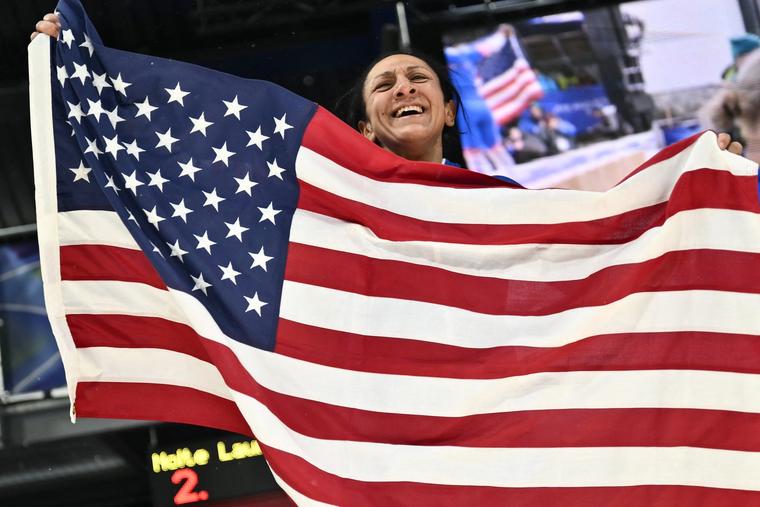
When Elana Meyers Taylor crossed the finish line in the solo women’s bobsled event, or “monobob,” at the 2026 Winter Olympics in Cortina d’Ampezzo on Feb. 16, she didn’t immediately know she had won. Like so many moments in her career, nothing was certain until the numbers told the story.
She looked to the scoreboard as German competitor Laura Nolte raced down the icy track. Seconds stretched, her heart hammering. Then the final time appeared — 3:57.93 — still at the top. Gold.
The first Olympic gold medal of her long career.
At 41 years old, Meyers Taylor had finally achieved the one medal that had eluded her across two decades of elite competition. By a razor-thin margin of just 0.04 seconds, she edged Nolte in one of the closest finishes in women’s Olympic bobsledding history.
But when she sank to the ground with tears of joy, her attention wasn’t on the crowd or cameras. It was on her two young sons, Noah and Nico, who soon reached her side. Both boys, ages 3 and 5, are deaf, and Nico also has Down syndrome. To them, she signed the only words that mattered: “Mommy won.”
Many were quick to celebrate this moment online, praising Meyers Taylor’s Christian witness and advocacy for families of children with disabilities.
Catholic author, speaker and radio host Katie McGrady reposted the video, calling it one of “the best moments of the games so far.”
“41-year-old bobsledder Elana Meyers Taylor just became the oldest Olympic gold medalist in history. But her greatest title isn’t ‘Olympian,’” added Lila Rose, president of Live Action. “It’s being a mother of two precious deaf children — one with Down syndrome — and being openly Christian, placing God above every medal.”
For Meyers Taylor, this moment distilled a culmination of decades of Olympic pursuit, but also a tribute to family, perseverance and faith.
‘Jesus Is the Way’
From the age of 9, Meyers Taylor dreamed of being an Olympian; however, that aspiration began not on ice, but on the softball field. She played at George Washington University, where she was the program’s first recruit and left as one of its most decorated offensive players.
Yet even success could not fill the void she felt after a canceled sophomore season. “I got really depressed,” she said in a 2014 interview with Cru. “I didn’t know what to do and I didn’t know what my purpose was. I just started researching religions. Something inside of me told me I needed more than this.”
Struggling with purpose beyond the sport, she turned to spiritual reading and felt a profound conviction that “Jesus is the way.”
“I can’t explain it by anything other than that,” she recalled. “It was so strong and powerful; I knew that I needed to change my life.”
That moment reshaped her purpose. She became deeply involved with Athletes in Action, an international ministry for Christian athletes, where she led Bible studies, mentored teammates and learned that athletic gifts could be a platform to share her faith.
That foundation of resilience and purpose became crucial when her first Olympic dream hit a roadblock with a failed softball tryout in 2003. Rather than abandon her aspirations, she pivoted. At her parents’ suggestion, she tried bobsledding in 2007 — emailing the U.S. coach and making the national team within weeks.
The rest, as she would prove, was history.
A Historic Run in the Winter Olympics
Meyers Taylor’s rise in bobsledding was steep and remarkable. She made her Olympic debut in Vancouver in 2010, winning bronze in the two-woman event alongside driver Erin Pac. She went on to add silver medals in Sochi (2014) and PyeongChang (2018). In 2022 in Beijing, she claimed silver in the monobob and bronze in the two-woman event, becoming the most decorated U.S. bobsledder ever and the most decorated Black athlete in Winter Olympic history.
Yet gold, the crowning achievement, remained elusive — always just out of reach by mere hundredths of a second. The transition from pusher to driver following the 2010 games demanded split-second precision, extraordinary hand-eye coordination and unwavering mental focus. As a pilot, Meyers Taylor carries the responsibility for every curve, every glide and every fraction of a second — all while mentoring teammates and modeling the resilience she preached.
Motherhood introduced a new rhythm to her life, not as a distraction from the elite sport, but as a motivating force. Her husband, Nic Taylor, himself a former Olympic bobsledder, has been a constant pillar of support. Together they are raising Nico and Noah, navigating early intervention, therapy and communication challenges while also maintaining leadership roles with the Global Down Syndrome Foundation and the Georgia Council on Developmental Disabilities.
“My boys have become my why,” she said during her gold-medal run, explaining that her reasons for competing had shifted from medals to purpose. “At the beginning it was to make an Olympic team, to win an Olympic medal, to win an Olympic gold medal. … I want to show my boys that despite any obstacles you may face, you can overcome them and you can go after your goals.”
Parenting children with special needs has granted her perspective. “It’s given me patience, it’s given me the drive to keep going, and it’s made me realize that even my worst days on bobsled are better than the worst days as a parent,” she later told NBC.
Meyers Taylor’s monobob gold — achieved on her fifth Olympic Games — was more than a medal. It was a narrative arc spanning years of triumphs, setbacks and moments when she nearly quit the sport. She has now not only become the oldest American woman to win an individual winter gold, but her sixth Olympic medal tied her with speed skater Bonnie Blair for the most medals by a U.S. woman in Winter Games history.
When the anthem played and the American flag rose, she stood not just as a champion, but a testament to endurance. She had run the race in every sense — athletic, spiritual and familial.
Relying on God
But her story isn’t finished. Later this week, Meyers Taylor will have another chance to chase Olympic gold in two-women bobsled. This time, she’ll race alongside Jadin O’Brien, a former Notre Dame track and field star whom Meyers Taylor personally recruited to join the team.
O’Brien, a devout Catholic, previously told the Register that Meyers Taylor’s Christian witness “strengthens our bond and gives us a competitive edge over other pilot-brakeman combinations,” describing their shared faith as an “extra tool.”
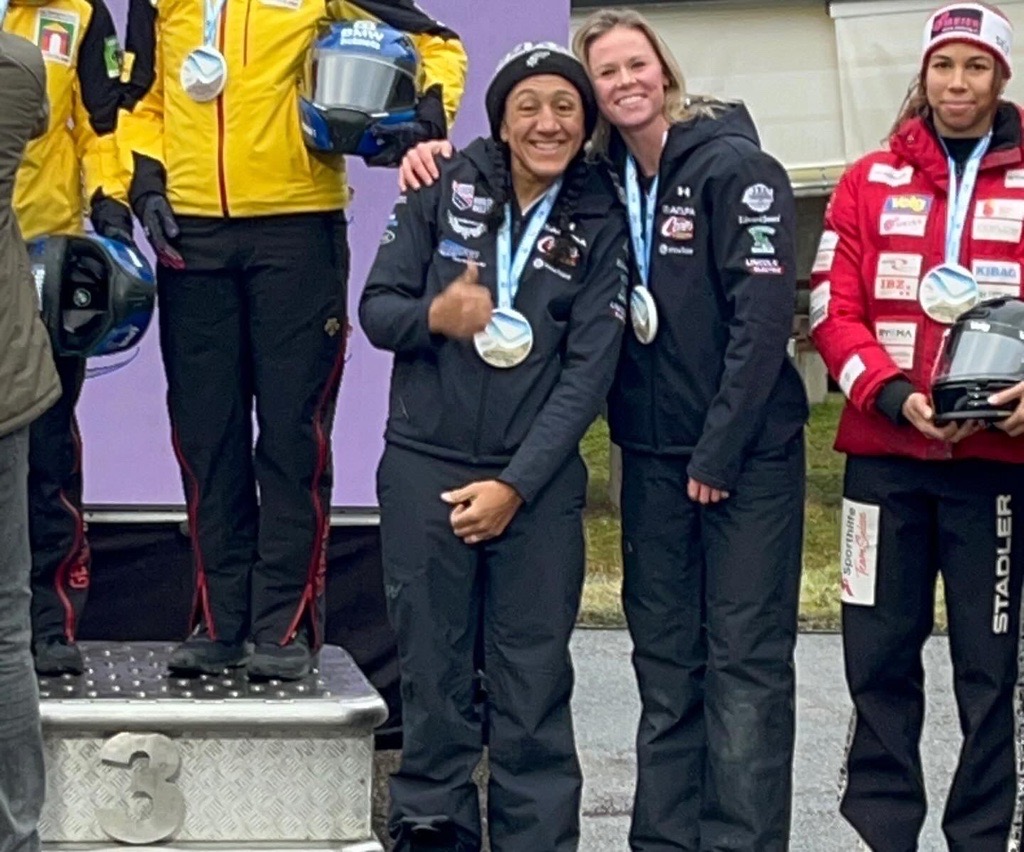
That tool was tested in January 2026, when the pair suffered a violent crash during a World Cup event in St. Moritz, Switzerland. The impact was so severe that the International Bobsleigh and Skeleton Federation declined to release the footage. Yet remarkably, both athletes walked away with only minor injuries.
“Only by the grace of God — and a small weight plate in the front of my sled — was I saved,” Meyers Taylor wrote on Instagram.
For Meyers Taylor, all the highs and lows in her Olympic journey have come to represent more than decades of perseverance on the ice. They are a testament to God’s guidance and the family who shaped her journey both as an athlete and a mother.
And in her latest moment of glory, what mattered most was not the medal around her neck, but the simple signed words that carried the deepest meaning of her life: “Mommy won.”
Draped in the American flag, she sank to the ground, embracing her children’s nanny and her sons, who were bundled in winter outfits and seemed only partly aware of the moment’s magnitude. She held Nico close as he playfully touched her face, while Noah watched wide-eyed.
After lingering in that tender embrace, she gradually pulled herself up, high-fived her coach and waved the flag to the crowd, a radiant mix of triumph, joy — and love.
- Keywords:
- olympics
- winter olympics
- female athletes
- children with special needs
- motherhood
- christian mothers