The Remarkable Coincidence That Linked St. Thérèse and Nietzsche
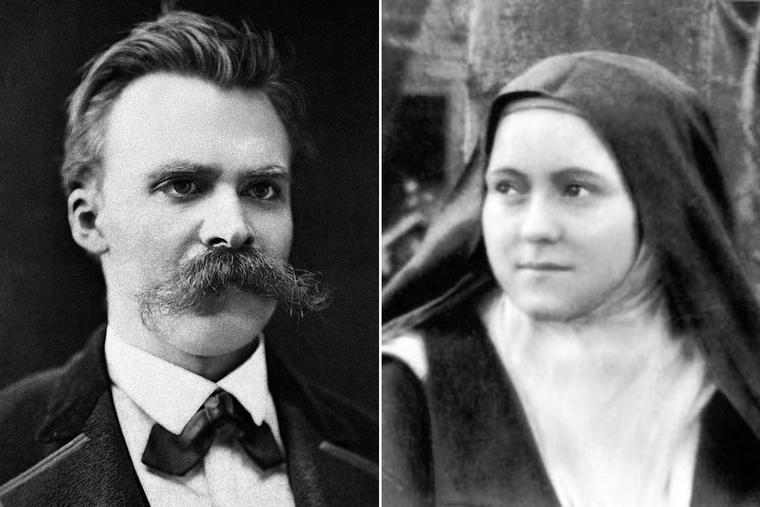
COMMENTARY: A Paris hotel elevator gave St. Thérèse of Lisieux a lasting image of the Little Way — while, in a striking historical irony, Nietzsche, the philosopher of the ‘death of God,’ may have been staying in the same hotel.
Why must it always be this way? Why can’t the journey be made easy, effortless even? Why, like Eliot’s Magi, does it always have to end in bitter lament?
Hard and bitter agony for us, like Death, our death.
In her poem “Uphill,” Christina Rossetti sounds the same mournful note. “Does the road wind uphill all the way?” she asks. “Yes,” she is told, “to the very end.“ And when she needs to know how long exactly that will be — “Will the day’s journey take the whole long day?” — the answer is both swift and sure: “From morn to night, my friend.”
There has surely got to be an easier way. And, in fact, there is, thanks to an impassioned young girl by the name of Thérèse of Lisieux, who, while steeped in a thoroughly bourgeois world, was yet determined all her life on a path of sublime and heroic sanctity.
While on her way to Rome to ask the Pope for permission to enter Carmel at age 15, she finds herself in Paris with her father and sister ensconced in a hotel with one of those brand-new contraptions called an elevator, which she has never before seen. What an amazing invention! By simply pressing a button, you needn’t ever again climb all those awful stairs. It instantly becomes the perfect metaphor for her life. And, by extension, the lives of all committed Christians. Why bother making the arduous climb to the Father when there is an infinitely easier way if only we would throw ourselves into the arms of the Son!
In the pages of a secret diary found after her death, Thérèse will write about her discovery, prompted by her wanting to be a saint, yet thwarted at every turn by the realization that she remains so painfully ill-equipped to become one.
“I have always noticed,” she says, “that when I compare myself to the saints, there is between them and me the same difference that exists between a mountain whose summit is lost in the clouds and an obscure grain of sand trampled underfoot by passers-by.”
But she is not at all disheartened or dismayed by such impediments as stand in her way. Instead, she tells herself, “God cannot inspire unrealizable desires. I can, then, in spite of my littleness aspire to holiness. It is impossible for me to be perfect, and so I must bear with myself such as I am with all my imperfections.”
How bracing and reassuring her realism! It is not just that, as the poet Eliot reminds us in Four Quartets, “we are only undefeated because we have gone on trying,” but that in the end it is always Another who has stepped in to complete and perfect that trying for us. In other words, for all of Thérèse’s repeated failures to reach the summit on her own — fueled, as it were, by the high octane of sheer human striving — it does not finally matter, for God will show her another way, a way far less demanding, indeed, one which she will call “the Little Way,” on the strength of which she will finally become a saint.
So, what’s the secret? Simply letting go and letting God.
“I wanted to find an elevator,” she explains, “which would raise me to Jesus, for I am too small to climb the rough stairway to perfection.
I searched, then, in the Scriptures for some sign of this elevator, the object of my desires, and I read there words coming from the mouth of Eternal Wisdom: ‘Whoever is a LITTLE ONE, let him come to me.’ And so I succeeded — I felt I had found what I was looking for. … The elevator which must raise me to heaven is Your arms, O Jesus! And for this I had no need to become perfect, but rather I had to remain little and become this more and more.
Which brings me to a most quirky coincidence. It seems that while staying at that hotel in Paris, wholly preoccupied with God, it doubtless never crossed her mind that there was another guest that week as well, one whose own preoccupations would most certainly not have been with God, indeed, whom he had famously declared was quite dead. He was that fierce atheist fellow from Germany called Friedrich Nietzsche, whose signature shows up on the same register.
Between the two of them, of course, there lay an abyss wider than the universe itself. But suppose they had actually met in that hotel? Who knows, perhaps even on an elevator! What on earth would they have said to one another?
Not all that likely, of course, that they’d have even met, much less fallen into conversation. But what a tantalizing possibility if they had! The pious little provincial filled with God, sipping tea with the godless philosopher full of contempt for people who persist in believing in God. The one destined to fall headlong into the arms of God, who will carry her off in death to a place of endless refreshment and bliss; the other, meanwhile, so consumed with hatred for a God he claims cannot exist, that he will end his days hopelessly insane, dying at last of syphilis and despair.
Each will die within a couple of years of the other — Thérèse in 1897, Nietzsche in 1900 — yet their respective lives so completely and utterly disparate that it hardly seems possible that they lived on the same planet, much less occupied the same hotel.
We must pray to the one for the sake of the other. Who knows how much good she may do for his immortal soul on the other side. She will certainly have known of him by now and, who knows? Perhaps they have met one another after all.