



Major New Mural Joins Heaven and Earth at St. John the Evangelist Church
The colorful mural is beautifully layered with spiritual and theological meaning.
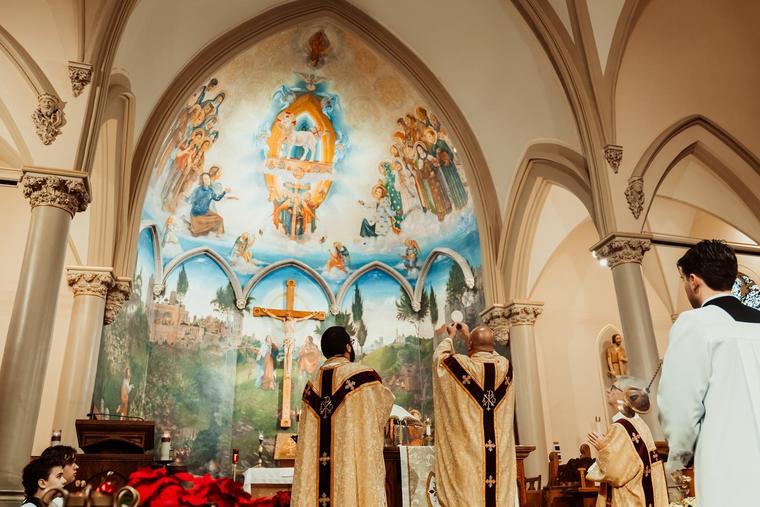
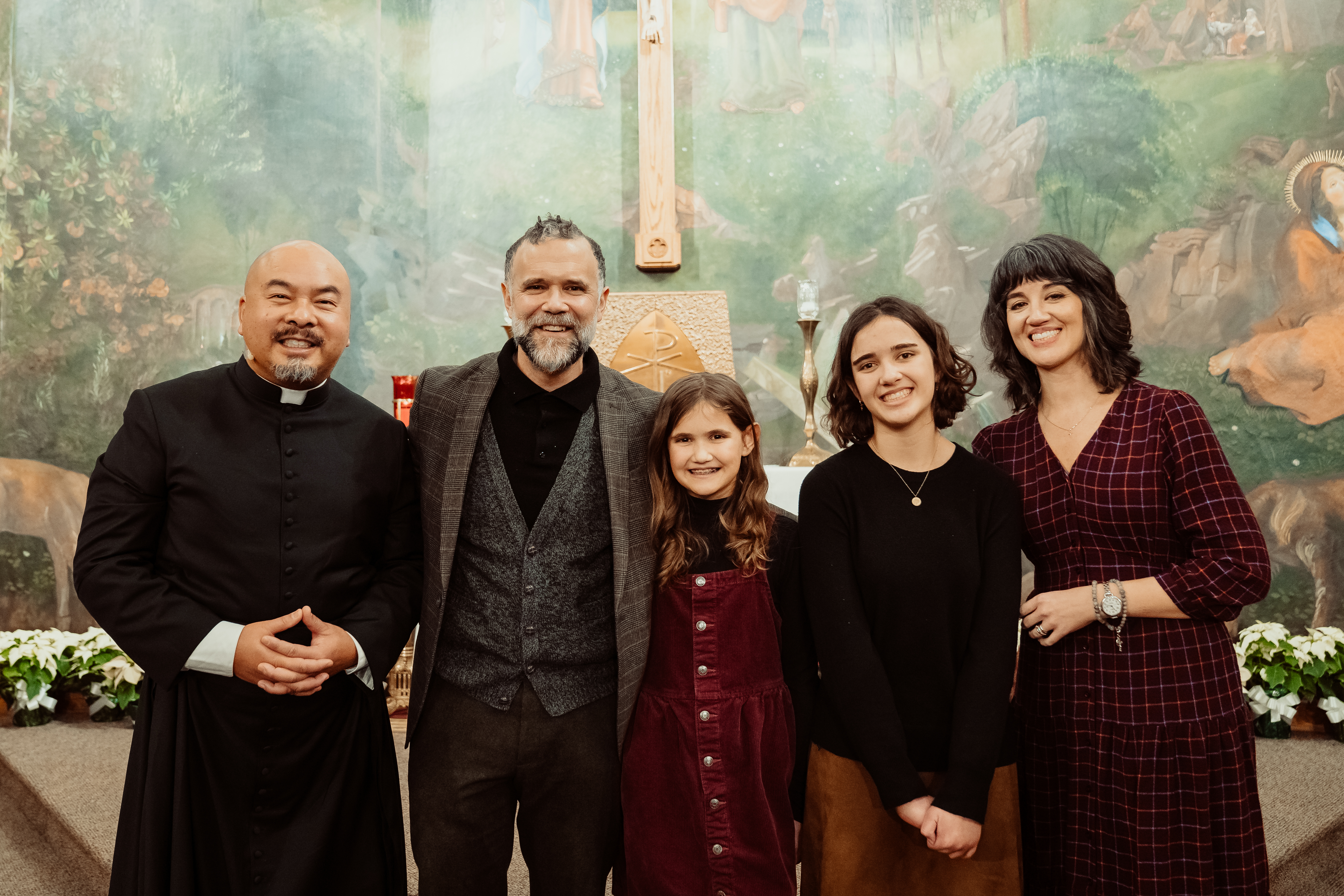
Christmas Eve at St. John the Evangelist Church in Jackson, Michigan, was the perfect time for parishioners to see the gift that was a year in the making: a new sacred mural filling the apse in the sanctuary.
Bishop Earl Boyea celebrated the vigil Mass for the mural’s first showing. This mural’s theme and inspiration come from the parish patron saint’s Book of Revelation. The 32-foot-high-by-21-foot-wide masterpiece, the likes of which are rarely seen today, took sacred and liturgical artist Joseph Macklin a full year to complete — he began in December 2024.
The colorful mural is beautifully layered with spiritual and theological meaning.
“The Book of Revelation is very present in this because St. John is our patronal saint,” said Father Chas Canoy, the parish’s pastor. “Macklin’s Masterpiece,” as it is referred to, “is meant to aid us in our worship of God.”
Pictured in much detail are saints, angels, the Trinity and many surprising images. The mural’s upper part presents “The Wedding Feast of the Lamb,” while the lower part presents “The Paschal Mystery.” Father Canoy pointed out the “hope is that this work draws the faithful more deeply into the sacred liturgy because these two subjects portrayed in the apse reveal what is actually going on in the Mass.” They bring heaven and earth together, as explained by the mural’s official title, The Cosmological Vision of Holy Mass.
Further explaining the mural, he said that there is a timelessness to Holy Mass in that we in the congregation in a certain sense participate in real time in the Paschal mystery in the temporal plane (represented in the lower apse), and simultaneously we join the angels and the saints in the eternal Wedding Feast of the Lamb (represented in the upper apse). In the Liturgy of the Eucharist, we adore the Lamb of God both on the cross at Golgotha and concurrently in the marriage supper of heaven.
“So this sacred art is meant to make us more deeply aware of these supernatural realities to which we are joined when we celebrate Mass,” the pastor said.
Father Canoy explained that Calvary and the Banquet of the Lamb are both made present to us in the Eucharist. One same Lord is inviting us to taste and see both — and the goal of the piece is to draw the faithful closer and more deeply into the reality of what occurs in the Mass.
The Mural’s Conceptualization
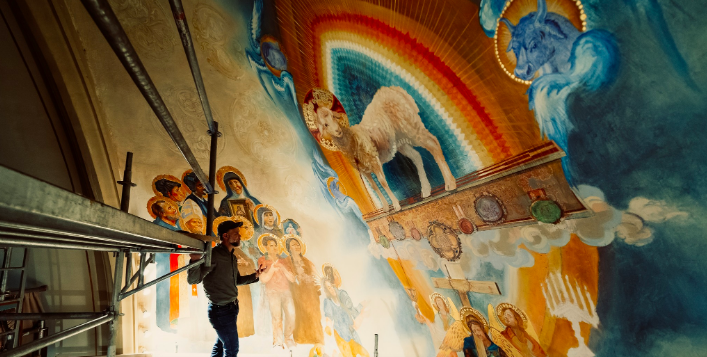
Pastor and artist worked together to develop the mural. Because the parish was St. John the Evangelist, “We wanted to use the motif that was very present in the Book of Revelation,” Father Canoy said. “And the Wedding Feast of the Lamb has just been a near and dear theme in my heart. Then, in combination with that, Joseph [Macklin] saw the old pictures of St. John and saw the motif of the tree of life. That got me thinking about the Pascal mystery in the bottom part.”
Indeed, St. John’s is the oldest church in the Diocese of Lansing. Completed in 1857 and built in Gothic style, it underwent changes in the late 20th century, but thankfully nothing drastic. Both the muralist and priest wanted to “restore its former glory,” Father Canoy told the Register. “We were thinking, ‘What’s the best way to draw people back into sacred art and back into the real significance of what happens at Mass?’”
That prompted the whole notion of the Wedding Feast of the Lamb, the Pascal mystery, and how Mass brings us concurrently both to the foot of the cross and to joining the angels and saints in the Wedding Feast of Heaven.
Macklin, a local artist who established Instrumentum Dei Studio in Jackson on what he refers to as “flying on the wings of the Holy Spirit” to focus on devotional and liturgical art, also pointed out that the mural “was strongly influenced by sacred-art history, in the sacred-art tradition within the Catholic Church. We pulled heavily from two artists in particular, Fra Angelico and Jan van Eyck.”
Both Renaissance artists were born and working around the same time in very different parts of Europe, yet both are “really primary influences to the stylistic visual program,” the artist said.
Noticeable is the influence of van Ecyk’s “Ghent Altarpiece,” specifically the adoration of the Mystic Lamb in this mural. Here, Jesus as the Mystical Lamb is at the heavenly Wedding Feast. In the realm of the same heavenly Wedding Feast, Fra Angelico’s influence is particularly noticeable in the angels present. And the seven angels blowing the trumpets are one of many ways the No. 7, the number of divine perfection prevalent in the Book of Revelation, is used in this work.
Ancient Is Ever New
In the wedding-feast portion, saints and blesseds are depicted adoring guests. Fra Angelico’s influence is also noticeable in the way they are grouped and presented.
“The 24 saints depicted in the upper apse were largely determined by our parishioners who had the opportunity one Sunday to write down their favorite saints,” Father Canoy explained. “Eighteen of those top vote getters are represented in there.”
Among the saints chosen by the parishioners are Sts. Michael, Joseph, John the Evangelist, Francis of Assisi, Teresa of Calcutta, John Paul II, Padre Pio, Thérèse of Lisieux, Anne, Mary (Our Lady of Guadalupe), Maximilian Kolbe, Faustina, Elizabeth Ann Seton, Carlo Acutis, Kateri Tekakwitha and Margaret Mary Alacoque (in honor of the parish’s devotion to the Sacred Heart of Jesus), plus Blessed Solanus Casey and Michael McGivney.
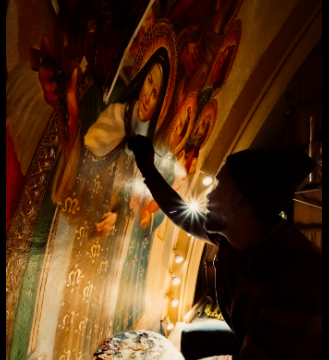
Father Canoy also emphasized recent saints chosen to be representatives from every nation, race, people and tongue, as St. John describes in Revelation: “I had a vision of a great multitude, which no one could count, from every nation, race, people, and tongue.” And some are saints “the faithful can invoke to intercede for the great afflictions of our time.”
St. Gianna Molla, for example, is an “intercessor for the great modern-day affliction of abortion, because she sacrificed her life for her unborn child so that she might live,” pointed out Father Canoy. St. Josephine Bakhita is a powerful intercession for the modern-day slavery that is human trafficking. And St. Mark Ji Tianxiang intercedes for those plagued by addiction.
He pointed out that St. Isaac Jogues appears in honor of “the 17th-century North American martyrs who were among the French Jesuits who first brought the Gospel to the land that would become the state of Michigan.”
And he also highlighted Servant of God Michelle Duppong — the only one without a halo — who died at the age of 31 on Christmas Day 2015 — who served as a FOCUS missionary and is “a wonderful model for young people” and “the importance of the lay faithful in the mission of evangelization.” The pastor said this parish was a pilot parish for FOCUS’ parish work.
Macklin said St. Carlo Acutis was added for several reasons: his witness amid the digital age (St. Carlo is known as “God’s Influencer”) and because this parish also has an elementary school. “Between Servant of God Duppong and St. Carlo Acutis, it’s a great tribute and testimony that the youth can look up to and see St. Acutis and then the Servant of God as models for them while they’re at school and beyond.”
Connecting Heaven and Earth
In other distinct visual ways, the mural connects the Mass and the Wedding Feast of Heaven and makes them present in the way Macklin set many scenes in the time and place of the church and parishioners — just as in some great works of sacred art the setting and background of Jesus’ saving mysteries are not Jerusalem or Galilee but the buildings and familiar landmarks of the artist’s era and region.
Father Canoy made the connection to Perugino’s Sistine Chapel painting of Jesus Christ giving the Keys of the Kingdom to Peter (Delivery of the Keys); the background is Florence in the Renaissance period.
“Basically, the message that’s being portrayed is that the sacred mysteries of Jesus are timeless and are for all people of all ages,” he explained. “The sacred mysteries of Jesus are relevant and apply to us now in our time and place, to you and me, just as much as they did to the people of Israel.”
In this new mural, the setting of the Paschal mystery portion is Jackson and the Diocese of Lansing. Depicted are Jackson City Hall, the county building, the old Post Office, the facade of different churches, the diocese’s St. Mary Cathedral, and the streets of Jackson where Jesus is shown riding a donkey and in other buildings raises the Eucharist at the Last Supper, carries his cross, is scourged and crowned with thorns. Jesus is represented 10 times throughout this landscape.
“All those scenes are in one single landscape, and that method is called continuous narrative,” explained Father Canoy.
The single-setting technique is characteristic of some Gothic and Renaissance works like Botticelli’s Life of Moses in the Sistine Chapel conveying events of Moses’ life in the same landscape.
In these scenes, all figures are small. Macklin pointed out that the upper room of St. Mary Cathedral pictures Pentecost where Our Lady is in the center, the Holy Spirit is directly above, and they are surrounded by the apostles. Below that scene is a representation of St. John’s parish priest, Father Canoy, plus Lansing’s Bishop Boyea and Pope Leo.
“I’ve seen the tradition historically of artists implementing people from that time into the painting,” Macklin said, “and these are ways for me to tie the contemporary members of the church, the faithful, into that scene of Pentecost with Our Lady and the 12 Apostles from thousands of years ago.”
Father Canoy said the Pascal mystery at the lower part of this cosmological vision of Holy Mass reads left to right, from Holy Thursday through Easter: “So you have the Holy Triduum right there before you in one landscape.” And above all, at the peak, is the Father’s hand in blessing. The mural is also filled with such symbolism.
For God’s Glory
“It’s very much a holy work of God that Joseph did for the glory of God,” added Father Canoy.
Prayer was the foundation. Macklin would often start at 3 a.m., beginning the day with Scripture and praying a Rosary — one Rosary grew to three Rosaries — before the Blessed Sacrament in the tabernacle. Then he worked in silence the rest of the day.
“I know if you’re in silence and have those conversations with either the saints or with Our Lord,” he said, “there’s no denying that the work that is being produced is born from those relationships with the Lord, with the saints, depending on what element of the project is being worked on at that time.”
The 42-year-old artist and his wife and two daughters are parishioners at St. Mary Star of the Sea in Jackson and sometimes attend Mass at surrounding churches, including St. John the Evangelist.
He studied fine art at the Columbus College of Art and Design in Ohio and previously taught high-school graphic design for 13 years, which included traditional art and design media in a variety of painting and drawing techniques, before founding his studio in 2021 to concentrate full time on sacred art.

Macklin can’t remember a time when he didn’t have an interest in painting or drawing, and in elementary school his parents reinforced growing skills with library books on Renaissance painters.
When Father Canoy encouraged him that his gifts could visually be used to glorify God, shortly after the COVID era, his wife Carly and he took concrete steps, “taking the leap of faith in pursuing a career in sacred art/design.”
Among numerous devotional private-based projects ranging from miniatures, measured in millimeters to private paintings of up to 8 feet in length or height, Macklin’s works include a Greek-influenced a Byzantine-style icon as an altarpiece for his alma mater, Lumen Christi Catholic High School in Jackson, an early Renaissance-style image of St. Gerard Majella for St. Gerard Parish in Lansing, and five Byzantine-style icons for the reredos at Church of the Resurrection in Lansing with two in the works of archangels Raphael and Gabriel.
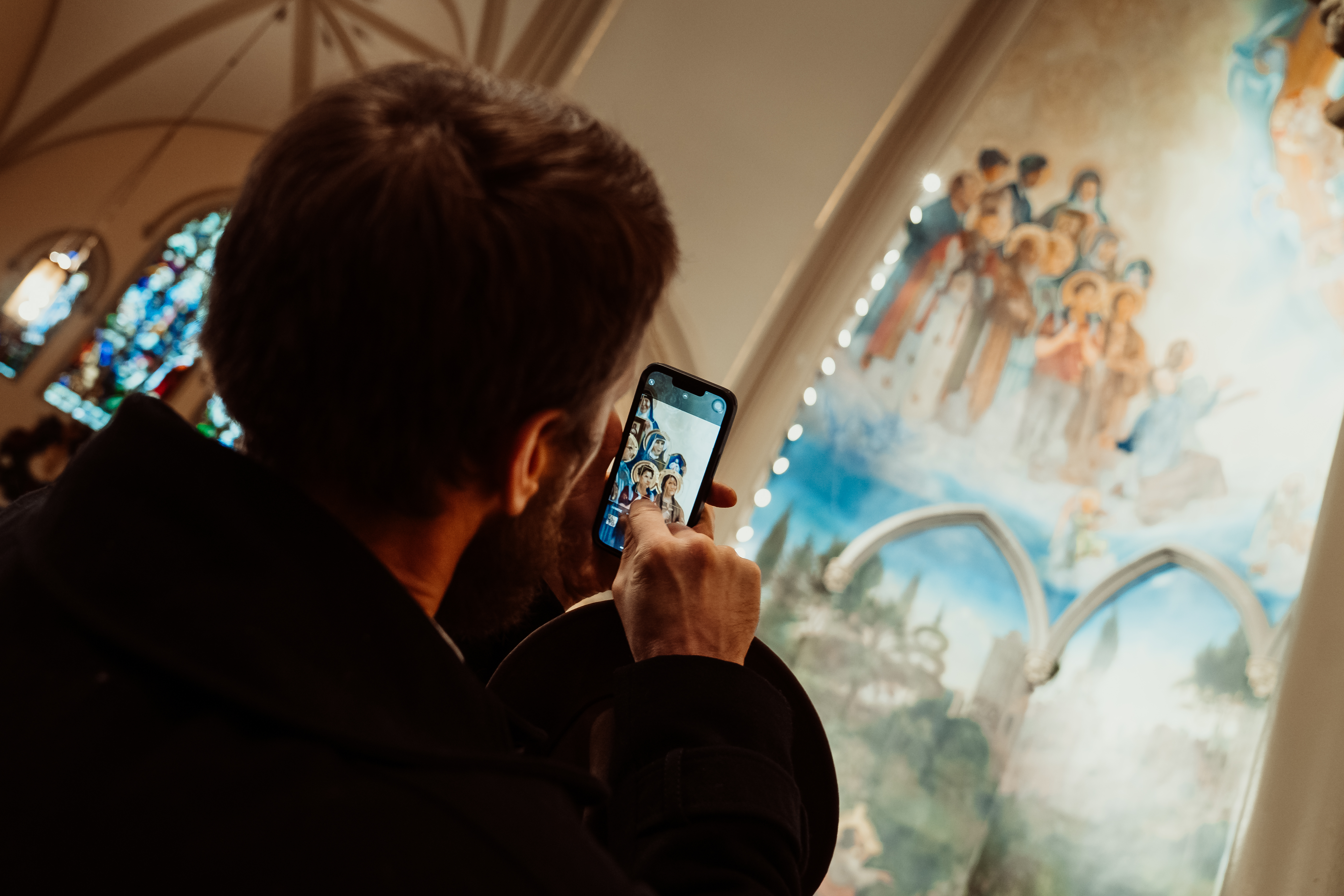
Silent awe was one major reaction from those packing the church for the first viewing. Father Canoy said the most common phrase was “Absolutely stunning!” He added: “It really put them in a frame of pondering and contemplation, which I think is part of Joseph’s goal.”
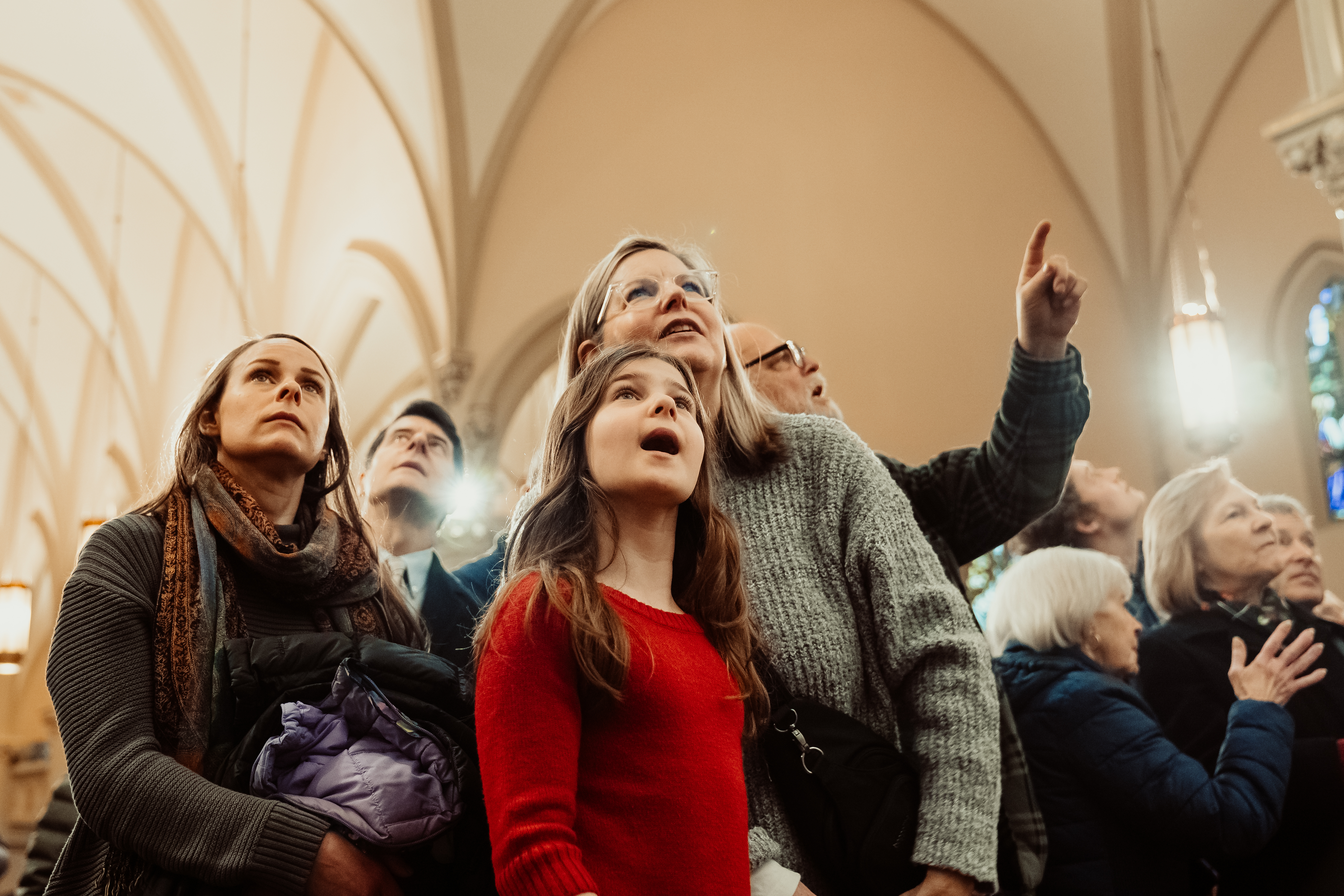
Parishioners Robert and Kimberly Moore-Jumonville were among those filling the church for the first look at the mural.
Kimberly was first focused on getting her granddaughters to their seats up front while threading her way through a crowd eagerly anticipating Christmas Eve worship. “Not until the mural caught my eye did I look up to be so astounded that I couldn’t catch my breath,” she told the Register. “The vision of the Lamb on a field of blue was so brilliant that I was at a loss for words; I just gaped, open-mouthed. The stream of blood spurting into the cup so poignantly highlights the intentionality of Christ’s sacrifice. That expression of God’s aching love for us will be the focus of my worship at St. John’s from now on. Celebrating the Marriage Supper of the Lamb visually as we participate in the representation of Jesus’ sacrifice in the Mass will go a long way to promote a liturgical disposition in all who worship here. Come and see!”
Although Robert had seen a bit of the mural while painting was in progress, he related how “seeing the mural for the first time in its entirety was something completely different — absolutely stunning!” On Christmas Eve he watched parishioners “drawn forward to the apse ... and they would lift their heads and eyes as if to heaven. I realized that was my experience, too: one of being transported through a window into a spiritual world. During Mass, I frequently focus on the altar and the priests; now, it’s as if a curtain behind them has been opened up to the heavenly Supper of the Lamb. Kimberly and I had taken a Jubilee pilgrimage to Rome this fall and visited the papal basilicas; Joe’s mural is like bringing a piece of Rome to Michigan. What a gift of worship!”
The pastor said there “is also a beauty in the wonderful tradition of sacred art, and we wanted to revive that tradition and restore the church to some of his former glory.” On both accounts, this mural clearly triumphs.
“This project, painted at the pace of a marathon sprint, was indeed Holy Spirit-led,” Macklin told the Register. “Many faith-filled parishioners of St. John’s lifted me up in prayer; and those prayers were certainly multiplied by the saints portrayed and answered by Our Lord in heaven. My hope is that this project will draw the gaze of those who look upon it ever closer to the one true and ever-living God.”
LEARN MORE
View the Mass followed by Q&A with artist and Father Canoy’s detailed explanations in a bulletin (pages 2, 8, 9) one and bulletin (pages 2-3).
- Keywords:
- catholic artists
- sacred art







.jpg)