The Story of Tech-Savvy Saint Carlo Acutis Spreads in Digital Age
Devotees of ‘God’s Influencer’ reflect on his witness for first feast day post-canonization.

This Oct. 12 is the first time that Catholics around the world can finally celebrate the feast day of Saint Carlo Acutis.
For Catholics who have been following St. Carlo Acutis’ life story and message, his canonization in September was the culmination of years of devotion to this extraordinarily popular saint.
The first millennial saint lived in the digital age: He had a computer, a flip phone and a PlayStation. Among practicing Catholics, there is a sense that Carlo — known for his computer-programming skills — is reaching people around the world, often through technology.
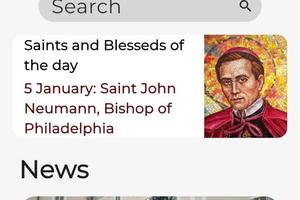
“It seems that everywhere I look — on Instagram, the Hallow app, Catholic media — I am finding something about Carlo,” said Maureen Crowley, religion teacher at The Ursuline School in New Rochelle, New York. “He turns up everywhere. And because of him, I am now so much more excited to receive the Eucharist.”
“I consider him a Franciscan-type saint, and I pray to him for different things. I am listening to a podcast about Carlo, and I am doing a novena to him through the Hallow app,” said Lorena Finnell, who lives in Quito, Ecuador.
There are numerous documentaries on YouTube on St. Carlo Acutis from Catholic organizations like EWTN (watch here and here) and Castletown Media (Carlo Acutis: Roadmap to Reality). There are videos about him from secular news organizations as well.
What has come to light is that many Catholics today use technology for their devotions and growth in spiritual formation.
“I used to be skeptical about these things. But then I saw the application. I realized that this was an instrument to reach people who otherwise would be totally isolated,” said Maria Baldi, an Italian who lives in New York. “This is exactly how the life and story of Carlo spread around the world. Technology is an instrument, and in the Catholic world, you see technology everywhere: podcasts, TV, radio and online prayer groups.”
In many countries, in fact, the story of St. Carlo Acutis was first shared through online prayer groups.
“At the end of 2020, my uncle Patricio had pancreatic cancer,” said Maria Luis Rojas from Santiago, Chile. “He was a very holy man. My aunt had learned about Carlo from the news of his beatification. It was then decided that we would form a family prayer group on WhatsApp for my Uncle Patricio’s healing by praying for Carlo’s intercession. He ended up living two and a half years, which was much longer than was expected. Not only did he live longer, but he also lived well.”
One of the outcomes of the prayer group was that Patricio, early on, decided that the prayer group would not only be for him, but also for others who were sick.
“So, in this way, our family prayer group saw that our prayers were multiplied. To this day, we continue to pray for others who are sick and for the souls in purgatory, to whom my uncle was immensely devoted,” Rojas said.
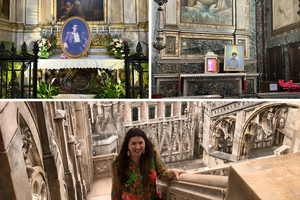
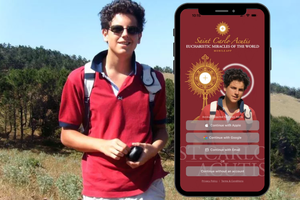
Many people learned about St. Carlo in Chile through his website and his exhibit on Eucharistic miracles.
“A Chilean woman named Aránzazu Álvarez de Eulate spent a year in Spain, and the day before she was to return, she went to Carlo’s exhibit on Eucharistic miracles, which really affected her. She asked if she could bring it back to Chile. This exhibit, which she named ‘ExpoCarlo Chile,’ really made Carlo famous in Chile. She brought a relic of his and travels around Chile with it,” said Rojas.
One of St. Carlo’s sayings was that the internet can be an “atomic bomb for good” — but it can also be used for bad things that diminish the human person.
The spread of his story — to the far corners of the world — through technology is surely an example of the good outcome Carlo so desired.
St. Carlo Acutis, pray for us!
- Keywords:
- carlo acutis
- digital age