Rupnik and Gaudí: A Tale of Two Virtues
COMMENTARY: As the Church confronts the legacy of Father Rupnik, the sanctity of Antoni Gaudí raises enduring questions about what sacred art reveals about the soul of its maker.

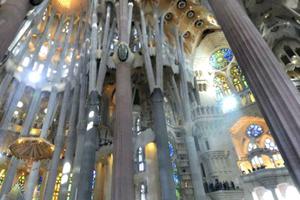
Pope Francis’ promotion of Antoni Gaudí (1852-1926) to “Venerable” last April rekindled interest in the Catalan architect’s work, most notably his grand edifice in Barcelona, Spain — the Sagrada Família (Holy Family) basilica.
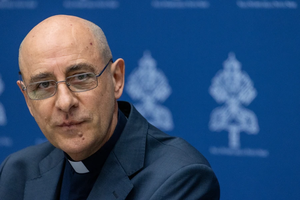
The ongoing scandal of the formerly celebrated artist, Jesuit Father Marko Rupnik, accused of sexual abuse and currently awaiting news of a canonical trial from the Dicastery for the Doctrine of the Faith, provoked an impassioned plea against his work.
Both are striking examples of how we are naturally wired to link the ethical life with the artistic.
The question of how moral character and creative genius are related is as old as Plato. Does experiencing good art make you a better person? Does a virtuous character give you a more refined artistic taste?
Intuitively, it seems there must be some connection, but philosophers have struggled to articulate precisely what the connection is.
It’s even harder when it comes to evaluating artists and their art. Does acting virtuously make you a better artist? Does creating good art make you a virtuous person?
The older Gaudí grew, the more thoroughly he dedicated himself to prayer, penance and fasting, spending hours in lectio divina (prayerful reading of Scripture) and meditation, and drawing closer to God each day. The nun who served as his housekeeper was thoroughly convinced of his sanctity. “With each passing year, I am more convinced of it. … I believe he deserves to be canonized.”
Officials are now examining alleged miracles attributed to Gaudí’s intercession, including the healing of artist Montserrat Barenys, whose vision was completely restored after she suffered a perforated retina and begged for Gaudí’s prayers.
Although best known for the Expiatory Temple of the Sagrada Família in Barcelona, Gaudí was prolific in his output. He received many lucrative commissions later in life, but he routinely declined them to concentrate on the Sagrada Família, now scheduled for completion in 2026 — a full century after the artist was fatally struck by a streetcar while on his way to Confession.
Like all sacred spaces, the Sagrada Família must be entered if you want to perceive an inkling of its power. The soaring, treelike columns and rich hues streaming from the stained-glass windows gently transport you to another dimension. Comparisons to Elsa’s Ice Palace in Frozen or Thunderbird Palace in The Legend of Zelda or even Minas Tirith in The Lord of the Rings, as tempting as they are, are entirely inaccurate. None of them touches upon the theological profundity of Gaudí’s vision.
Several notable figures converted to Catholicism precisely due to the influence of the Sagrada Família, particularly architect Kenji Imai (1895-1987) and sculptor Etsuro Sotoo (b. 1953), both Japanese.
Coincidence? Hardly.
Pope Benedict XVI elegantly explained this at the dedication ceremony in 2010. Gaudí “brilliantly helped to build our human consciousness, anchored in the world yet open to God, enlightened and sanctified by Christ.” He “overcame the division between human consciousness and Christian consciousness, between living in this temporal world and being open to eternal life, between the beauty of things and God as beauty.”
This integration of the temporal and eternal through human consciousness was, indeed, a pressing task that Benedict XVI undertook both as a theologian and as the Successor of Peter. It is also a distinguishing mark of Japanese art, as French philosopher Jacques Maritain (1882-1973) keenly expounds in Creative Intuition in Art and Poetry, giving us a useful foundation for understanding why Imai and Sotoo were so attracted to Gaudí’s work.
And yet, if we were to walk into the Sagrada Família without any knowledge of its architect, would we know it had been designed by a saint? It’s one thing to say that the Basilica draws artists like Imai and Sotoo into the theological and spiritual richness of the Catholic faith, but it is quite another to say that such a stunning artistic accomplishment could only be the work of a saint.
Conversely, when John Paul II walked into the renovated Redemptoris Mater chapel in the Apostolic Palace in 1999, did he know that the mosaics had been designed by an alleged sexual abuser, Father Marko Rupnik? Although it’s uncomfortable to admit, Pope St. John Paul II noted at the inauguration ceremony that Father Rupnik’s mosaics “bring to life the wealth of the Eastern tradition, reinterpreted with the knowledge of one who also knows the Western heritage. Here East and West, far from being in opposition, exchange their gifts in order to give greater expression to the unfathomable riches of Christ.”
Should Pope Leo remove the mosaics now that Father Rupnik has been unmasked?
Again, Jacques Maritain may offer some help to untangle this mess.
Drawing from the philosophy of Aquinas, Maritain argues that art is directed not toward the good of the agent, but to the good of the object being made. The virtue directed toward the good of the artwork, techne (“craftsmanship”), is distinguishable from the virtue that aims at the good of the agent, phronesis (“prudence”).
But this does not mean that the moral life is completely disconnected from the artistic life. The faciendum (i.e., the work to be done) always enters into the line of morality, but only as a means for the faciens (i.e., the one doing the work) to achieve moral goodness. The end of art can never be to make the artist a better man, but the making of an artwork may nonetheless be a means of making him a better man. Maritain writes that those working in the fine arts alone “participate through the transcendence of their object, which is beauty, in the nobility of the speculative sciences.”
No one understood this better than Antoni Gaudí, who constantly strove to integrate his deep knowledge of science, nature, metaphysics and art, but never conflated the end of fine art with the attainment of his own moral perfection. Another way of saying this is that Gaudí, while striving to complete the Sagrada Família, never believed its ultimate purpose was to make him holy. Indeed, by declaring him a Servant of God, the Church acknowledges that he achieved holiness even though less than a quarter of the basilica was completed at the time of his tragic death.
Gaudí, though not initially devout, underwent a radical conversion while working on the Sagrada Família. His work on the project must certainly have contributed to his conversion, but he never identified the end of the basilica to be the completion of his conversion; the end, rather, was the perfection of the basilica itself. Gaudí was able to distinguish his techne (“craftsmanship”) from his phronesis (“prudence”).
Maritain warned of the consequences of conflating the two. In a famous response to famed artist and friend Jean Cocteau (1889-1963), who was sinking into deeper moral decrepitude with each passing year, Maritain wrote that “the purity of the artist, as much as it costs him, serves nothing to save his soul.”
But Maritain adds that the purity of the artist is indeed authentic purity, paid for by the weight of the pain a created spirit must bear in trying to open a window onto uncreated beauty. The purity of the saint is so closely assimilated with the purity of the artist that the latter prepares the way for the former, and this is precisely how Gaudí understood his own spiritual journey.
Although the connection between Father Rupnik’s moral and artistic life would be much harder to dissect, I would argue that it’s virtually unnecessary when we have masterworks like the Sagrada Família — created not only by great artists but by saints like Antoni Gaudí.
Daniel B. Gallagher is a lecturer in literature and philosophy at Ralston College in Savannah, Georgia.
- Keywords:
- antonin gaudi
- rupnik
- catholic artists
- plato