Hidden Crosses in the Life of Edith Stein
COMMENTARY: At her canonization in 1998, Pope St. John Paul II described her as ‘a martyr for love, who gave her life for her friends, [and] let no one surpass her in love.’

The year was 1893, when a tragedy shook the foundations of Edith Stein’s family. Her mother, Auguste Stein, had given birth to 11 children, with four dying in infancy. When Edith, the youngest child, was only 2 years old, Auguste’s husband started out the door on business related to his lumber yard. The baby called him back for another kiss goodbye, and that was the last time Auguste would see her husband. He died of heat stroke that day.
Widowed at age 44 with seven children to support, Auguste Stein suffered quietly, as she took over the management of the lumber yard. In a field largely foreign to women, she excelled, often working 16-hour days. Her motivation was strong and selfless, as her priority was giving her children every opportunity for a good education.
Auguste was eager to make her children’s dreams come true, so when Edith said she wanted to study at the university, that became the plan. To Edith, the study of philosophy meant the pursuit of truth, which she hungered for. At age 15, she had become an atheist, despite her mother’s deep attachment to the Jewish faith.
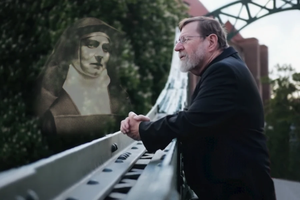
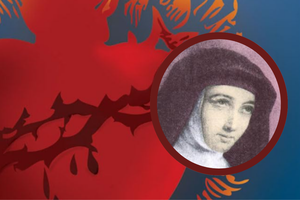
Edith Stein was born in Breslau, Germany, on the Jewish Day of Atonement, Oct. 12, 1891. Born into a Jewish family, she eventually became a philosopher, a Catholic, a nun and then a saint. Her choice of the religious name Teresa Benedicta of the Cross signified her mystical connection with the suffering of Christ.
Edith climbed to the top of her class and received her doctorate in philosophy in 1917, graduating with the highest honors. She had never heard of “carrying Christ’s cross,” but this is what she experienced when she applied for jobs as a university professor —and was rejected because she was a woman. Later, after her conversion to Catholicism, she had the remarkable insight that even people unaware of Christ’s cross may be carrying it when they suffer from injustice.
While Edith was in college, she had three experiences that sparked her curiosity about Christianity. One occurred when she and a friend were touring a cathedral and saw a woman with shopping bags praying there.
In Life in a Jewish Family, Edith wrote, “In the synagogues or the Protestant churches I had visited, one went only for services. But here was someone interrupting her everyday shopping errands to come into this church … as though she were here for an intimate conversation.”
The second experience occurred when World War I broke out and one of Edith’s friends, Adolf Reinach, a convert to Christianity, was killed in action. Edith went to visit his widow, also a convert, and expected her to be devastated. The widow, however, radiated courage and peace. Later, Edith realized this woman’s belief in the Resurrection gave her hope of seeing her husband again.
Edith decided to volunteer as a nurse with the Red Cross in Austria, going to a hospital that housed patients with contagious diseases. Once her training was over, she received an enamel brooch, showing a red cross against a white background. The Christian symbolism of the cross did not strike her as significant at the time.
Tending to wounded and dying soldiers, she performed small acts of kindness that revealed her compassionate heart.
For example, one fellow had stopped eating, but she discovered he liked oranges and chocolates, so she provided these for him. She worked tirelessly, and after just two weeks as a volunteer, she was in charge of 60 typhoid patients.
The third turning point in Edith’s life came in 1921, when she was looking for a book to read at a friend’s house and stumbled upon the autobiography of St. Teresa of Avila, a Carmelite doctor of the Church. After reading the book, she declared, “This is the truth.” At that moment she decided to become Catholic and a Carmelite nun.
She was baptized in 1922 and entered a Carmelite convent 10 years later, taking the name Teresa Benedicta of the Cross. Her sister, Rosa, would also enter the convent shortly after.
In a letter, Sister Teresa Benedicta wrote eloquently about the cross:
“By the cross I understood the destiny of God’s people which … began to announce itself. I thought that those who recognized it as the cross of Christ had to take it upon themselves in the name of all.”
As Hitler’s vicious campaign against Jews thundered through Germany, some of Sister Teresa’s family members escaped to other countries, but others were not so fortunate. Writing on Passion Sunday in 1939, she mentioned offering herself as a sacrifice for peace, so that Hitler, whom she called “the Antichrist,” would be overcome.
A chilling document from the Netherlands Red Cross reveals that Sister Teresa fell victim to Hitler’s deadly plan. It lists Edith Teresa Hedwig Stein as having been arrested “for reasons of race and specifically because of Jewish descent” on Aug. 2, 1942. On Aug. 7, she and her sister were sent to Auschwitz, where they died two days later.
Eyewitness accounts describe Sister Teresa Benedicta as peaceful and compassionate as she tended to others in the camp. At her canonization in 1998, Pope St. John Paul II described her as “a martyr for love, who gave her life for her friends, [and] let no one surpass her in love.”
What a beautiful summary of a saint who lived in mystical union with Christ’s cross!