Don’t Let a Priest’s Failure Cost You Your Faith
COMMENTARY: The failures of individual priests need not become a crisis of faith when our eyes remain fixed on Christ and the sacraments.
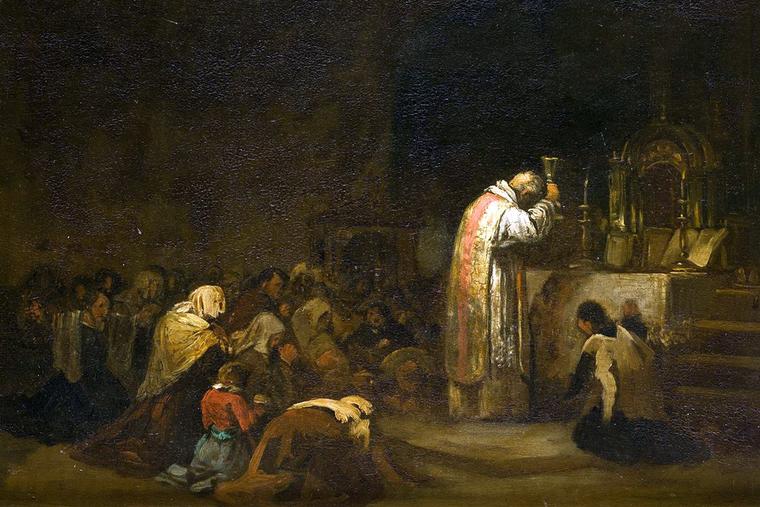
People will disappoint you, and priests are people. They are also in persona Christi — in the person of Christ — bringing us the sacraments and leading us to heaven. We hold them in high esteem, but when they fail, disappointment can threaten to seep into our very faith. If their example seems hypocritical, it can cause confusion, anger, cynicism or even apathy toward religion.
As members of their flock, we are affected by our shepherds. So, how can we believe in a Church when its leaders let us down?
Consider who a priest is. He is not his own. The priest belongs to the Church, ordained to serve God and the faithful through sacramental ministry. We pray for vocations and celebrate each new ordination as each man becomes Christ to us, giving his life to the Church. But do we pray for our priests daily?
There is fatigue from long days and nights spent bringing us the sacraments, counseling the downhearted, ministering to the sick and dying, managing a parish or mission, preaching the Gospel and representing the Church in so many ways. It’s an all-consuming vocation: “You are a priest forever, according to the order of Melchizedek” (Hebrews 5:6 and 7:17, quoting Psalm 110:4).
Cardinal Timothy Dolan has used this description in his writings and addresses:
The priesthood is a call, not a career; a redefinition of self, not just a new ministry; a way of life, not a job; a state of being, not just a function; a permanent, lifelong commitment, not a temporary style of service; an identity, not just a role.
Our faith is intertwined with our priests, who teach and guide us. Scandal from the clergy, therefore, shakes us up. Some people cannot accept or comprehend it, so they leave. For those who remain, there needs to be a reckoning alongside the disappointment to separate Jesus and his sacraments from human weakness.
In a well-known story about St. Francis of Assisi toward the end of his life, some people from a nearby town asked him to intervene with their parish priest who was in a scandalous relationship with a woman of that town. St. Francis was brought before the priest in front of the angry townspeople. They expected the saint to admonish the fallen priest.
Instead, St. Francis fell to his knees, took the priest’s hands into his own stigmatized hands, kissed them and said, “All I know and all I want to know is that these hands give me Jesus.” The priest was converted and changed his way of life.
How to Respond
In a Reddit post, someone asked: “Does anyone on here have guidance for someone dealing with disillusionment with the clergy?” The person shared they had been affected by more than one scandal and were struggling to remain Catholic.
Responses included recognizing priests as humans with flaws, seeking spiritual growth elsewhere within the Church, focusing on Jesus and the Eucharist, finding another parish if there’s a personality conflict with a particular pastor, and in serious cases, holding them accountable by reporting it.
The laity are sometimes left on their own when there is a scandal or other serious issue involving a priest. Perhaps the thinking is not to air dirty laundry as if addressing a situation will make it worse or spread it. But when an explanation is lacking, there is a natural human reaction to wonder what happened.
In a family, if the father leaves and no explanation is given to the children, the silence, in and of itself, is a cause for further woundedness and distrust. In the case of scandal, the situation of harm can be multifaceted when there is silence or even resentment at the laity for wanting to know what is going on. We are also at risk to be so curious as to seek gossip and spread it.
Regardless of how a scandal is handled, we can look for ways to overcome disappointment and shore up our faith rather than detracting from the one, holy, Catholic and apostolic Church established by Our Lord.
What We Can Do
- Spend time in prayer, especially before the Blessed Sacrament, praying for the clergy and for our own faith to remain strong.
- Do not expect perfection. For personality conflicts and disagreements, consider that we might be the problem, but regardless, priests too need mercy.
- Make connections to shore up your faith and parish through parish organizations and ministries.
- Support and participate in the work of the Church, including faithful Catholic media, as a way of strengthening your faith.
- Keep your focus on Christ and the sacraments.
- Recognize that history abounds in human imperfection and scandal, but the gates of hell have not prevailed against the Church.
Father Mark-Mary Ames offers insight on how to react “when priests get it wrong.” He explains that there are generational differences, and that some priests may have been swayed by a culture not in line with Church teaching. If a priest’s words seem unclear or inconsistent with Church teaching, he suggests that you approach the conversation with kindness, seek clarity, and above all, place your trust in the Lord:
It is not our job to supervise the priests or save the Church, but we can charitably address problems and certainly report wrongdoing. And regardless of any problems with individual priests, remember to pray in thanksgiving for the gift of the priesthood, which brings us the fullness of God’s gifts.
“If I were to meet a priest and an angel, I should salute the priest before I saluted the angel. The latter is the friend of God, but the priest holds His place.” —St. John Vianney
- Keywords:
- scandals
- priesthood

Patti Maguire Armstrong Patti (Maguire) Armstrong is an award-winning journalist and was managing editor and co-author of the bestselling Amazing Grace Series. Her latest books are the humorous and inspirational second-edition Dear God, I Don't Get It, Dear God, You Can't Be Serious!, What Would Monica Do?, Holy Hacks and Michelle Duppong: Hope in the Depths of Suffering. Patti worked in social work and public administration before staying home as a freelance writer while she and Mark raised their 10 children in North Dakota. Follow her on Twitter at @PattiArmstrong and read her blog at PattiMaguireArmstrong.com.