Tony Abbott: ‘Sometimes Governments Must Choose the Least Bad Option’
In a conversation with the Register, the former Australian prime minister defends tough immigration policies, calls for stronger Catholic witness in public life, and pays tribute to Cardinal George Pell.
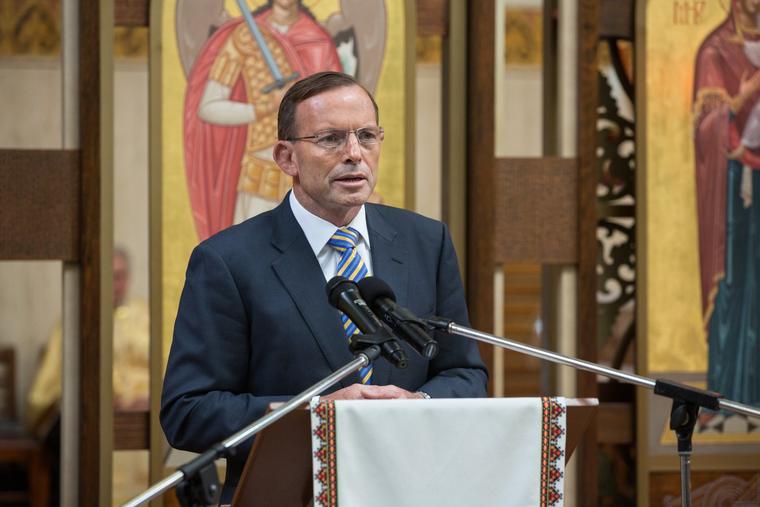
LONDON — Tony Abbott is one of Australia’s most recognizable statesmen, serving as prime minister of Australia from 2013 to 2015.
A practicing Catholic, he has remained an influential voice in debates about the future of Western civilization, the role of Christianity in public life, and the moral responsibilities of elected leaders.
During his time as prime minister, Abbott drew international attention for his government’s response to illegal maritime immigration and human-smuggling networks targeting Australia. His government, which reopened offshore detention, restored temporary protection visas, and established a policy to turn boats around through “Operation Sovereign Borders,” was highly effective in stopping such arrivals. At the same time, such policies drew criticism from Catholic bishops who called for a more humane response.
In this June 23 interview with the Register on the sidelines of the Alliance for Responsible Citizenship (ARC) conference in London, Abbott argues that the people‑smuggling trade is intrinsically exploitative and gravely dangerous, adding that responsible governments must sometimes choose “the least bad option” in an imperfect world to protect human life and uphold the common good.
The author of a new book, Australia: A History — From Convict Colony to Great Democracy, Abbott also speaks about the need for more practicing Catholics to enter politics, shares his opinion on “cultural Catholicism” in public life, and offers a tribute to his fellow countryman, the late Cardinal George Pell.
Mr. Abbott, first of all, the theme of this conference is “The Age of Reconstruction,” where prominent speakers from around the world have examined the decline of Western civilization and what can be done to reverse it. What’s been your main takeaway from the conference?
I think this conference is unique in that, unlike the general run of conferences which tend to deal with economics, politics and/or geopolitics, this delves deeply into culture and civilization. Politics is often said to be downstream of culture, and ultimately culture is downstream of faith — a faith that people can believe in that’s bigger than themselves. That’s what makes this, I think, a very special conference.
Do you think the West needs a more distinctively Catholic political presence? Is the faith underrepresented in the public square?
Yes, I certainly think we need more people of faith in our public life. I always cringe a little when I hear Christians say that getting involved in the messiness of public life is somehow a dereliction of faith. I think we should be in the world, even if not entirely of the world.
What would you say to Catholic politicians, like Andy Burnham for example, speculated to become Britain’s next prime minister, who are culturally Catholic but do not uphold the magisterium in its fullness and don’t attend Mass regularly? Is there a need for Catholics in public life to step up and practice their faith as the Church asks?
Well, I don’t claim to be anything like a perfect Catholic myself, but I think all of us are better people, certainly if we’re Catholics, if we’re more regular at Mass and receiving the sacraments.
Turning to immigration, many point to Australia as an example of strong action against illegal immigration, dangerous crossings and human smuggling. What would you say to Americans and Britons who are wrestling with this issue and want an ethical policy that genuinely works?
I’ve often observed that moral theologians don’t normally make good statesmen because sometimes in this imperfect world you’ve got to choose the least bad option. The people‑smuggling trade is evil: It’s responsible for much exploitation and many deaths, and it simply has to be stamped out. Just as sometimes very dire and difficult things need to happen in war, I think that sometimes you need to be prepared to take pretty direct action if you are going to end what is, at the moment, akin to a peaceful invasion of Britain by people coming across the Channel in small boats.
In practical terms, what kind of policy response do you think would work in Britain and the United States?
The humanitarian thing to do — the genuinely humanitarian thing — is to stop people-smuggling. In the case of Britain, that would stop drownings in the English Channel. In the case of the United States, it would stop the entry of a whole lot of people who are not going to be helpful to America, as well as other people who are simply seeking a better life. But in the end, as people in government, you’ve got a duty to your own citizens that trumps any duty to give a better life to outsiders who have no real claim on you. The only people who have a real claim on another country are its citizens, or people who have demonstrated that they can make a very serious contribution to that country — not people who are simply seeking a better life for themselves.
Why do you think, particularly in Britain, there haven’t been many effective policies to deal with this?
Lack of leadership.
Somebody said that if Russian soldiers were coming over with guns, the government would quickly find a way to stop them. So is it simply a question of political will?
I think some people feel they are constrained by a combination of rich‑country guilt, an overdeveloped, and in this case misguided, sense of compassion, cultural Marxism, or a misguided respect for institutions like the European Court of Human Rights (ECHR). The idea that Britain — which has been the place where so much of what we now regard as human rights originated — should be deferential to the ECHR, I just think, is crackers.
Finally, a word about Cardinal George Pell. As you know, he often attributed the decline of society to the abandonment of traditional Christian values and moral truths and the rise of moral relativism. What would you like to say about him?
I think Cardinal Pell was a modern‑day saint. He was, in a sense, a contemporary martyr, given that he was subjected to a form of living crucifixion. The more that his memory is cherished, his example celebrated, and his life honored, the better for all of us.
- Keywords:
- catholic politicians
- australia
- u.k.
- united states
- immigration crisis
- cardinal george pell
- faith in the public square

Edward Pentin Edward Pentin is the Register’s Senior Contributor and EWTN News Vatican Analyst. He began reporting on the Pope and the Vatican with Vatican Radio before moving on to become the Rome correspondent for EWTN's National Catholic Register. He has also reported on the Holy See and the Catholic Church for a number of other publications including Newsweek, Newsmax, Zenit, The Catholic Herald, and The Holy Land Review, a Franciscan publication specializing in the Church and the Middle East. Edward is the author of The Next Pope: The Leading Cardinal Candidates (Sophia Institute Press, 2020) and The Rigging of a Vatican Synod? An Investigation into Alleged Manipulation at the Extraordinary Synod on the Family (Ignatius Press, 2015). Follow him on Twitter at @edwardpentin.