Elizabeth Ann Seton: The Saint America Needs at 250
COMMENTARY: The saint’s contribution to America would come not through politics or military triumph, but through sanctity expressed in action.

America does not suffer from a lack of opinions. It suffers from a lack of saints.
At nearly every level of national life, Americans are exhausted by outrage, distrust, loneliness, ideological tribalism, and the steady collapse of institutions that once held communities together. We debate endlessly how to repair the country’s politics while spending far less time asking whether the deeper wound is spiritual.
That is one reason the life of Elizabeth Ann Seton feels startlingly relevant as the nation celebrates its 250th anniversary.
Born in 1774, she was not simply alive during the American founding. She belonged to it. She grew up inside the uncertainty, ambition, optimism, and instability of the early republic. She moved among the social circles of the young nation’s elite and witnessed firsthand the creation of a new country still struggling to define itself.
Yet Elizabeth Ann Seton’s contribution to America would come not through politics or military triumph, but through sanctity expressed in action.
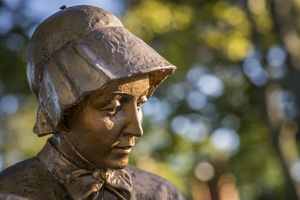
We speak often of America’s Founding Fathers. Perhaps Catholics should be bold enough to recover another phrase: Founding Mother.
Mother Seton helped build the moral and spiritual foundations of the United States at a moment when those foundations were still fragile. She did so not from a position of power, but from suffering.
After the death of her husband and the collapse of her family’s financial stability, she became a young widow responsible for her children and extended family members. In the midst of grief and uncertainty, she converted to Catholicism despite fierce anti-Catholic prejudice in American society.
That choice cost her socially and financially. Yet she embraced it anyway because she believed truth demanded it.
Her conversion reminds us that religious liberty is not merely a constitutional principle. It is also a personal act of courage.
Mother Seton understood something many modern Americans have forgotten: freedom without moral conviction eventually becomes hollow.
In 1809, at the invitation of John Carroll, she moved to Emmitsburg, Maryland, and founded the Sisters of Charity of St. Joseph’s, the first religious congregation for women established in the United States. There, she began building what would become one of the most consequential charitable and educational movements in American history.
The sisters educated girls when many believed formal education for women mattered little. They cared for widows, orphans, immigrants, and the sick when few public systems existed to help them. They confronted epidemics, urban poverty, and they served neighborhoods that others ignored. The sisters even tended to the wounded on battlefields during the American Civil War. Their mission eventually spread across the country through schools, hospitals, orphanages, and ministries that shaped generations of American life.
Mother Seton also helped answer a question that haunted the early republic: Could Catholics truly belong in America?
Many Protestants doubted it. Catholicism was often viewed as foreign, authoritarian and incompatible with democratic ideals. Mother Seton answered those suspicions not primarily through argument, but through visible holiness and service to neighbor.
She and the sisters helped demonstrate that Catholicism did not weaken the American experiment. It strengthened it through sacrifice, education, discipline, mercy, and care for the common good.
This matters today because the country is once again struggling with fragmentation and distrust. Americans increasingly inhabit separate moral universes. Institutions are weakening. Communities are thinning. Many people hunger for meaning but distrust the very traditions capable of sustaining it.
Mother Seton offers a different vision of national renewal.
She believed love of God necessarily overflowed into love of neighbor. She believed patriotism required responsibility. She believed education formed both intellect and character. She believed the poor possessed dignity. She believed suffering could become a mission. Most of all, she believed holiness was not withdrawal from the world, but transformation of it.
America at 250 does not merely need better politics. It needs deeper virtue. Elizabeth Ann Seton spent her life building exactly that, which is why she deserves to be remembered not only as America’s first native-born saint, but as one of its founding mothers.
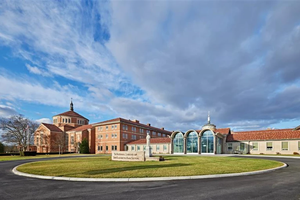
Rob Judge is the executive director of the National Shrine of Saint Elizabeth Ann Seton, which in September will host its second annual “Saints on the Way” conference, bringing together representatives from guilds dedicated to advancing the causes of Americans on the path to sainthood.
- Keywords:
- elizabeth ann seton
- catholic education