Archbishop Gänswein: ‘Time Is Ripe’ to Lift Restrictions on Traditional Latin Mass
Former secretary to Benedict XVI urges Pope Leo XIV to revisit ‘Traditionis Custodes,’ citing pastoral need, Benedict’s vision, and ‘Summorum Pontificum.’
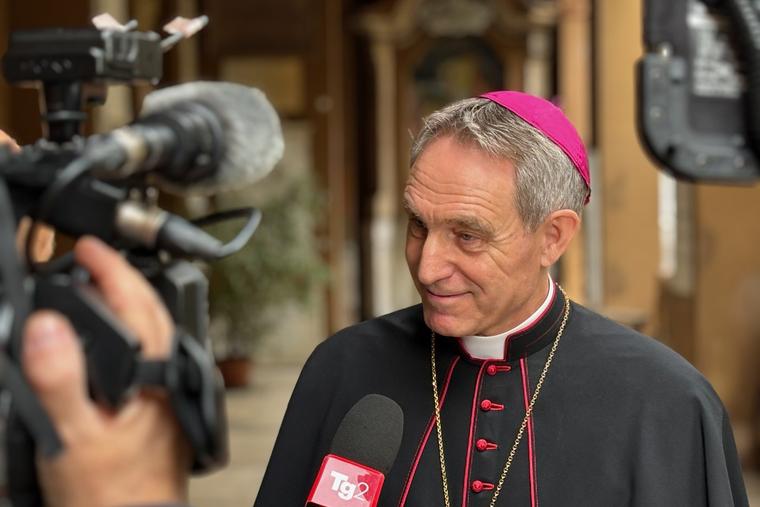
Pope Benedict XVI’s longtime personal secretary has said now may be the opportune moment for Pope Leo XIV to lift restrictions on the traditional Roman rite.
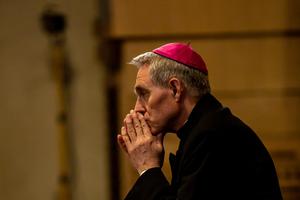
Former head of the papal household, Archbishop Georg Gänswein, told Nico Spuntoni of the Italian daily Il Giornale July 7 that he had “read with interest” the appeal of Il Giornale’s director to abolish restrictions on the pre-reformed rite that Pope Francis instituted in 2021 with his papal decree Traditionis Custodes, adding that he hoped for a “decision in this direction.”
Now serving as apostolic nuncio to the Baltic States, Archbishop Gänswein recalled witnessing Benedict XVI’s “pain in his heart” upon reading the text of his successor’s decree. “I believe this is the kairos [opportune moment]," he said, “to lift those restrictions and move beyond the setback represented by that text.”
The interview coincided with the 19th anniversary of Benedict’s 2007 motu proprio Summorum Pontificum, which liberalized the use of the pre-1970 Roman rite. Archbishop Gänswein said its aim was to “grant full rights to a rite that had never been abolished,” restore its place in the Church, and bring an end to liturgical conflict.
He emphasized that Benedict, though accustomed to criticism, remained resolute when convinced of a course of action. That same determination, he suggested, shaped the promulgation of Summorum Pontificum.
Recalling the genesis of Summorum Pontificum, Archbishop Gänswein pointed to Benedict’s personal experience of a failed 1988 agreement with Archbishop Marcel Lefebvre, founder of the Society of St. Pius X (SSPX).
As Cardinal Joseph Ratzinger, on May 8, 1988, he and Archbishop Lefebvre had signed a doctrinal statement and a canonical solution for the SSPX, which included plans for a future bishop. But the next day, convinced that the Vatican would delay fulfilling the accord and aware of his advancing age, Archbishop Lefebvre wrote to say he would not follow Rome’s timetable, and planned episcopal consecrations regardless, and then carried them out without a papal mandate on June 30 of that year, thus effectively repudiating the agreement.
“For him, having experienced firsthand the agreement that Lefebvre reneged on in 1988, the schism was a personal source of suffering,” Archbishop Gänswein explained. “[Benedict] said it would have consequences not just for a few days, but would be a wound to the unity of the Church destined to last.”
But Archbishop Gänswein added that Summorum Pontificum was as much directed toward the internal life of the Church as to reconciling the SSPX, as Benedict had witnessed “unsatisfactory aspects” in the application of Ecclesia Dei, Pope St. John Paul II’s 1988 motu proprio that aimed to heal the divisions following the consecrations. “Something therefore had to be done,” he recalled.
Benedict XVI was “very pleased” with the positive results of Summorum Pontificum, and was convinced it marked the beginning of a bridge that could eventually lead to “healing the existing rift in the liturgy.” The late pope had, “above all, great confidence in young people,” Archbishop Gänswein said, and he maintained that the vetus ordo “celebrated for many centuries could not fail to be revitalized.” He was also pleased with how the Ecclesia Dei institutes — those communities who celebrated the traditional Roman liturgy but did not wish to be part of the SSPX — were operating.
“Can we say that Summorum Pontificum has worked?” Spuntoni asked.
“Yes, it was bearing fruit,” Archbishop Gänswein replied. “It worked especially for young people, and this is seen first and foremost in the ever-increasing numbers of the Paris-Chartres pilgrimage each year.
“These young people are nourished by the beauty of the liturgy,” he continued, but added they are “by no means opposed” to the Second Vatican Council. “It is not true that those who have a traditional liturgical sensibility and attend Tridentine Masses are anti-conciliar; those who claim this are motivated solely by ideology,” he said.
In an interview last week with Corriere della Sera, Archbishop Gänswein described the SSPX’s decision to consecrate four more bishops on July 1 without a papal mandate as “horrible,” adding that “their understanding of tradition is not tradition.” But he argued that the SSPX question is not mainly one of liturgy, and therefore he said he believed Rome could be more “generous and fatherly” regarding those who, remaining in full communion with Rome, wish to celebrate the Traditional Latin Mass.
Pope Francis, he said, had “made a mistake without realizing it” by imposing Traditionis Custodes. He noted that the “majority of bishops” supported Summorum Pontificum and what it had achieved, affirming a report last year by the journalist Diane Montagna showing that the results of a survey of bishops carried out by the Dicastery for the Doctrine of the Faith contradicted the stated rationale for imposing Traditionis Custodes.
“The liturgical peace that has been damaged will be restored,” Archbishop Gänswein predicted.

Edward Pentin Edward Pentin is the Register’s Senior Contributor and EWTN News Vatican Analyst. He began reporting on the Pope and the Vatican with Vatican Radio before moving on to become the Rome correspondent for EWTN's National Catholic Register. He has also reported on the Holy See and the Catholic Church for a number of other publications including Newsweek, Newsmax, Zenit, The Catholic Herald, and The Holy Land Review, a Franciscan publication specializing in the Church and the Middle East. Edward is the author of The Next Pope: The Leading Cardinal Candidates (Sophia Institute Press, 2020) and The Rigging of a Vatican Synod? An Investigation into Alleged Manipulation at the Extraordinary Synod on the Family (Ignatius Press, 2015). Follow him on Twitter at @edwardpentin.