St. Thomas Aquinas’ Silence Spoke More Profoundly Than His Words
COMMENTARY: After producing one of the greatest bodies of theological thought in history, St. Thomas Aquinas fell silent — reminding us that even the highest human wisdom gives way before divine mystery.
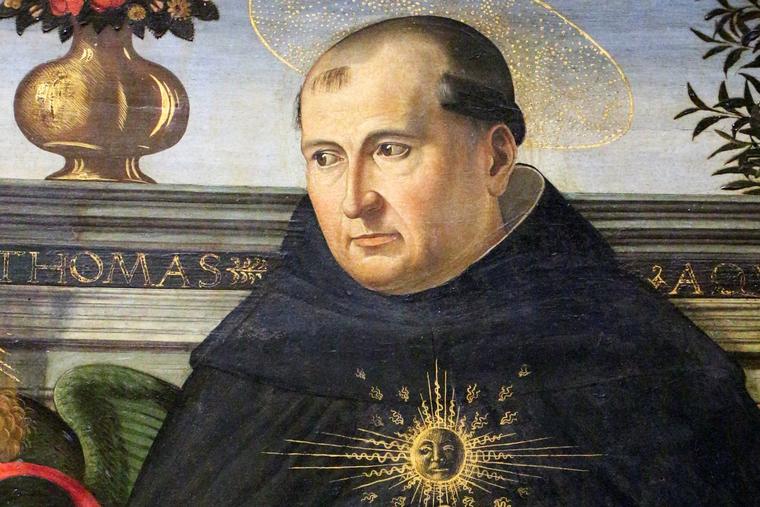
St. Thomas Aquinas, whose feast the Catholic Church celebrates Jan. 28, bequeathed to posterity as many as 10 million words across approximately 60 works. He was able to dictate his words to as many as four secretaries at the same time, and on different subjects.
To put his prolific contribution in perspective, let us imagine a gifted writer who, over the course of a long life, penned as many as 100 books, each of which contained 350 words. His total number of words would be 35,000, a mere pittance to that of Aquinas, who accomplished his extraordinary feat during the span of two decades.
It would be unjust to praise Aquinas merely for his prodigious output. The extent of his production was matched by the depth of his thought.
Philosopher Peter Kreeft regards him as the greatest of all philosophers (and many concur) specifically for eight reasons: truth, common sense, practicality, clarity, profundity, orthodoxy, medievalism and criticism of modernity. That he never deviated from these qualities can be understood only in terms of his prayerful relationship with God.
One can hardly imagine a philosophy so bizarre or unbelievable that it has not been seriously taught by some philosopher or another. Aquinas was a consistent and persistent apostle of the truth.
Nonetheless, despite his verbal prodigality, it can be said that it was in his silence that he conveyed his most profound truth. We learn from the record of his canonization process: On the feast of St. Nicholas (Dec. 6), in the year 1273, as he returned to his work after Holy Mass, he suddenly became silent. He did not write or dictate anything. He laid aside the Summa Theologiae he had been working on. His good friend, Reginald of Piperno, troubled by Aquinas’ unusual behavior, asked, “Father, how can you want to stop such a great work?”
The Angelic Doctor’s laconic response was, “I can write no more.” After a long while, Reginald put his question to Aquinas once again. “Reginald, I can write no more,” was his response. “All that I have hitherto written seems to me nothing but straw (videtur mihi ut palea).”
After a long time, Aquinas gave added meaning to his earlier response: “All that I have written seems to me nothing but straw ... compared to what I have seen and what has been revealed to me.” For the most expressive of minds, Aquinas had experienced what is inexpressible. Among all human beings, the most gifted of us can do no better than knock on the door. God exceeds human capacities to comprehend him. Our highest knowledge is radically incomplete. We continue to search, but whatever we find becomes the occasion for further searching. Our ultimate answers await us in the next world. Aquinas’ silence is assuring us of that fact.
In his book The Silence of St. Thomas, Josef Pieper makes the following interpretation of Aquinas’ sudden and mysterious silence: “He is silent, not because he has nothing further to say; he is silent because he has been allowed a glimpse into the inexpressible depths of that mystery which is not reached by any human thought or speech.” We should not be frustrated when we cannot find answers to our burning questions. The answers to the deepest mysteries will be found, but not in this world. We are encouraged by the words of St. Paul: “Eye has not seen, nor ear heard, nor have entered the heart of man the things which God has prepared for those who love him” (1 Corinthians 2:9).
It may be misleading to refer to the contribution of St. Thomas Aquinas as “Thomism.” Because Aquinas was unreservedly interested in truth, he placed his thought in that perennial stream of traditional truth that continues to be enlarged and is therefore timeless. He leaves room open for further elucidations of the truth. Aquinas himself refrained from giving knowledge a specific name. The “ism” in Thomism can be misleading.
The contribution of St. Thomas Aquinas has been duly recognized and praised by a number of popes. Aeterni Patris of Pope Leo XIII (1879) states that “Among the Scholastic doctors, the chief and master of all towers Thomas Aquinas, who, as Cajetan observes because ‘he most venerated the ancient doctors of the Church, in a certain way seems to have inherited the intellect of all’ …he is rightly and deservedly esteemed the special bulwark and glory of the Catholic faith.”
In Doctoris Angelici (1914), Pope Pius X states that “St. Thomas perfected and augmented still further by the almost angelic quality of his intellect all this superb harmony of wisdom which he inherited from his predecessors and applied it to prepare, illustrate and protect sacred doctrine in the minds of men.”
In Studiorum Ducem (1923), Pope Pius XI states that “Thomas possessed all the moral virtues to a very high degree and so closely bound together that, as he himself insists should be the case, they formed one whole in charity ‘which informs the acts of all the virtues.’”
In Humani Generis (1950), Pope Pius XII states that “the method of Aquinas is singularly preeminent both for teaching students and for bringing truth to light; his doctrine is in harmony with divine revelation, and is most effective both for safeguarding the foundation of the faith, and for reaping, safely and usefully, the fruits of sound progress.”
Aquinas’ philosophical and theological contributions to posterity are unequaled. They are, at the same time, a great gift from a providential God.
- Keywords:
- st. thomas aquinas