‘O Sacred Banquet’: A New Book Inspired by St. Thomas Aquinas’ Eucharistic Prayer
'O sacred banquet in which Christ becomes our food, the memory of his Passion is celebrated, the soul is filled with grace, and the pledge of future glory is given to us!' reads the prayer, which Dominican Father Patrick Mary Briscoe has prayed daily for years.
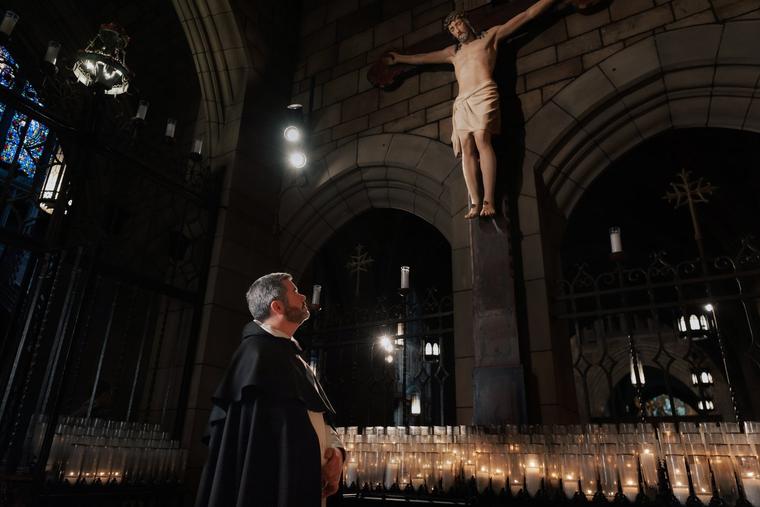
Before St. Thomas Aquinas set quill to parchment to write the Summa Theologiae — one of the most influential works of theology and philosophy ever composed — he wrote a prayer to the Eucharist that the Church still prays today: O Sacred Banquet (O Sacrum Convivium).
In his new book, O Sacred Banquet: Exploring the Eucharistic Mystery with Saint Thomas Aquinas (Our Sunday Visitor, 2026) Dominican Father Patrick Mary Briscoe, who serves as general promoter of social communication for the Dominican Order, relates that Aquinas wrote this prayer, in part, because he was at the right place and the right time.
In 1263, Aquinas was an instructor of theology for Dominican friars in the town of Orvieto, Italy, when a Eucharistic miracle took place. Tradition tells us, Father Briscoe writes, that a German priest, Peter of Prague, who was experiencing doubts about the doctrine of transubstantiation — the belief that the bread and wine truly become the Body and Blood of Christ during Mass — went to Rome on pilgrimage in the hope of strengthening his faith.
While celebrating Mass along the way, in the town of Bolsena, Father Peter saw all of his doubts removed in an instant when the consecrated Host began to bleed. Pope Urban IV, who was living in Orvieto at the time (during a period of political and civil and political unrest) called for an investigation into the alleged miracle. The miracle was found to have been credible, and the sacred relic was enshrined in the Orvieto’s cathedral, where it remains today.
Pope Urban IV subsequently established a feast of Corpus Christi, commissioning Aquinas, who he had consulted on matters of theology, to write new liturgical texts for the Mass and an Office honoring the Eucharist, which Father Briscoe writes, are “without a doubt Thomas’s finest literary works.”
“O sacred banquet in which Christ becomes our food, the memory of his Passion is celebrated, the soul is filled with grace, and the pledge of future glory is given to us!” reads the prayer, which Father Briscoe writes he has prayed daily for years.
The Register interviewed Father Briscoe about his new book, what we can learn from St. Thomas’ prayer, and the fruits that we can expect from a renewed reverence for the Eucharist.
Is this book intended both for those who already have a strong devotion to the Eucharist and for those who may be new to it? What can readers expect to learn from it?
Since the outset of the U.S. bishops’ Eucharistic Revival, I have been privileged to serve as a “Eucharistic Preacher.” I have traveled the country, visiting rural parishes and urban cathedrals, delivering lectures, keynotes, homilies and retreats. Everyone had something to say, and everyone had something to learn. In large part, this book was shaped by that experience. It is informed by all the conversations and prayer shared with priests and parishioners, religious and bishops throughout this remarkable period.
We have just celebrated the Solemnity of Corpus Christi, one of the occasions when non-Catholics are most likely to see belief in the Eucharist expressed publicly. In what ways is this feast as important today as it was in the time of St. Thomas Aquinas?
The questions that concern the Eucharist are perennial questions. They drive to the fundamental considerations of what it means to be a believer. The Eucharist is not about an isolated sacramental ritual. To celebrate and honor the Eucharist means to ask: Do I believe God’s word? Do I believe he is near? Do I want to be with him?
In your book, you mention that you have prayed the O Sacrum Convivium daily for years. What inspired you to incorporate this prayer into your daily routine, and how has it shaped your spiritual life?
This prayer is often prayed by Dominican friars and sisters before we begin the Divine Office. The Rosary is the chief devotional practice entrusted to and shared by the brothers and sisters of the order. After the Rosary, I think the second most important is this prayer. It was written by St. Thomas as part of the texts prayed during the feast of Corpus Christi. For me, it is the prayer for praying, the prayer that opens and begins my conversations with God. It declares and claims his nearness, since we pray it in the presence of the Blessed Sacrament; and since we typically pray it on our knees, it reminds me of who I am before him.
What did Aquinas mean when he described the Eucharist as a banquet?
St. Thomas’ rich Eucharistic theology understands the Eucharist as communion; and for him this means that fellowship and friendship are constitutive of the sacrament. The Eucharist is the sacrament of unity precisely because it draws together and unites the members of the Church. Banquets are festive and celebratory; for this reason, thinking of the Eucharist, which is the “food of the angels,” as a banquet allows us to more deeply understand how the Eucharist orients and animates eternal realities in our lives. We are moving toward the horizon of heaven, and the Eucharist is the food for this journey. In the Gospels, Jesus teaches us in his parables to understand the Kingdom as a Wedding Banquet, a great celebration of joy and plenty. In the Eucharist, we begin, even now, to taste those eternal delights.
In your book, you write that Aquinas loved the Eucharist “as much as anyone could on this side of eternity.” How did he express that love throughout his life and ministry?
One day, reports a certain sacristan of the priory in Naples, Brother Dominic of Caserta, St. Thomas Aquinas was caught up in rapturous prayer in the priory chapel. He was weeping before a crucifix. Brother Dominic, who remained hidden, witnessed the crucifix speak to the saint, crying out, “You have written well of me, Thomas. What reward will you receive from me for your labor?” Imagine the sacristan’s further surprise at St. Thomas’ beautiful answer: “Nothing, Lord, except you.” The whole of his academic life, the whole of his religious life was for God and for God alone. It was, in other words, a Eucharistic life.
Have you noticed signs of a renewed devotion to the Eucharist in the Church since the Eucharistic Revival began? If so, what stands out to you?
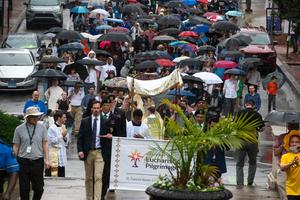
Undoubtedly. For me, the greatest surprise has been the enthusiasm for processions. I had some hesitation about these public displays of faith. Like most, my concerns were largely around security. And yet, the processions are obviously the most important part of the Revival. Our people are longing to see the Church alive and present, engaging the world but offering a way to the transcendent. Repeatedly, I witnessed Catholics weeping, celebrating, singing, kneeling, bowing and cheering with joy and fervor before the Eucharistic Lord. It wasn’t manufactured. We’re not nearly organized or well-resourced enough for that. It could only have been his grace.
What advice would you give to Catholics who want to approach the Eucharist with greater reverence and intentionality?
The key is to be in his presence. One obstacle I frequently encounter is that people are afraid that they are going to pray incorrectly or wrongly. Adoration isn’t choreographed or coded. Just go to be near him. Start with a quick visit: five minutes. But do it a few times a week. Speak with him, not only to him or at him. And let him speak to you.
In your book, you describe the Eucharist as the Church’s supreme act of remembrance. You write at length about the importance of memory. Why is remembering Christ’s death and sacrifice so central to the Christian faith?
In the age of institutional failure, it’s easy to think of the Church as one other institution. But she is not. She is not a human structure or convention. She was born on the cross from the very side of Christ. This is everything.
- Keywords:
- real presence
- adoration
- eucharistic
- st. thomas aquinas