Dominican Father Gregory Pine Addresses Theology of Speech and ‘Training the Tongue’
New book is practical guide — grounded in thought of St. Thomas Aquinas — that invites readers to reflect on how their words shape their interior lives.
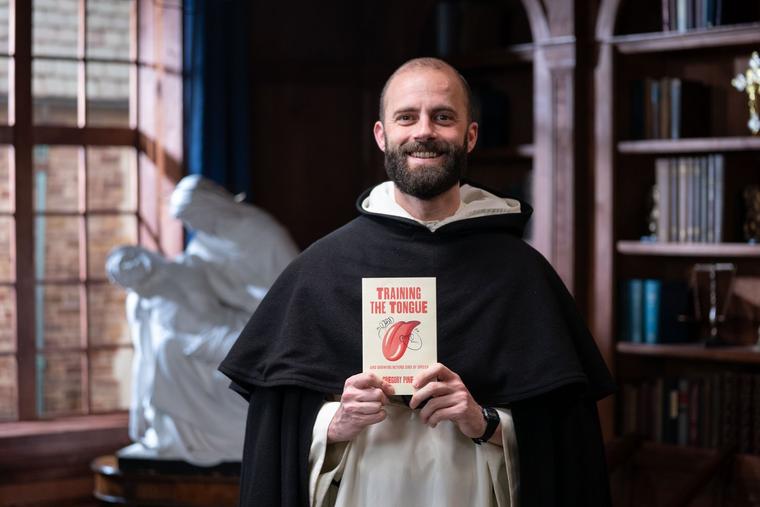
In his new book, Training the Tongue and Growing Beyond Sins of Speech (Emmaus Road), Dominican Father Gregory Pine freely admits that ever since he can remember he has struggled to achieve “purity of speech.”
With disarming candor, Father Pine recounts his own past verbal missteps: a white lie he told to avoid blame, a wounding remark he made out of a desire to seem clever, the time he talked disparagingly about a friend, his overzealous correction of others, and the “rough-and-tumble” banter he was slow to realize might be offensive to those outside the East Coast suburb where he grew up.
Knowing that the author, a professor of dogmatic and moral theology at the Dominican House of Studies in Washington, D.C., has stumbled in these ways makes it easier for readers to take stock of their own sins of speech. Yet Training the Tongue isn’t simply a jeremiad against “bad talk.” Rather, it is practical guide — grounded in the theology of St. Thomas Aquinas — that invites readers to reflect on how their words shape their interior lives.
“The facility we’re seeking is not so much a technical skill as it is a character strength,” Father Pine writes. “If we are to train our tongues, we will have to grow in virtues — virtues like truthfulness, friendliness, generosity, and forthrightness.”
What is ultimately at stake, Father Pine explains, is nothing less than our ability to cooperate with God’s plan for us — to live in communion with him and with each other.
“The tongue … is the most refined of bodily instruments through which we cultivate communion with each other,” Father Pine writes.
The Register interviewed Father Pine by email Feb. 9 about his new book.
Training the Tongue isn’t simply about avoiding “sins of speech”; it could be read as a guide to living a virtuous Christian life. Why is the way we speak to others so central to moral and spiritual formation?
In effect, our speech concretizes our thoughts and affections, but it also does a lot to form them. We testify to what we are experiencing, but the way we speak also informs the way that we process our experiences. It’s something of a feedback loop.
You discuss how “bad talk,” such as gossip, lying, disparagement, and simply withdrawing from conversation, stems from a rejection of communion with others. Can you expand on how, as you write, these tendencies stem from our own wounds? And what can we do to reverse them?
At some level, many of us are worried that we are either too much or too little or both. Without ever deciding to, we treat out interactions as if they were competitive or comparative. When we feel like we are missing out, losing out, or otherwise suffering by comparison, we often feel prompted to even the score. We fall into many of these sins because we’ve been hurt and want to hurt back or because we feel like we’ve been left out in the cold and want to gather around the hearth with the “cool kids.”
Do you think people today are less concerned about the moral implications of their speech than they were in the past? If so, what cultural forces do you think have contributed to that shift?
I’m not sure that things are better or worse than they’ve been. As Foucault writes, there are neither good times nor bad times, just perilous times. If these times are especially perilous, it probably has something to do with our means of communication. We can know everything about everything and weigh in with reckless abandon. We feel like we have to have an opinion and take a stand on so many things. A lot of this is totally untenable. We’d probably do best to lapse into silence.
In the book, you offer specific practical tips for making conversation with others. If we’ve lost the knack for making friends, can changing the way we speak — and listen — help restore it?
I certainly hope so. I think that learning to listen well is a lost art that needs to be recovered. We need to learn anew how to take an interest.
Social media often mocks inauthentic or formulaic speech — what’s sometimes called “corporate speak”— and prizes bluntness and humor instead. How do we strike a balance between speech that might be too superficial and “straight talk” that has the potential to alienate others?
Our world oscillates between transparency and discretion. Neither are virtues in their own right, but they feature into virtuous life. I think a lot of moderating our speech comes down to knowing what the circumstances call for. The general trajectory should be towards a richer sharing with a certain set of people with whom we share our lives and towards a certain freedom and facility with everyone else. We should, ultimately, enjoy conversation to the extent that — temperamentally — we are capable of doing so.
Many young people today came of age in Zoom meetings and online communication. What particular challenges does that pose for forming habits of good speech and meaningful conversation?
A lot of conversation is contextual. It comes down to little things like posture, body language, micro-expressions, et cetera. These things are super difficult to communicate and pick up via technological means. I fear that all of us are losing something of our emotional intelligence, for this reason. It’s no surprise that we feel the need to “touch grass.” I think we need help getting out of our heads and back into our bodies. Conversation is an event, a kind of happening. We need to relearn how to relish this encounter.
What is the most frequently committed sin of speech you hear in the confessional?
Lying and gossip.
You conclude the book with a chapter on prayer, which you call “the highest expression of speech.” In what sense is prayer a conversation, and what advice would you give our readers who may struggle with that concept?
In conversation, you are effectively sharing your life to the extent that your able. You are effectively performing the communion that is available to you and your interlocutor. Something similar is going on in prayer. We are effectively referring our life to God and waiting on his word. It needn’t be over-formulaic, but it ought to be present. Prayer is a place in which we learn to be curious about our experience and honest with our findings in the presence of One who welcomes us in a vulnerable state. It gives us courage to live.