Meet St. Peter Julian Eymard, Apostle of the Eucharist
SAINTS & ART: His deep devotion to the Blessed Sacrament led to the founding of a new congregation — and a revival of Eucharistic adoration around the world.
In most places, Aug. 2 is the optional memorial of St. Eusebius of Vercelli, a fourth-century bishop who took part in the fight against Arianism. But it is also the optional memorial of St. Peter Julian Eymard, the “Apostle of the Eucharist.” Having concluded a three-year-long Eucharistic renewal in the United States in 2024, perhaps we should better make Eymard’s acquaintance.
Eymard was born in 1811 in the French Alps. In 1828, he sought to enter the Oblates of Mary Immaculate, a new order that had emerged in France a little over a decade earlier. His own health and his mother’s death ended those plans, and in 1831, he became a diocesan seminarian for Grenoble, the diocese for which he was ordained in 1834. He served as a diocesan priest until 1839, when he entered the novitiate for the Society of Mary (Marists). He would remain a Marist, exercising various responsible offices in the congregation, until 1856.
During this period, Eymard became acquainted with the practice of nocturnal adoration. Nocturnal adoration is a Eucharistic devotion whereby the Blessed Sacrament is exposed on the altar throughout the night for adoration (usually rotational) by the faithful, concluding in the morning with Benediction of the Blessed Sacrament. It was intended — as its name suggests — to adore Jesus in the Eucharist while also making reparation for neglect of and offenses against the Blessed Sacrament.
These were years during which Eymard’s Eucharistic spirituality began to mature and, in 1856, he received permission to leave the Marists to join the religious congregation he had just founded in Paris, the Blessed Sacrament Fathers (Congregation of the Most Blessed Sacrament, S.S.S). By 1858, a female branch had been created, the Servants of the Blessed Sacrament.
The new congregation promoted adoration of the Blessed Sacrament, especially Nocturnal Adoration, and prepared adults whose childhood religious formation had been neglected to receive their first Holy Communion.
By 1863, the first group of religious in the community had made canonical vows. The community also inaugurated perpetual adoration of the Blessed Sacrament. In 1865, Eymard was elected superior general for life of the new congregation. Life meant three years: He died Aug. 1, 1868. As the day was already the obligatory memorial of St. Alphonsus Liguori, his optional feast is observed the next day.
Eymard was beatified in 1925 and canonized in 1962. Their U.S. province is headquartered near Cleveland.
The Blessed Sacrament Fathers were proponents of Nocturnal Adoration in the United States, which in many places took the form of exposition in a central church to which neighboring parishes came on a rotational basis throughout the night to keep adoration, usually scheduled on the First Friday to First Saturday of the month, to align with promises connected to both those days. Once popular, especially in densely populated Catholic areas of the Northeast and Midwest, these devotions were somewhat lost in the 1970s-80s. Starting in the 1990s, however, many parishes came to restore parish Eucharistic days and nocturnal adoration. For those wanting prayers and the Office of the Blessed Sacrament for use during nocturnal adoration, click here.
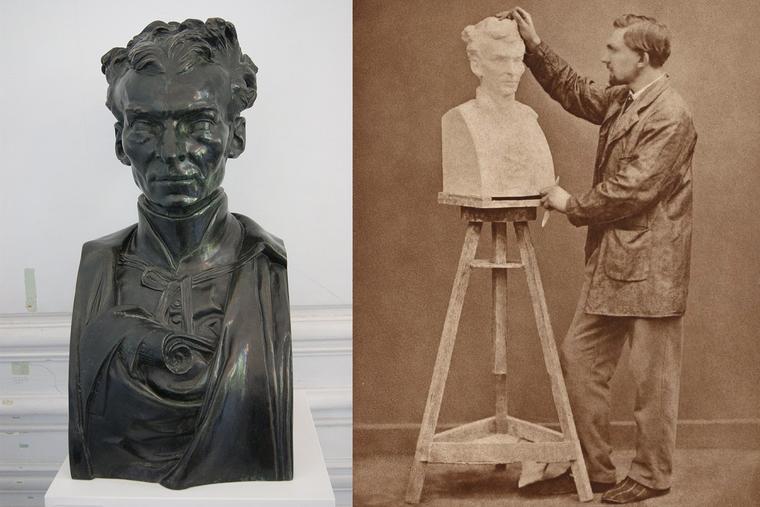
Most saints whose depictions in art we discuss involve painting. St. Peter Julian Eymard was memorialized artistically by the 19th- and 20th-century French modern sculptor, Auguste Rodin. Modeled in 1863, when Rodin entered a monastery for several months following the death of his sister, it was later cast in 1925. The distraught Rodin was considering giving up his career; Eymard supposedly encouraged him to persevere in his field. A second sculpture, only of Eymard’s head, was similarly modeled and cast on that same schedule. They can be seen in the online collection of Philadelphia’s Rodin Museum. A photo of Rodin working on the bust, from Paris’ Rodin Museum, can be seen above.
- Keywords:
- st. peter julian eymard
- saints & art