St. Monica and the Spiritual Roots of an Augustinian Pope
SAINTS AND ART: The quiet perseverance of St. Monica and the conversion of her son, St. Augustine, offer a clear window into the spiritual tradition shaping Leo XIV.
Invoking St. Monica to pray for us can seem almost redundant, since most Catholics already associate the mother of St. Augustine with her tireless prayers for her son’s (and her husband’s) conversions. As the Church becomes acquainted with its Augustinian pope, it is fitting to learn more about the spirituality of his order, a spirituality shaped in no small part by the quiet perseverance of St. Monica and the dramatic conversion of her son.
St. Monica was born in Tagaste, in what is now modern Algeria, sometime around A.D. 331 and was raised in a Christian family. (By that time, Christianity had been legalized in the Western Roman Empire and the Council of Nicaea had already met.) She married Patricius, a pagan official, praying constantly for him because, apart from being a pagan, he also had a temper and was probably unfaithful.
Augustine was their oldest boy (of three children) and he was far more interested in contemporary intellectual pursuits than religion. It is clear that Monica stormed heaven for the conversion of both her husband and son. Take note, especially modern parents concerned about their children’s spiritual futures: a mother’s prayers are seldom ignored. If the persistent widow extracts a just judgment from the unjust judge, what will a loving mother obtain from a generous Father?
Monica never abandoned her husband or son, even though she was later a widow. Augustine frequently involved her in his own philosophical discussions and it’s also said that Monica was good to Augustine’s concubine and illegitimate son. Augustine himself attributed the seeds of faith that germinated in his adulthood to those sown by his mother in childhood.
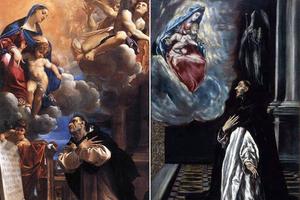
Tradition has it that St. Monica was weeping over the fate of her son when she received the vision of an angel who, after he inquired why she was crying and was told of her concerns for her boy, assured her that Augustine one day would stand on the same “rule” (way of life) as hers. That moment is depicted in a painting by Maggi from the early 18th century.
Monica’s prayers finally bore fruit when, in April 387, Augustine was baptized by St. Ambrose of Milan, with St. Monica in attendance. She would die six months later, in Ostia, a port near Rome, as she and Augustine were preparing to return to North Africa. Her final words of instruction concerned what to do with her mortal remains: “Lay this body anywhere. Let not the care of it trouble you at all. This only I ask of you: that you remember me at the altar of the Lord, wherever you may be.”
Those words, recorded by St. Augustine in his Confessions, are part of the Catholic tradition that recognizes the importance of prayer — and especially the offering of Holy Mass — as suffrages for the souls of deceased persons. St. Monica was originally buried in Ostia; later, her remains were translated to Rome as her cult developed in the 15th century. Monica’s death is depicted in art by Gozzoli in the mid-15th century, here.
The life of St. Monica was depicted in a cycle of works by Gozzoli’s contemporary, mid-15th-century artist Antonio Vivarini. Examples are here and here.
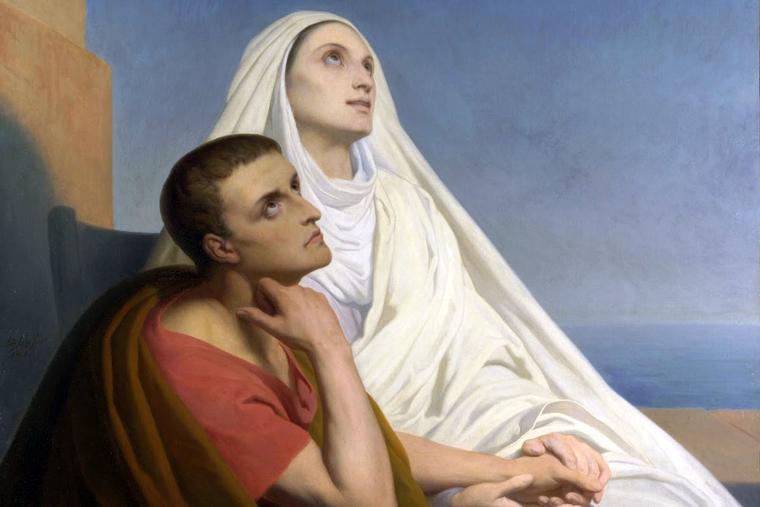
I chose “St. Augustine and St. Monica” by 19th-century Dutch artist Ary Scheffer to illustrate our saint because the painting underscores the close bond between mother and son, so evident in Augustine’s own great work, The Confessions. Regardless of her worries and even disappointments, Monica never abandoned her son, being with him in the most important and profound way possible: prayer.
The painting depicts the two, side by side, holding hands. Their eyes, however, are focused on something (or Someone) greater: they are turned heavenward. A light illumines them: Monica facing an open horizon, Augustine in a sense emerging from darkness on the left. Augustine assumes a classic Roman pose, appropriate to his education and rhetorical training. Monica, who is usually in widow’s black, is here in white robes. (There are those who believe that Monica was a Berber, among the people of North Africa — would this have been typical clothing?)
Of course, Monica’s life was a lot more innocent than her son’s. Both exude a calm peacefulness, almost the visual expression of Augustine’s observation that a man’s heart is restless until it rests in God. Shall we assume this scene is post-baptismal?
The oil painting itself is relatively large: 4.5 feet high by 3.5 feet wide. It is in London’s National Gallery.
- Keywords:
- saints & art
- st. monica
- st. augustine
- 'pope leo xiv'