What the Sacred Heart Reveals About Divine Mercy
The Sacred Heart shows that God’s mercy flows from love — a love that is wounded and radiant.
The Church marks the Solemnity of the Sacred Heart of Jesus on the third Friday after Pentecost (or, in the United States, the Friday after Corpus Christi).
Devotion to the Sacred Heart of Jesus became prominent in the Catholic Church thanks to St. Margaret Mary Alacoque (1647-1690). She had mystical visions throughout her life and, from about age 9-13, was bedridden because of rheumatic fever. She vowed to enter religious life and was cured, but later, when her family’s fortunes improved upon the transfer of its financial administration from her uncle to her brother, she began to think of marriage.
Going to a ball, she returned to a vision of Christ scourged, reminding her of his love for her. This incident parallels the experience of St. Faustyna Kowalska who, at a dance, saw the suffering Christ asking her, “Why do you put me off?” Both left those parties and began looking for a religious community. Alacoque joined the Visitation Sisters in 1671, aged 24.
From 1673-75, she experienced a series of visions from Our Lord, focused on the meaning and devotion to the Sacred Heart. As I wrote elsewhere, devotion to the Sacred Heart centers on Christ’s all-consuming love for mankind, his passionate love for humanity. But devotion to the Sacred Heart also focused on the unrequited nature of that love, how often man’s response to the divine love is mere indifference. But Jesus is not just any person; his love is divine as well as human, and cannot be passed by neutrally. That is why a strong element of reparation — of efforts to “make up” for the spiritual indifference of others is present in devotion to the Sacred Heart.
In addition to the theology of devotion to the Sacred Heart, St. Margaret Mary’s visions included a number of devotions, including the idea of a “holy hour” (she spoke of 11 p.m. to midnight on Thursday before first Friday) to join with Jesus in his agony in the Garden of Gethsemane, and of the “nine First Fridays.” Our Lord asked Catholics to receive Communion on nine consecutive First Fridays of the month, in honor of the Sacred Heart and Christ’s Passion. In turn, he promised that those who did so would receive the grace of “final repentance,” i.e., of dying repentant of their sins and in God’s grace, receiving the sacraments. Indeed, Our Lord conveyed 12 “Promises” to St. Margaret Mary, connected with the Sacred Heart and our salvation. They appear here.
St. Margaret Mary’s revelations were studied and later promoted by her spiritual director, St. Claude de la Colombière, a Jesuit. The Society of Jesus has traditionally been a strong promoter of devotion to the Sacred Heart of Jesus; our late Jesuit Pope’s final encyclical, Dilexit nos, focuses on “the human and divine love of the Heart of Jesus Christ.”
Just as there have been calls for recovering the centrality of Sunday (clearly demanded by divine commandment), so there have been efforts in recent years among Catholics to restore a distinctive spirituality to Fridays. Fridays have traditionally been associated in Catholic and Orthodox circles with Christ’s Passion. Devotion to the Sacred Heart of Jesus, particularly with its focus on First Fridays of the month, has complemented that attention to Christ’s Passion with an awareness of the unbounded love — symbolized by the Sacred Heart — which fueled Our Lord’s willingness to undertake that Passion “for us and for our salvation.” Indeed, Our Lord asked Sister Margaret Mary for a feast of the Sacred Heart on this Friday, specifically designating it as the octave day of Corpus Christi (when the Solemnity of the Body and Blood of Christ is observed on its traditional day — the Thursday after Trinity Sunday — and not transferred, as in the United States, to the next Sunday).
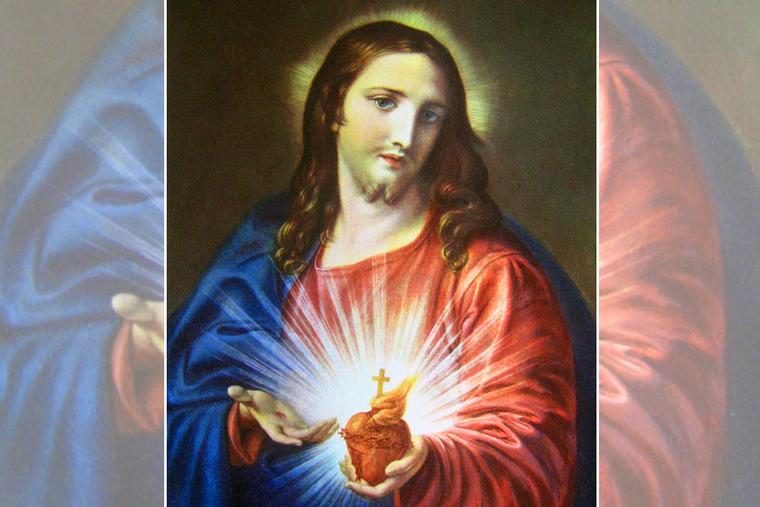
The 18th-century “Italian” artist Pompeo Batoni painted the depiction of the Sacred Heart we see in this article. The original painting is in the Jesuit Church (the Gesù) in Rome. Batoni specialized in portraits and, indeed, there is something of a portrait-like depiction to this painting.
The iconography of the painting reflects all the standard elements of depiction of the Sacred Heart. Jesus is traditionally shown as offering his Sacred Heart to the viewer. Normally, the eyes of Christ are entreating and one hand is revealing his Heart, either by parting his robes or, as here, pointing to it. Jesus’ Heart is usually depicted in his chest or, as we see here, his Heart in his hand, offering himself to us. Such depictions reflect the theology of the Sacred Heart, which is the theology of love: love can only be offered, not imposed, but it demands a response. That can be a response of love, indifference, or even hate: freedom allows all three, but even freedom does not make all three of equal moral value. After all, the love demanding a response is divine.
Most depictions of the Sacred Heart are marked by three elements, intrinsic to the love that Heart expresses: a cross, a crown of thorns, and a living flame of love. The Heart will also normally be radiating light around itself to showcase its centrality. At least some part of Christ’s robe will be red, the color of blood, often contrasted with a green or blue robe. His hands will usually bear the nail marks and his halo often has a cross-shape. Most Sacred Heart depictions are on a dark background to highlight Jesus’ centrality and, especially, the core of his radiating Heart.
Divine Mercy images, based on the 20th-century private revelations to Sister Faustyna Kowalska, focus on the centrality of Jesus’ Heart as the source of mercy, but do not depict it. Sister Faustyna speaks of Christ parting his Robe to reveal two streams of light — red and white — blood and water, “the fountain of sacramental life in the Church” (as the Preface at today’s Mass will remind us) that flowed from Christ’s Pierced Heart (John 19:34-37) on Calvary. The Divine Mercy image is also usually on a dark background: Christ’s unique centrality is highlighted.
Among Our Lord’s Sacred Heart promises was an assurance of blessing to all places where the image of the Sacred Heart is exposed and honored. Again, like the Brown Scapular, the image of the Sacred Heart is not a magic talisman: It is intended to be a constant reminder of Jesus’ love for us. Not that long ago, it was a tradition for such an image to be hung in a Catholic’s home. Why not renew that practice in your home today?
- Keywords:
- Sacred Heart of Jesus
- Divine Mercy