When the Nazis Came, These 11 Nuns Chose Love Over Fear
SAINTS & ART: In 1943, the Sisters of Nowogródek offered their lives in place of 120 men.
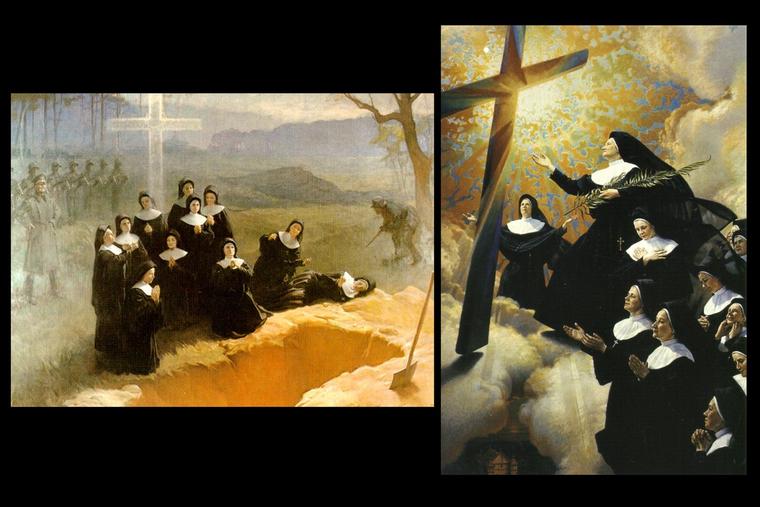
Eleven nuns were shot by the Germans in a pine forest early in the morning of Aug. 1, 1943.
Many religious were killed by the Nazis. What was so special about these nuns? Their story.
Navahradak today is a town in Belarus about 70 miles east of the Polish border. Between the world wars, it was Nowogródek, a town in Poland. The 1939 Molotov-Ribbentrop-Molotov Pact between Germany and its Soviet ally brought the Red Army to Nowogródek and the area annexed to the USSR. When Hitler turned on his erstwhile ally, the Nazis came. They remained until 1944, when the Soviets returned. When Belarus gained independence in 1991, its borders followed what they had been in the Soviet Union.
The Congregation of Sisters of the Holy Family of Nazareth had a house in Nowogródek between the wars. They prayed and also taught the local girls various skills and subjects. There were tensions, as it was a mixed area where ethnicity followed religion — Poles mostly Catholic, Belarusians mostly Orthodox — but the sisters were accepted. Then came the occupiers.
The Soviet arrival brought secularization and de-Polonization campaigns, e.g., the sisters were not to wear habits or live communally in their convent. After two years, the Germans replaced the Russians. The sisters may have been allowed to resume their habits and go back to their convent, but it does not mean the Nazis welcomed them.
Places like Nowogródek were ethnically cleansed. The Jewish population was murdered. Catholic clergy were targeted. Locals were often seized and sent to forced labor in Germany for the Nazi war effort. The last may very well have been the spiritual catalyst for the martyrdom.
In mid-July 1943, the Germans arrested 120 men, probably for forced labor. The women of the town came to the nuns, begging them for prayers that their men be returned to them. The sisters agreed, praying for God to release the men and, if necessary, to take them instead. They did not have to wait long for their prayer to be answered.
On Saturday, July 31, 1943, the Germans came to the convent in the afternoon and took 11 nuns to the local Gestapo headquarters for interrogation. One sister, who was away, returned later that day to an empty convent. She was hidden and spent the rest of her life living at the local church.
The nuns were questioned by the Germans the whole night. Toward morning, they were bundled into a truck and taken outside the town to a coniferous forest where a large grave had already been dug. The sisters were then shot, each falling into the grave atop the others. They would remain buried there until the Germans were driven out. In 1945, their remains were exhumed and brought by sleigh for burial outside the white church (fara) in Nowogródek, the church they served. Later, they were again exhumed and buried inside the church, where they remain today.
One priest who was on the Gestapo’s arrest list, Father Alexander Zienkiewicz, was also saved that night. The next morning, after the sisters were killed, he was in the confessional before Sunday Mass when an anonymous “penitent” warned him of what was happening. He escaped and would eventually end his days in Wrocław (western Poland), where he was a beloved chaplain for many decades to young people. He died in 1995 and his cause for beatification is underway.
I visited Nowogródek in 2003 and learned the sisters’ story. I was particularly struck by the story of one of the sisters: Sister Kanuta (Józefa Chrobot). Józefa did not plan on a religious vocation. She expected to be married and even had a fiancé. But she had a mystical experience in which she felt God calling her, telling her, “Do not marry Stanisław! Your beloved is waiting for you in Grodno, and he will give you a red dress for a wedding present.”
Grodno (Belarusian Hrodna) is the largest town near Nowogródek with which Józefa had few connections. And a red dress was a strange wedding gift. But she obeyed, entering the convent. And while she might not have found a human fiancé in Nowogródek, the 47-year-old found the Bridegroom who did give her a red dress for the nuptial feast of the Lamb. When the sisters were exhumed, it was found that the bodies had fallen into the grave in such a way that Sister Józefa’s habit was wholly stained by their blood.
Pope St. John Paul II beatified the sisters in 2000. Their cause is known in Poland, less so in the West (although the Sisters of the Holy Family of Nazareth have promoted it), in part because Belarus is largely cut off from the West.
Adam Styka (1890-1959) painted their martyrdom. Styka was a Polish painter classically trained in France who was renowned for his Orientalist paintings as well as paintings of the American West. His religious paintings are found in churches around Europe and the United States. He is buried at the National Shrine of Our Lady of Częstochowa, the major Polish-American shrine, in Doylestown, Pennsylvania.
Styka captured the moment of the nuns’ deaths in this painting, which is typically used to illustrate their martyrdom. The sisters are gathered in prayer (like the Carmelite martyrs at Compiègne). The sister on the far right has already been shot and lies on the ground. The sister next to her has just been shot and is falling atop her. The others await their turn. The sisters stand out clearly; the Germans fade into the background, their commander (hands on hips) off to the left, his platoon behind him, another killer on the right.
The misty fade of the picture is also probably historically accurate: the sisters were murdered just after dawn, when the forest would have been wet with dewfall. A mystical white cross appears next to the sisters. From what I remember, the trees were thicker, and one of them had been the marker for the site of the grave. Today, a cross stands at the site.
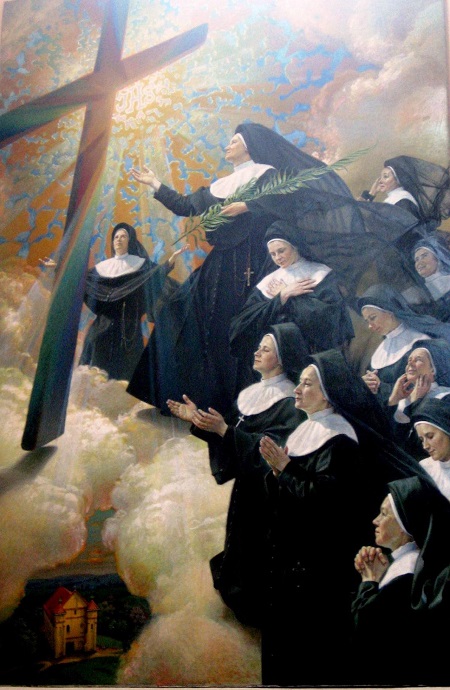
A second painting, painter unknown, depicts the moment after: their entry into heaven. The 11 sisters are in the clouds, reaching out for the cross. Presumably, their superior bears a palm branch — the sign of victory — on their behalf. Light opens into the wedding feast awaiting them; a break in the clouds on the left reveals the Nowogródek church (fara) where their holiness was shaped for that entry into beatitude.
Although the sisters died Aug. 1, that time period is already crowded with various saints (Aug. 1 is the obligatory memorial of St. Alphonsus Ligouri). The martyr nuns are observed on Sept. 4 in various Polish diocesan liturgical calendars (usually as “Sister Maria Stella [the superior] and Companions,” though the name of a particular blessed is also added to the formulary if she came from that diocese).
For us, their story is more than history: it is a reminder that even in times of cruelty, the Bridegroom still clothes his faithful brides in the red garment of love.”
- Keywords:
- saints & art