The Immaculate Heart of Mary Treasures the Mysteries of Christ
SAINTS & ART: The Church honors the Immaculate Heart as a vessel of deep spiritual insight into the life of Christ.

Modern Mariology tends to emphasize Our Lady as the model disciple. That’s not a wholly novel thing, inasmuch as she described herself as “handmaid of the Lord,” something Catholics have long affirmed in the Angelus prayer. But it is a change of focus from Mary’s unique status to Mary as a model for us.
That’s why it’s no coincidence that the Solemnity of the Most Sacred Heart of Jesus is immediately followed by the optional memorial of the Immaculate Heart of Mary. We’ve already seen earlier in June another such linkage between God’s action and Our Lady’s participation in salvation history: the Solemnity of Pentecost, often called the “birthday of the Church,” is now followed by the Solemnity of Mary, Mother of the Church.
The Bible speaks in three places of Mary’s heart — an important counterpoint to Protestants who insist on looking for Biblical warrants for everything and who still sometimes harbor a certain animosity toward Catholic devotion to Our Lady. Two are direct, one less so. Twice (Luke 2:19 and 2:51) it speaks of Mary “treasuring” things “in her heart.” The first occurs at Jesus’ birth, right after the adoration of the shepherds. The second takes place some 12 years later, after the finding of the Child Jesus in the Temple.
Both these instances point to contemplation, something clearly present in Mary’s life and which should be present in all the Lord’s disciples’ lives. Mary does not look at “events.” She sees or tries to see what is happening through the vision of God’s plan. We might add that both of these instances involve some measure of trouble. True, the Church’s tradition is that Mary’s giving birth was painless, since pain in childbirth is associated with the disintegrative consequences of sin (Genesis 3:16) and Mary is free of sin.
But that doesn’t mean there were not other kinds of sufferings attendant to Jesus’ birth. Unlike Elizabeth with John, Mary does not give birth at home in Nazareth with the support of relatives and friends. She gives birth in a faraway stable, after having traveled by beast maybe some 90 miles and denied even the minimal human lodging of an inn. Mary is a woman of faith, but even a woman of faith must have pondered why he “who will be called Son of the Most High” (Luke 1:31) makes his appearance in the world amid such conditions.
The second instance of her contemplative “treasuring” is after the events of losing her Child for three days, only to find him in the Temple, admired by the doctors of the Law but from whom she receives something of a strange greeting. As the Polish author Roman Brandstaetter observed, any home in which the Son of God is present is going to be different, especially on where the focal point of life is and, as Luke’s Infancy Narrative peters out into Jesus’ undescribed “hidden life,” Mary certainly must have contemplated both the life she, Jesus and Joseph were living as well as the question asked about John by the hill people of Judea: “What will this Child be?” (Luke 1:66). As Mary, even in these blessed moments of her life also experienced them amid troubles, we can ask ourselves as Christian disciples the realism of our pretenses toward God when we experience difficulties in life.
The third allusion to Mary’s Heart comes from Simeon, when Jesus is presented in the Temple 40 days after his birth. Simeon prophesies that he will be “the rise and fall of many in Israel,” but immediately implicate Mary in his fate: “a sword will pierce your own soul, too” (Luke 2:35). True, the word is not “heart” but “soul” (ψυχὴν), but Luke immediately links that piercing of Mary’s “soul” with the revelation of what is in the “hearts” (καρδιῶν) of “many.” And, later, of course, Jesus teaches that what is truly in man that makes him defiled comes “from the heart” (Mark 7:19, 21).
Of course, Catholics see Mary’s heart pierced as she watched her Son die on the cross, the true moment of Christ as “a sign of contradiction.” His Passion, Death and Resurrection was why he came into the world. And while Christ’s Heart was physically ruptured by the soldier’s lance, Mary’s was spiritually as well.
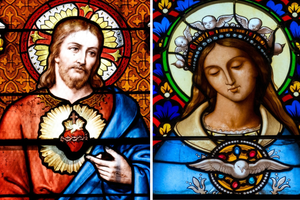
That is why depictions of the Immaculate Heart of Mary — like this work of 19th-century Austrian painter Leopold Kupelweiser in Vienna’s Peterskirche — include certain standard iconographical elements. They are the sword piercing Mary’s Heart (alluding to Simeon’s prophecy); flowers (usually lilies, signifying her purity); and a flame (pointing both to the love she bears to the sons and daughters given to her by Christ on the cross — John 19:26-27 — as well as to the Holy Spirit). As with illustrations of the Sacred Heart, there will usually be a red robe, indicative of the Passion, rather than the traditional white, often with a blue cloak, the definitive Marian color.
Devotion to the Immaculate Heart of Mary grew up particularly in the post-Tridentine era, promoted especially by St. John Eudes. It was reinforced and promoted by the three visionary children at Fatima, including Our Lady’s promises for the “Five First Saturdays” devotion. Saturday is traditionally devoted liturgically to Our Lady.
Our Lord promised blessings on places where the image of his Sacred Heart was displayed. Early on in Catholic practice, that image was often paired with one of the Immaculate Heart of Mary, something you might consider for your home.
- Keywords:
- immaculate heart of mary
- saints & art