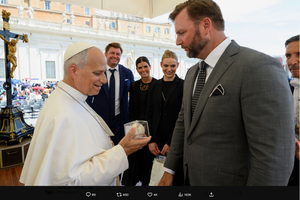
Sacred Ground: The National Eucharistic Pilgrimage in the Heart of the Navajo Nation
Witness the historic visit at St. Michael's Mission founded by St. Katharine Drexel in words and pictures.

“It was 55 degrees this morning,” I thought, staring in disbelief at the dashboard, which now read 109.
Hours had passed on roads so remote that nothing formed by human hands was visible in any direction, except a pair of well-worn railroad tracks stretching out like shiny ribbons, disappearing into the shimmering horizon.
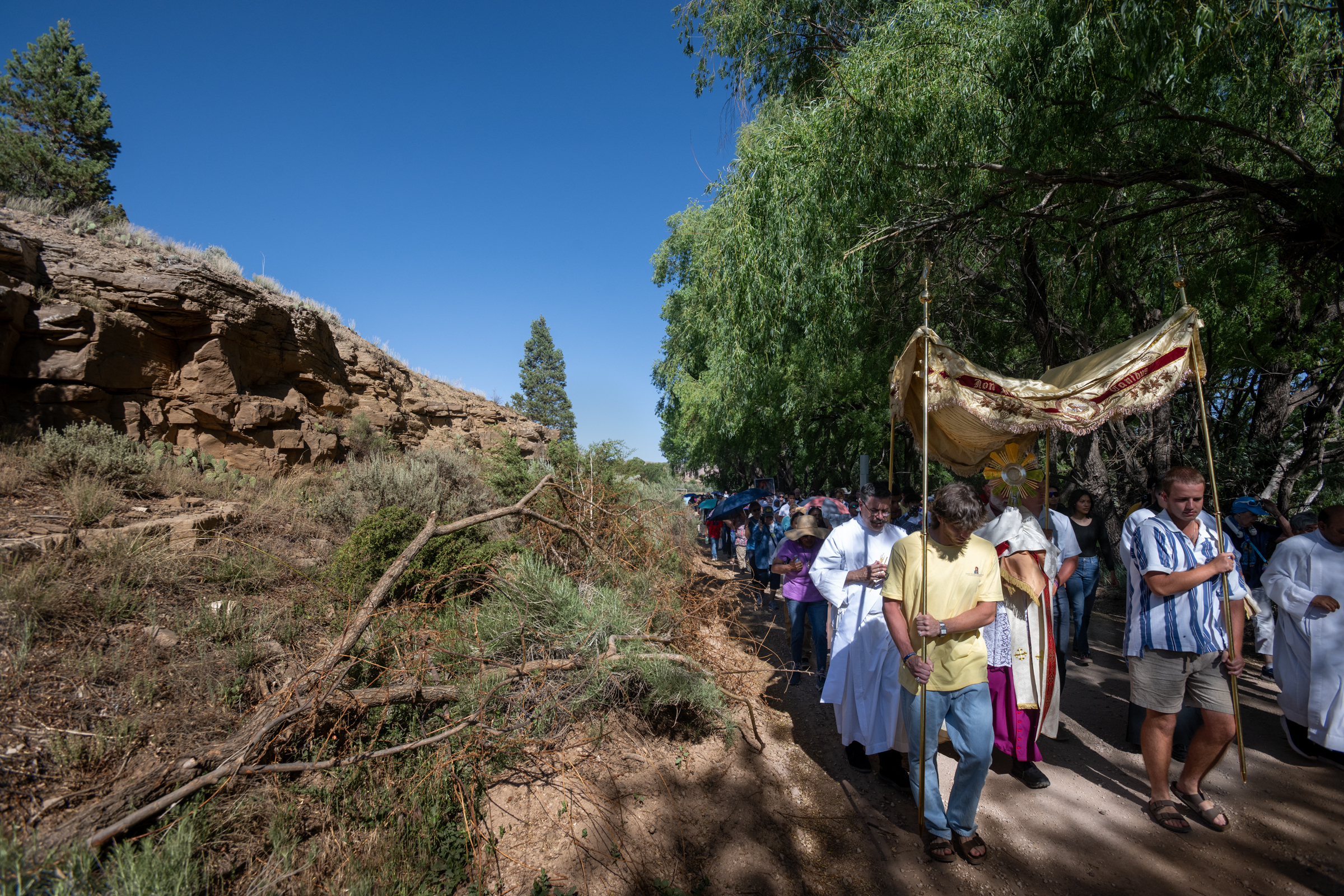
The landscape was rugged, arid and unforgiving.
Clouds of dust rose from distant plains like dry tidal waves, only to vanish moments later into the scorching air. And it was into this stark yet spiritually vibrant landscape the National Eucharistic Pilgrimage carried the Blessed Sacrament, journeying into the heart of the Navajo Nation.
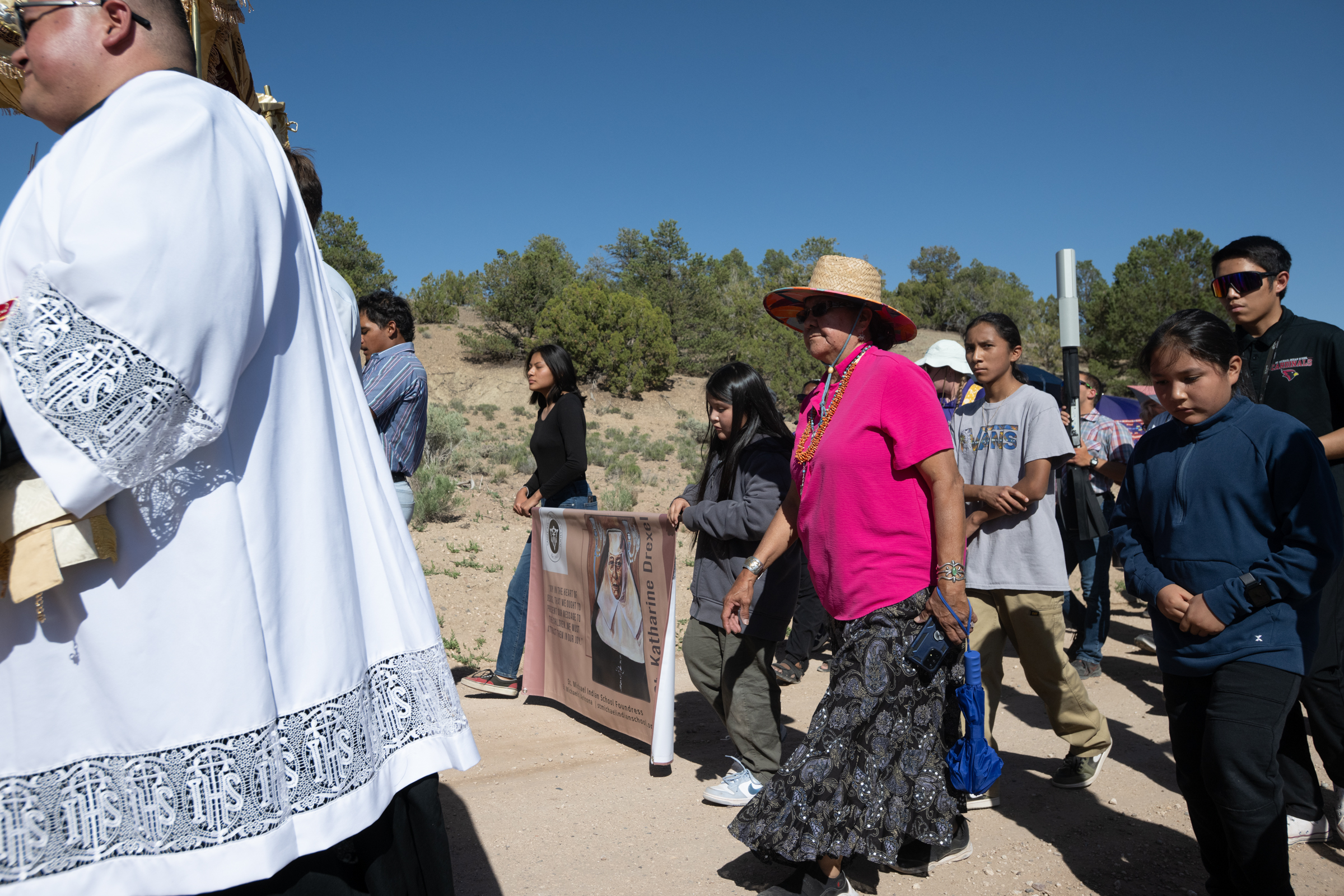
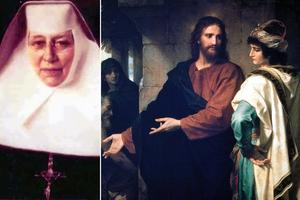
St. Michael’s Mission, where the Eucharistic procession arrived, was founded through the visionary leadership of St. Katharine Drexel, an American heiress who dedicated her life and fortune to serving Native American and African American communities.
In the late 1890s, she became deeply committed to providing Catholic education for Navajo children, purchasing land on the edge of the reservation specifically for this purpose. She persuaded the Franciscan Fathers from Cincinnati to send missionaries, leading to the founding of St. Michael’s Mission.
Her work was revolutionary for its time.
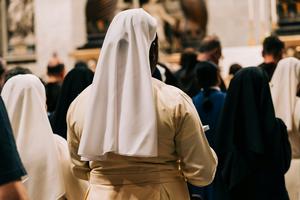
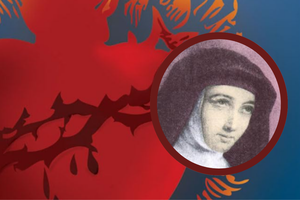
Born into Philadelphia’s wealthiest family, she could have enjoyed a life of comfort and privilege. Instead, she embraced Christ’s love and chose a path of radical service, founding the Sisters of the Blessed Sacrament and establishing schools and missions across the American West and South.
She chose a life of True Wealth.
During a visit to the region, Cardinal Eugenio Pacelli, who later became Pope Pius XII, met with Mother Drexel, who passionately advocated for the Native Americans. Inspired by her perseverance, Pope Pius XII established the Diocese of Gallup in 1939 specifically to be “of and among” Native American communities, a direct outcome of her pioneering efforts.
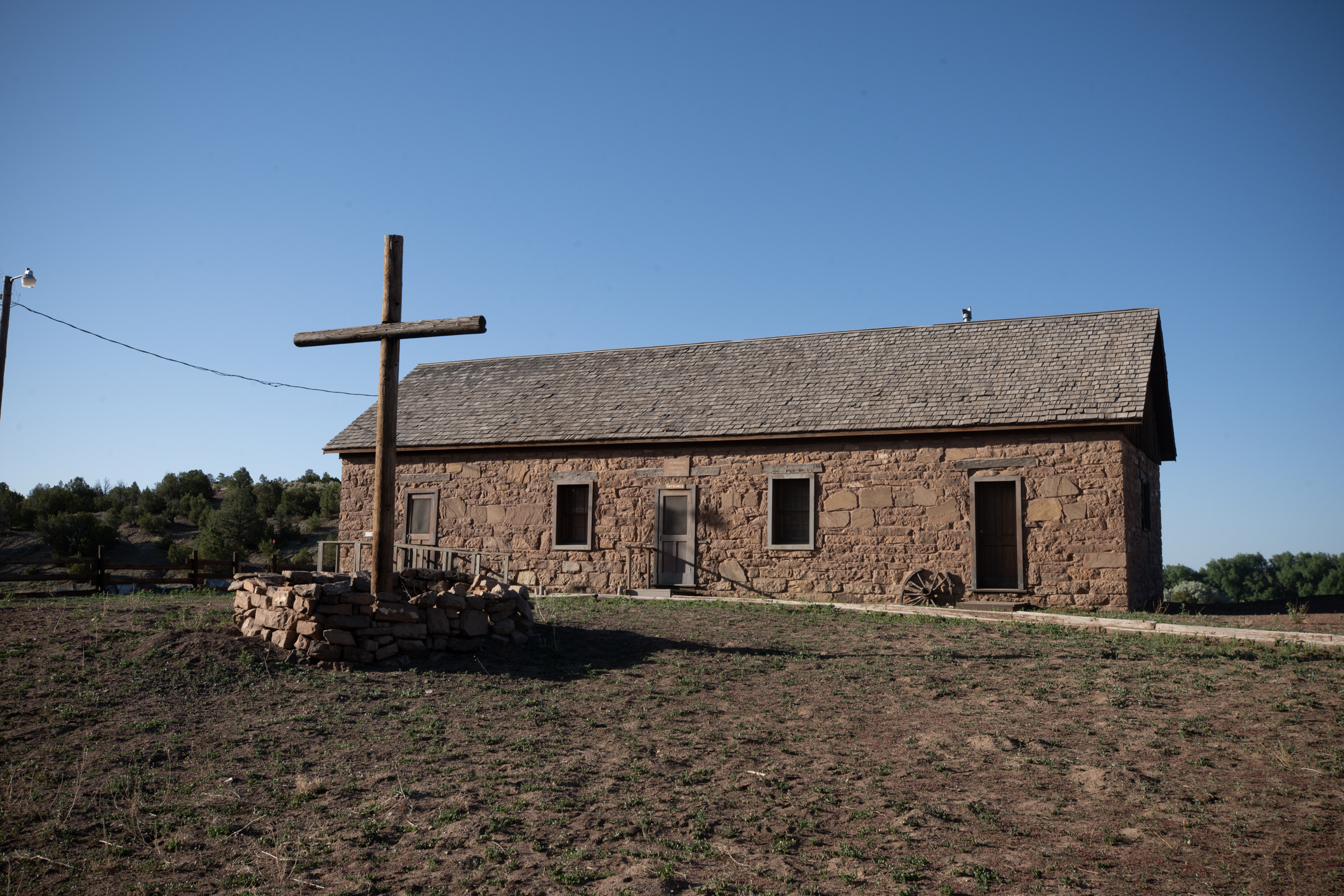
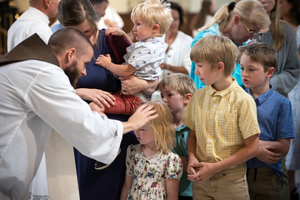
In his homily at the Church of Mary, Mother of Mankind, in the heart of St. Michael’s Mission, Bishop James Wall spoke movingly of the historical roots of faith here. He recalled how evangelization in the Americas had struggled until Our Lady of Guadalupe appeared in 1531. Miraculously, millions embraced Christianity following her apparition. And just eight years later, in 1539, the first Mass was celebrated near present-day Gallup, in the Zuni Nation, marking the beginning of Eucharistic presence in these ancient lands.

Today, faith flourishes vibrantly among Navajo Catholics. At the heart of this thriving community is St. Michael’s Mission School, educating more than 370 children and actively expanding to meet growing demand. The parish itself is enriched by young adults who actively engage in parish life, forming a dynamic, hopeful community. Their youthful enthusiasm and deep reverence symbolize both continuity and a powerful renewal of faith.

Standing amidst that timeless landscape, it became clear why this pilgrimage route was named after St. Katharine Drexel.
Her legacy of charity and Eucharistic devotion pulses unmistakably through the heart of the Navajo people. She understood that the Gospel message is not about erasing identity but about perfecting it in Christ.
What began as her dream of providing Catholic education for Navajo children has blossomed into a vibrant faith community, a beacon of hope in one of America’s remote regions.
The desert teaches patience, endurance, and the ability to find life in unlikely places; qualities embodied by the faith community at St. Michael’s Mission.
In a landscape seemingly hostile to human flourishing, this Catholic community has not only survived but thrived, offering a powerful witness to the power of grace.
As the procession moved from the school Drexel founded to the Mission Church, carried by people whose ancestors knew this land long before the first European arrived, a profound truth was revealed: In a way, Native Americans grasped something lost in our modern societies and cities — that God’s creation itself is his cathedral.
Something to which St. Francis of Assisi would attest.
That every living thing, every stone, every created thing testifies to his glory and infinite majesty.
How fitting that as Jesus Christ, fully present in the Eucharist, entered the heart of the Navajo Nation, he — the Creator of all — was lifted high beneath the very sky he formed.
And between the rocks that would be pillars, and the sky that would be a decorated domed ceiling, the faithful processed.
And here, in this vast cathedral of stone, sand and sky, everything pointed clearly to the One Truth …
That it all comes down to the Eucharist …

Because it all comes down to Him.
And in the end, that’s all that’s ever mattered.