Remembering Robert Wilken
COMMENTARY: The contributions of Wilken, who died June 6, to American religious life extended beyond the large network of students he guided.
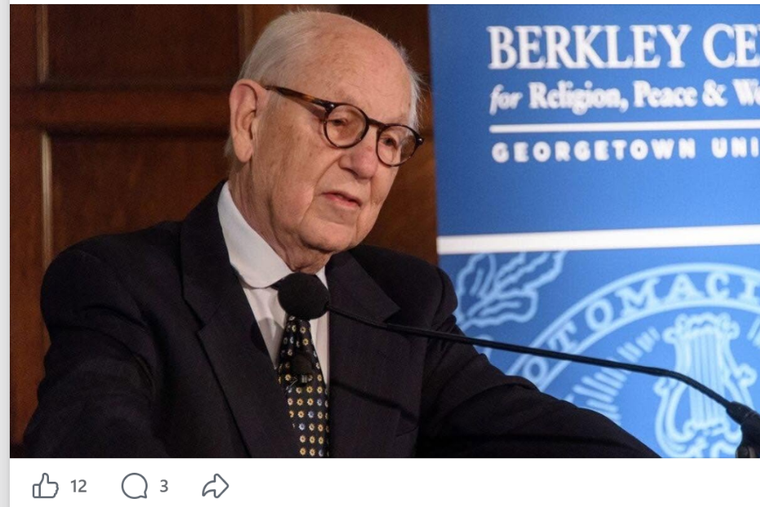
Robert Louis Wilken — radical Christian disciple, devoted husband and father, distinguished patristics scholar, elegant writer, serious baseball guy — died on June 6, a few months short of age 90.
Curiously enough, the first thing that comes to mind when I think of this longtime friend and colleague is a pop-quiz Q&A I heard years ago in Charlottesville, Virginia, where Robert was an adornment of Mr. Jefferson’s university for many years:
Question: What’s the best restaurant in Charlottesville?
Answer: The best restaurant in Charlottesville is wherever Robert is cooking tonight.
But perhaps that’s not so curious after all, for Robert’s culinary genius embodied important dimensions of the man.
He was a loyal son of New Orleans, where he grew up, a town where good cooking and robust eating are reverenced. And Robert’s was a very rooted human personality, of the kind one finds in old-school southern gentlemen.
A great cook respects tradition but is willing to engage in what we might call the development of culinary doctrine: stretching the conventional boundaries but always in dynamic continuity with the received truths. The Robert Wilken whose Christian pilgrimage eventually led him from theologically rigorous Missouri Synod Lutheranism to dynamically orthodox Catholicism lived that kind of authentic development in his spiritual and theological life.
Culinary genius is both delicate and robust, all the while remaining honest in its handling of the ingredients and materials at hand. In books like The Spirit of Early Christian Thought, Robert’s impeccable scholarship displayed all those qualities.
And Robert’s cooking was a great exercise in hospitality. So he gave those of us fortunate to savor his skills in the kitchen a foretaste of the Wedding Feast of the Lamb, for which he yearned as only a thoroughly converted Christian disciple can yearn.
Robert’s love for his wife Carol, sons Gregory and Jonathan, and the rest of his family was deepened and enriched by his love for the Lord Jesus Christ. The formation he received at Concordia College in Austin and at Concordia Seminary in St. Louis forged in him a love of the Lord that combined deep piety with great intellectual depth. He knew that the Church was Christ’s, not ours, and he knew that Christ would make good on his promise never to abandon his Mystical Body in the world. Robert could therefore tell the story of the Church without blushing, in the confidence that, even during its most unlovely periods, the Church was being guided by her Lord toward her final end, of which we read in Revelation 21-22.
And that faith-grounded honesty was why another historian, Cardinal Timothy Dolan, esteemed Robert’s scholarship and carried Robert’s book, The First Thousand Years: A Global History of Christianity into the Sistine Chapel on the evening of March 12, 2013, at the opening of the conclave to elect a successor to Pope Benedict XVI: a factoid I happily pointed out on NBC as the cardinals swore their conclave oaths.
(Robert never told me whether there had been a significant uptick in sales the next day.)
Robert Wilken’s contributions to American religious life extended beyond the large network of students he guided, many of whom enjoyed significant careers of their own and thus extended Robert’s intellectual influence over several generations. As one of the founders of the Institute on Religion and Public Life and its journal, First Things, Robert helped shape the public discussion of the place of religiously grounded moral conviction in our national life for decades. At the same time, he knew that the Church was not simply another voluntary association in the kaleidoscopic free-for-all of American society.
Rather, as he put it in the 2004 essay that I regard as his most important contribution to First Things, the Church is a culture: a way of life with distinctive rituals, ideas, and vocabulary that may help form a more humane public culture, but a culture with its own integrity that can — and in some cases, must — maintain that integrity over-against the surrounding public or civic culture. And by reminding the ambient public culture that God is ultimately sovereign, the culture that is the Church protects culture and society from succumbing to the totalitarian temptation that seems baked into political modernity.
Robert Louis Wilken lived a life of consequence quietly, with firm convictions but without boisterousness. He died at a moment when the screamers dominate what we ironically call the public “discourse”; that calm, measured voice of gentlemanly reason will be sorely missed. How blessed we were, though, to have heard his voice for so long. And how glad we should now be that he will be an intercessor at the Throne of Grace.
- Keywords:
- robert wilken