Mahmoud Decision Furthers US Supreme Court’s Protection of Parental and Religious Liberty, Legal Scholars Say
‘The effect of this opinion will be to alert government agencies that parents’ constitutional rights to direct the religious upbringing of their children are alive and well under our Constitution …’

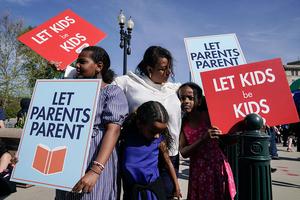
A Catholic mom in Maryland told the Register she is grateful that a U.S. Supreme Court ruling has restored the ability of public-school parents to find out beforehand if a teacher plans to present material on sexuality and gender identity and to opt their children out if they wish.
Montgomery County public schools began in 2022 presenting storybooks affirming same-sex marriage and transgender identity, and a year later they stopped notifying parents about it and stopped letting them keep their children from lessons that used the books.
“We believe in the Church’s teaching that as parents we are the primary educators of our children, that we are to raise our children in the faith, and that that is our sacred duty and responsibility. So when our children are exposed to things that oppose the Catholic faith, we need to teach them differently,” said Grace Morrison, a mother of seven, in a telephone interview Monday.
“And the court confirmed that that is absolutely protected. We have a right to be in the public arena, and receive public education, and still uphold our religious beliefs, and still live by them,” she said.
By a 6-3 majority, the court ruled Friday that the Montgomery County Board of Education must inform parents about storybooks presenting same-sex marriage and fluid gender identity before using them in class and must allow them to opt out.
Writing for the majority in the case, Mahmoud v. Taylor, Justice Samuel Alito found that the “LGBTQ+-inclusive story books” are “unmistakably normative” and send a message against the religious beliefs of the Catholic, Orthodox and Muslim parents who brought the lawsuit by endorsing same-sex marriage and transgender identity.
“They are designed to present certain values and beliefs as things to be celebrated, and certain contrary values and beliefs as things to be rejected,” Alito wrote.
‘Religious Freedom’
Patrick Brennan, a law professor at Villanova University’s Charles Widger School of Law, called the decision “a big and broad win for religious freedom.”
Brennan told the Register he was pleasantly surprised that the court extended a principle in a previous religious-freedom case, Wisconsin v. Yoder (1972), in which the court decided that the burden on Amish parents to send their children to school against their religious beliefs outweighed the state government’s interest in making sure that children are educated.
“By rooting the decision in this principle that focuses on the burden imposed on parents, the court required the state’s policy to satisfy strict scrutiny, its most demanding standard of review,” Brennan said by email.
By not offering an opt-out, the school board’s policy “burdens the religious exercise of parents when it requires them to submit their children to instruction that poses ‘a very real threat of undermining’ the religious beliefs and practices that the parents wish to instill,” Alito wrote, quoting from Yoder. “And a government cannot condition the benefit of free public education on parents’ acceptance of such instruction.”
Brennan praised the court for, in his view, ruling on the side of the free-exercise-of-religion clause of the First Amendment of the U.S. Constitution.
“The effect of this opinion will be to alert government agencies that parents’ constitutional rights to direct the religious upbringing of their children are alive and well under our Constitution and, notably, that a policy that invites denigration or ridicule of parents’ religious beliefs will be found to violate the Free Exercise [Clause] guarantee against coercion,” Brennan said.
“This holding and opinion continue the court's development of a robust body of principles that protect the religious liberty of individuals and groups against the forces of the vast modern state and its project to standardize citizens. The court's recognition of the religious importance of parents’ shaping the education of their children in ways related to religion was stunning and most welcome,” Brennan said.
Dwight Duncan, constitutional law professor at the University of Massachusetts School of Law, said the decision “emphasizes that the free exercise of religion entails notice of and opportunity to opt out of public-school practices like forced exposure to ideas antithetical to the parents’ right to direct the religious upbringing and education of their children.”
“This fits the pattern of the current Supreme Court valuing religious freedom when it comes into conflict with other interests,” Duncan told the Register by text. “It is probably the strongest religion-friendly court in our country’s history.”
Not Happy
Justice Sonia Sotomayor, writing for the minority, attached the entire book Uncle Bobby’s Wedding, a children’s book about two men civilly marrying, as an appendix to her dissent. The color images of the book contrast sharply with the black-and-white text of the opinion.
Sotomayor argued that the court’s majority in Mahmoud has invented a right of parents to keep their kids from being exposed to ideas that clash with their religion.
She said public schools “offer to children of all faiths and backgrounds an education and an opportunity to practice living in our multicultural society,” adding that the shared experience of school “is critical to our Nation’s civic vitality.”
“Yet it will become a mere memory if children must be insulated from exposure to ideas and concepts that may conflict with their parents’ religious beliefs,” Sotomayor wrote.
Jesuit Father James Martin, who has criticized Church teachings on homosexuality, said the court decision in Mahmoud “is a reminder that objecting to LGBTQ issues often falls under the guise of ‘religious objections.’”
“But pretty soon, even speaking to, or doing business with, an LGBTQ person (or having them teach your children) will be framed as a threat to one's ‘religious values.’ It's important to remember that Christianity should not be used as a fig leaf for homophobia,” Father Martin wrote on social media.
Kelley Robinson, president of Human Rights campaign, an advocacy organization that opposes the decision, described the Maryland parents’ lawsuit as one of several “targeted attacks on inclusive education” and said the court’s ruling on Friday “weaponizes religious freedom to further marginalize vulnerable students.”
“Every child deserves to see themselves reflected in the stories they read and to be celebrated in their classrooms for who they truly are. This ruling not only tells LGBTQ+ students that they don’t belong, but that their experiences and existence are less worthy of respect,” Robinson said in a written statement.
‘Deep-Seated Convictions’
The U.S. Conference of Catholic Bishops filed a friend-of-the-court brief in Mahmoud supporting the parents this past March.
Bishop Kevin Rhoades, chairman of the U.S. bishops’ Committee on Religious Liberty, praised the court’s decision Friday, saying that when schools address “deep-seated convictions about faith and morals … they ought to respect all families.”
“Parents do not forfeit their rights as primary educators of their children when they send their kids to public schools. The parents in Montgomery County did not seek to impose their religious viewpoints on others; they simply asked to opt out of a program that was offensive to their faith,” said Bishop Rhoades, who leads the Diocese of Fort Wayne-South Bend, Indiana, in a written statement.
“To be sure, children should not be learning that their personal identity as male or female can be separated from their bodies. But if a public school chooses to offer these kinds of programs, it ought to respect those who choose not to participate,” Bishop Rhoades said. “The school board was wrong to interfere with the rights of the parents, and I am grateful that the Supreme Court has moved to rectify this injustice.”
Morrison and her husband have an adopted daughter from Ukraine who has Down syndrome. She told the Register her daughter was 10 when Morrison found out almost by accident that the school system planned to present material affirming same-sex marriage and alternative gender identities.
“Honestly, it was the grace of God protecting her. I found out from a neighbor in a casual, quick conversation,” Morrison told the Register by telephone Monday. “And that was how most people found out, was by this word of mouth.”
The books disturbed her.
“There was a clear agenda, a one-sided agenda, that directly opposed our faith,” Morrison said.
School officials said opting out of the material wasn’t an option, so she kept her daughter home from school for several days.
She said the material presented a conflict — in most things, Morrison told her daughter to follow her teacher’s instruction, but in sexuality and gender identity she felt she had to give her a different message.
“We believe as parents,” she said, “raising our children in the faith is the most important thing, to understand their faith and prepare them for all eternity.”
Eventually, she and her husband pulled their daughter out of the public schools and educated her privately, at a cost of $25,000 a year, according to the plaintiffs’ brief in the case.
She said she’s not sure if she and her husband will send their daughter back to the public-school system in Montgomery County, saying that their trust in the school system has been shaken, adding that they want to see what changes school officials make in the aftermath of the court’s decision.