JD Vance’s Pitch for a National Reversion
In ‘Communion,’ the vice president and Catholic convert argues that America should follow his lead by returning to its Christian roots
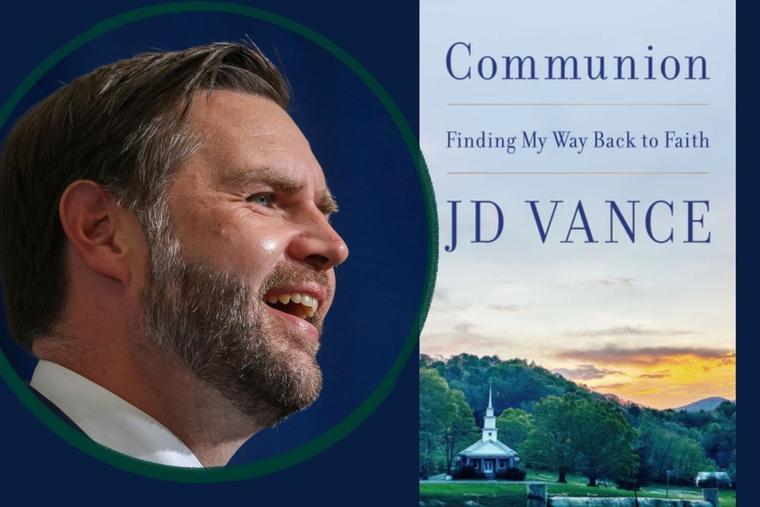
In his latest memoir, Communion: Finding My Way Back to Faith, Vice President JD Vance writes with the zeal of a convert. Christianity has transformed his life, he says, and he’s eager to share how it can transform yours, too.
Except Vance, who became Catholic in 2019, isn’t primarily interested in convincing others to become Christian on a personal level (“though I’d welcome it,” he writes). Instead, the vice president wants to make the case for Christianity on the national level: as the creedal ethos of American society, informing everything from our country’s social values to its economic policy.
Communion is built around an implicit analogy. Just as Vance returned from secular individualism to Christianity, America should undergo its own reversion — not simply through more people in the pews, but through a public life that is once again shaped by Christian belief.
This thesis is what connects the book’s first half, which recounts Vance’s journey away from and then back to faith, to the latter half, which lays out the prominent role that the 41-year-old vice president believes Christianity should play in American society going forward.
As such, Communion is neither a strictly spiritual memoir nor a political manifesto. It’s both, with Vance’s personal faith journey serving as the basis for his political conclusions.
In fact, at one point, Vance even links the logic of his own conversion to his political outlook, writing that “if what brought me back to my faith was the sense that the Church answered life’s big questions, then I must resist the effort to confine Christ’s moral teachings to a few social issues.”
Good Fruit
Vance is so bullish on Christianity’s role in American public life primarily because he believes that Christianity can do for the nation what it’s done for him personally: Bear good fruit.
Despite graduating from Yale Law, getting rich as a venture capitalist, and breaking into public prominence via his 2016 best-seller Hillbilly Elegy, Vance writes that the elitist rat race had left him burnt out and ill-prepared to be a good husband and father. When he eventually returned to the Christian faith, it was not through an epiphany about Christ’s divinity. Instead, it was through the belief that it would make him a better man, which Vance came to largely through the witness of Christians around him.
“It was the set of ideas and practices that generated the most good, the most truth, and the most beauty of anything I’d encountered,” the vice president writes. “Nothing else came close.”
Specifically, Vance says he was attracted to Catholicism by the Church’s account of character formation as a slow, grace-aided process of growing in virtue. The Church’s communal teachings and character also spoke to him. He writes that taking his cues from Catholicism has helped him overcome some of the trauma of his chaotic upbringing, making him more patient, self-giving and forgiving.
Some of Vance’s critics might not see much evidence that the vice president has been transformed by Christian practice, but he says his wife Usha has certainly noticed a difference. “Therapy didn’t work for you,” she once told him. “But church does.”
And if Christianity has made Vance a better man, he’s convinced that it can make America a better nation, correcting the societal rot introduced by secular liberalism.
In Communion, Vance links the eclipse of Christianity’s national influence to most of society’s present-day ills, including “rising racial strife, a gender gap among our young people, falling rates of love and partnership, and a society with a declining population.”
At one point he suggests that it should be no surprise that removing God’s name from the oaths and alliances of the post-war West has coincided with a lack of civilizational identity and strength. As Vance writes, “our abandonment of Christian culture has coincided with an apparent decline in our collective will to live.”
Vance’s critique here isn’t partisan. While he criticizes the left for propping up “self-discovery” as an ultimate virtue, he blasts the right for a slavish adherence to free-market principles over other more human considerations, like the well-being of families.
“We ought to stop worshipping such false idols and get back to worshipping God,” he writes.
Politics and Christianity
Vance’s use of “we” here is telling. For the vice president, if America is going to become Christian again, it must be influenced by Christian values at every level of society. Not everyone in America needs to be Christian, Vance writes, but Christianity needs to take its rightful place as America’s “creed,” the “shared moral language” of the nation.
A central theme of Communion, as the name suggests, is that no man is an island. While each of us has free will, Vance writes that we are also “members of a community, influenced and formed by what’s around us.” These broader societal influences have an impact not just on the things we buy or the sports we follow, but on our religious belief and moral practice. In fact, after the birth of his first son, Ewan, Vance writes that he became preoccupied with the question of “how to build a culture of virtue,” not just in his family or local community, but “within our entire society.”
This insight helps explain Vance’s impatience with a version of politics that treats religion as a purely individual choice. And given Vance’s identification with postliberalism, a political outlook that sees state power as an important tool for promoting the common good, it is clear that he sees political institutions and public policies as playing a role in this reversion.
In Communion, Vance never argues that government can manufacture faith. His point is that broader social forces like politics can help shape the environment in which belief either withers or flourishes. For instance, he notes “churches will struggle to attract working-class people if those people are forced to work on Sundays,” suggesting the need for political intervention.
But if Vance believes that politics can help foster Christian renewal, an obvious question follows: Where has this worked? Here, Communion is noticeably less developed, especially for a book that is so focused on fruits.
For instance, Communion provides no contemporary examples of countries that have successfully spurred Christian renewal through political intervention. It makes several references to the strength of Christian civilization in the past. But it’s unclear that these examples support Vance’s thesis, precisely because he is calling not merely for the maintenance of a Christian culture but the recovery of one.
Perhaps the lack of contemporary examples is because Vance is proposing something that he thinks has yet to be tried in the post-Christian West. But perhaps it is because those countries that have made the attempt, such as Hungary under Viktor Orbán, do not appear to have been particularly successful.
The Fruit of a ‘True Witness’
This lacuna shouldn’t be taken as proof that politics has no connection to Christianity’s flourishing. But it does imply that Vance’s approach is somewhat experimental and is not bound to guarantee any sort of national revival.
This is because the source of Christianity’s fruitfulness, most fundamentally, is grace. And grace is received by personal adherence to Christ and His Church. While a president’s speech can speak of the importance of Christian principles and a legislature can pass laws that make the faith easier to practice, these are not means through which people can encounter sacramental grace. In other words, societal factors can lead a horse to holy water, but they can’t make it get baptized.
Vance’s own case is instructive. Although his own conversion was socially mediated, it was also something that he intentionally pursued. He was drawn by the fruits of Christianity, he desired to become a Catholic, and he is now the one who practices the faith. There is something internal and intimate about a personal conversion that no national policy can produce.
Given his public office — and the fact that he is expected to make his own bid for the presidency in 2028 — it is understandable that Vance’s focus in Communion’s second half is on public policy and its connection to Christianity on a national level.
But as Communion also suggests, Christians eager to promote the faith via politics would do well to remember the primary factor that led to Vance’s conversion in the first place, as highlighted in the book’s opening: the “true witness” of Christian believers, who, through their adherence to Christ and His Church, bore fruit that attracted.
- Keywords:
- jd vance
- catholic converts
- faith in politics
- faith in the public square
- catholic politicians
- catholic life