Questions Linger After Nigerian Priest’s Suicide in Massachusetts
The priest’s death has raised questions over what role the Trump administration’s visa restrictions may have played in the tragedy and over why he was so afraid to return to Nigeria.
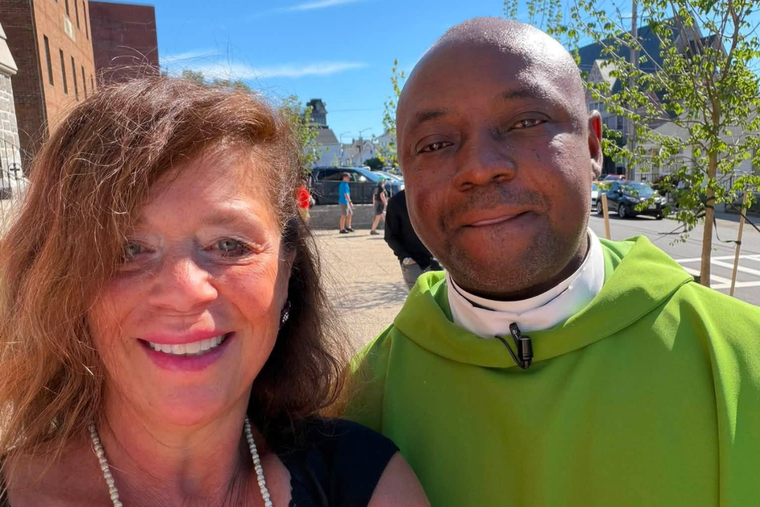
A Catholic priest from Nigeria who killed himself in Massachusetts earlier this month was distraught over being unable to extend his stay in the United States and the recent death of the bishop of his home diocese, people who knew the priest told the Register.
The priest’s death has raised questions over what role the Trump administration’s visa restrictions may have played in the tragedy and over why he was so afraid to return to Nigeria.
Father Benjamin Madu, 54, who had served as a hospital chaplain and a weekend Mass celebrant for a parish collective on Cape Ann, died July 2, according to the Archdiocese of Boston, where he had ministered for the past five years.
Authorities had not released a cause of death as of Monday. But an email message an archdiocesan official sent priests 10 days ago on behalf of Archbishop Richard Henning and seen by the Register said the priest “tragically took his own life.”
A spokesman for the Essex County District Attorney’s Office told the Register the death is under investigation.
The priest’s visa allowing him to stay in the United States was due to expire on July 29, and the Diocese of Abakaliki leadership had directed Father Madu to return to Nigeria even earlier this month, according to the Archdiocese of Boston.
Bishop Ernest Obodo, an auxiliary bishop of a neighboring Nigerian diocese and the apostolic administrator of the Diocese of Abakaliki, told the Register he directed Father Madu to come home early so as not to overstay his visa and to give him an opportunity to rest and prepare for his new assignment in the diocese, which was due to start Aug. 4.
“We are still in shock and trauma processing the sudden death of our beloved priest, Fr Ben,” Bishop Obodo told the Register by email.
Feared Returning Home
Father Madu was usually easygoing and cheerful, but his outlook turned after the illness and April 10 death of Bishop Peter Nworie Chukwu, 60, who led Father Madu’s home diocese of Abakaliki, according to Curt Williams, a Congregationalist chaplain at Salem Hospital in Salem, Massachusetts.
“He was very sad, and it changed things for him. There was a level of trust there that he lost. It’s the first time he seemed upset about his future,” said Williams, who told the Register he spoke to Father Madu at least twice a week during the approximately year and nine months they worked together.
While Father Madu had family in Nigeria and would visit them for several weeks around Christmastime, he did not want to move back to Nigeria permanently, though a colleague and four parishioners who knew the priest all told the Register that he never said why.
As July approached, the prospect of returning home appeared to weigh heavily on Father Madu.
On June 14, the priest had a panic attack while driving to St. Joachim Church in Rockport to say Sunday Mass and ended up in the emergency room, he told parishioners at Mass the following week. Father Madu also announced during that June 21 Mass that he would be returning to Nigeria, telling parishioners that “his heart was shattered.”
During an 8:15 a.m. Mass at St. Ann’s in Gloucester that same day, parishioner Janine Boucher said, Father Madu shared that when he was scared as a child, his father would cough and clear his throat, which made him feel better.
“He was like a little boy up there, sharing all these things. And you felt for him,” said Boucher, 62, who attended the priest’s Mass at St. Ann’s Church in Gloucester. “I could feel that sadness and fear — complete fear.”
“This jolly, gentle man was sad. He was crying. He didn’t want to go home and die,” she said.
Paul F. Murphy, who often attended Masses celebrated by Father Madu at St. Joachim, described Father Madu’s death as “heartbreaking.”
“I know people tried, present company included, to help get his visa extended, but his bishop was calling him home,” said Murphy. “But he was clearly scared to go home, and that bothers me greatly — that he had so much stress in his life.”
Some U.S. news reports, such as a July 3 story from The Boston Globe, have implied that Father Madu was afraid to return to Nigeria due to targeted violence against priests in the country. While people who knew Father Madu find that explanation plausible, they say he never mentioned kidnappings and violence or any other reason.
“I sensed he was afraid of something,” said George Lieser, 75, a parishioner who attends St. Joachim. “He never would communicate what it was.”
The Catholic Secretariat of Nigeria reported last year that 145 Catholic priests in the country were kidnapped (many for ransom) between 2015 and 2025, of whom 11 were killed, according to Agenzia Fides.
Violence against Catholic religious figures is less common in the heavily Christian southeast region of Nigeria where Father Madu came from compared to certain other parts of the country. Yet kidnappings have happened there, including in the Diocese of Abakaliki, where a priest and, later, a group of nuns and a seminarian were abducted (and later released) in 2023.
“There is insecurity in Nigeria but we are all going about our mission work with absolute trust in God. The insecurity is widespread in Nigeria but more dangerous in the North,” Bishop Obodo told the Register.
The Visa Problem
Father Madu was in the United States on a religious-worker visa, also known as a R-1 visa. The visa allowed him to stay in the country for five years while working for the Archdiocese of Boston, which in federal-government language was the “petitioner” for the priest, who is known as the “beneficiary.”
To stay in the United States beyond this month, the priest needed to obtain a second R-1 visa, which would have granted him up to five additional years. To get it, he would have had to leave the country first before applying.
That process theoretically got easier in January 2026, when the Trump administration ended a requirement that R-1 visa beneficiaries wait 12 months before applying.
The development was welcomed by the U.S. Conference of Catholic Bishops, who have urged the Trump administration to streamline the R-1 visa process. Many U.S. dioceses depend on foreign priests for parish ministry.
But according to immigration lawyers who spoke to the Register, other recent changes made by the U.S. government have made the prospect of obtaining or renewing R-1 visas difficult for priests from Nigeria and certain other countries.
In December 2025, President Donald Trump added certain countries deemed “high risk,” with special restrictions on entry into the United States, including Nigeria. U.S. Citizenship and Immigration Services began what it calls a “hold and review” policy, pausing consideration of visa applications for beneficiaries from high-risk countries.
The Register spoke with Ogor Winnie Okoye, an immigration lawyer with an office in Lynn, Massachusetts, who was born in Nigeria and moved to the United States in her 20s. Okoye, who did not know Father Madu, said the federal government’s pause in considering visa applications for Nigerians has affected religious workers trying to come to the United States and likely affected Father Madu.
“It would have been an easy route for him if he left and there was no pause,” said Okoye, referring to the hold on processing visa applications. “A lot of things were just not working in his favor.”
Entry into the United States on R-1 visas can be denied either by U.S. Citizenship and Immigration Services in this country, by the U.S. consulate in the person’s home country, or by a U.S. Customs and Border Protection officer who interviews a foreign national at an airport or port of entry, said Lance Conklin, an immigration lawyer in Maryland who has been helping religious workers get visas for many years.
In recent years, he said, U.S. consulates (which are under the U.S. Department of State) have been the hardest for his clients to deal with in certain countries, including in Nigeria.
“R-1 visas in general have been denied in consulates. That’s always the risk anywhere. Nigeria is more problematic than most,” Conklin told the Register.
But Conklin, who did not know Father Madu, also said that the publicly known facts of his case don’t lend themselves to an easy interpretation.
“There’s nothing that’s obvious to me on what his issue was. It’s hard to know what it was,” Conklin said.
The Register contacted the press office of the U.S. Citizenship and Immigration Services on Monday morning but did not hear back by publication of this story. The U.S. Department of State acknowledged a request for comment on Monday but did not provide one by publication of this story.
‘A Really Fine Man’
Father Madu had served as a chaplain at Salem Hospital, about a half-hour from Cape Ann, since May 2021. He began helping out at the parish collaborative on Cape Ann in April 2022, according to the church bulletin.
Parishioners told the Register that churchgoers initially had trouble understanding his accent when he first started saying Mass there, but that they got used to it and warmed up to him.
“He was a really, really fine man — gentle, great smile, loved interacting with people,” said Murphy, who serves as chairman of the elected board that oversees town government in Rockport.
Boucher recalled that Father Madu was gentle and quiet by nature, but he became “vibrant and enthusiastic” when he was proclaiming the Gospel or preaching.
Lieser said Father Madu got people singing during Sunday Mass.
“He was a sweet man who brought his culture, his faith — his simple, kind of joyous faith — to every Mass that he said. I loved his approach. He was genuine, and you knew he meant what he preached,” Lieser, a commercial mortgage banker, told the Register. “So he had a little touch of Southern Baptist revivalism. It was good for stodgy New Englanders.”
Williams, who worked alongside Father Madu at Salem Hospital, said Father Madu seemed overworked. Many Catholics go to Salem Hospital, Williams said, so the demand for the sacrament of anointing of the sick was heavy and emotionally draining, and the priest’s parish work during his time off from the hospital added to the stress.
“He was definitely not a complainer. But you’d see sometimes where he was tired,” Williams said. “He needed a break.”
‘Anger, Confusion’
Lieser said that after Father Madu’s June 21 announcement that he would be leaving the U.S., he offered to help assemble an immigration law team to help the priest extend his visa, but that he eventually declined.
“He said he would think about it, but he was reluctant,” Lieser recalled.
Some in the parish are angry about the visa problems Father Madu encountered before his death.
“As we mourn and pray for Father Ben, we must accept the awful truth that we are all responsible for this tragedy,” wrote Brother Patrick Garvey, a diocesan hermit who ministers in the parish, in the parish bulletin. “Father Ben deserved better from the Church. He deserved better from our country. He definitely deserved better from me. Maybe he deserved better from all of us.”
Lieser said the Archdiocese of Boston should have fought harder for the priest against the Trump administration’s restrictions on visas for Nigerians.
“It’s racist. It’s unjust. It’s wrong. And the diocese should stand up and say that,” Lieser said. “Maybe they did everything they really could do. I’m just not convinced.”
Terrence Donilon, a spokesman for the Archdiocese of Boston, said the archdiocese did everything it could to help Father Madu.
“We tried everything humanly possible to help him stay in Massachusetts. We consulted with experienced immigration attorneys, we looked at the policy of the government that had changed, and we were simply met with the reality at every step he had to return to Nigeria,” Donilon told the Register by text.
Boucher, who captured the last known images of Father Madu via a cellphone video as he recessed out of Mass on June 21, told the Register on Tuesday that the priest’s death has dominated conversation at Janine’s Fitness, a business she runs in Rockport.
She also said that neither she nor the parishioners she has talked with are blaming U.S. immigration and visa restrictions for the priest’s death.
“We don’t know what really happened. May never know,” Boucher said. “But God knows.”
- Keywords:
- nigeria
- priests
- mental health
- visa