Papal Nuncio to Great Britain: A Visit From Pope Leo Is ‘Likely’
The apostolic nuncio to Great Britain, Archbishop Miguel Maury, has been in the Vatican's diplomatic service for nearly four decades.
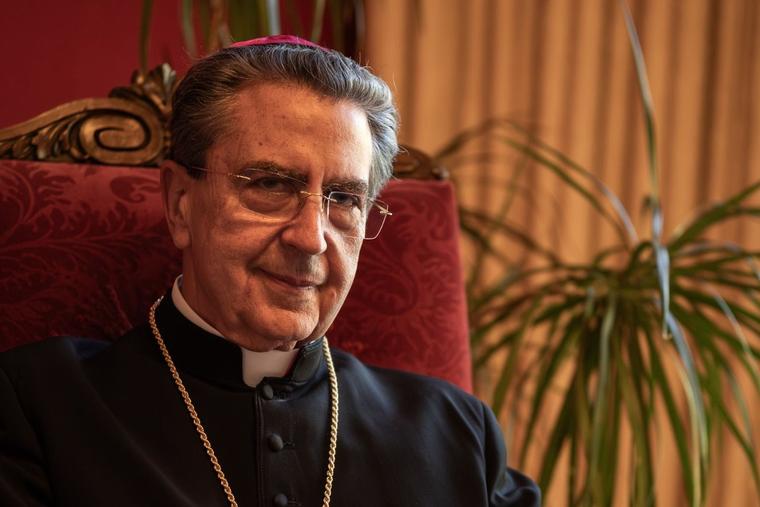
The Pope’s representative in Great Britain is hopeful that Pope Leo XIV will visit England and “awaken the conscience of the West.”
A papal visit to England is “likely, desirable, and I would even say unavoidable,” Archbishop Miguel Maury Buendía, apostolic nuncio to Great Britain since 2023, told ACI Prensa, the Spanish-language sister service of EWTN News.
A visit to Great Britain is “likely, because King Charles III paid a state visit to the Vatican last year, and it is logical that the United Kingdom would now invite Pope Leo XIV to return the visit,” he added.
The last pope to make an official visit to the United Kingdom was Pope Benedict XVI in 2010.
Archbishop Maury said that, as the first English-speaking pope in more than eight centuries, the welcome for Pope Leo would be “extraordinary and his message amplified throughout the English-speaking world.”
“The bishops of England and Scotland also hope that a papal visit will reinvigorate the proclamation of the faith in one of Europe’s most secularized societies — one which, I would say, is currently experiencing a time of grace,” the papal representative said.
“The spiritual vacuum of recent decades is giving way to a quiet Christian revival among younger generations,” the archbishop continued. “Religious practice is increasing among Catholics, thanks in part to the thousands of immigrants and children of immigrants who are revitalizing parish life and contributing to the growth of Catholic communities.”
“Everything suggests that the pontificate of Leo XIV is called to awaken the conscience of the West just as that of St. John Paul II once stirred the conscience of the East, so that the Church may once again breathe fully with both of its lungs,” he said.
Born in 1955 in Spain, Archbishop Maury was ordained a priest in 1980. He never imagined he would become an apostolic nuncio. Nevertheless, in obedience to one of his superiors, he entered the Holy See’s diplomatic service in 1987, beginning a career that would lead him to represent the pope in various countries around the world for more than 39 years.
The book Faith, Life, Diplomacy, published in Spanish and Italian, reflects on Maury’s nearly four decades of diplomatic service in countries such as Kazakhstan, Kyrgyzstan, Tajikistan, Romania, and Moldova.
The following is an edited version of the nuncio’s full interview with ACI Prensa:
You have published Faith, Life, Diplomacy, a book about your service in countries such as Kazakhstan, Kyrgyzstan, and Tajikistan, where Catholics are a minority. What did you learn there, and what left a lasting mark on you?
I discovered the great humanity of those peoples and the devastating effects on their souls of 70 years of communist and atheist rule. The Muslim majority and millions of Russian Orthodox believers abandoned their faith, while the Catholic minority preserved it — despite being deprived of priests for at least 20 years — thanks to the daily family rosary.
Another thing that impressed me positively was the desire of the younger generations to learn and to serve society, now free from the terror under which their parents lived. This contrasts sharply with the apathy and selfishness present among much of Western youth.
When Pope Benedict XVI sent me as his representative to those countries, I asked him for advice. “Go,” he told me, “to the remote places where none of your predecessors has gone, and bring them the pope’s blessing.”
I did so, just as I have continued to do in the countries to which Pope Francis later sent me.
Beyond the joy such — sometimes uncomfortable and risky — journeys bring to people, they provide an unfiltered view of realities on the ground, free from assumptions and prejudices, that can help enlighten officials in the Roman Curia.
You began your diplomatic service in Rwanda. You arrived at a difficult time, amid the massacres in Burundi, and remained there when the genocide erupted. What do you remember most? Were you afraid of dying?
I began my diplomatic service in Kigali at age 31, and I truly feared that a stray bullet might hit me. In fact, I still have one that came through my bedroom in the middle of the night.
Certainly, no one intended to kill us, but the combatants’ lack of training was evident. As far as I know, apart from a few Europeans who had married Tutsi women and were specifically sought out during the genocide, only one elderly French religious sister and an Italian volunteer fell victim to stray bullets.
We should not forget that most of the victims on both sides were killed with machetes. In other words, people knew exactly whom they were eliminating.
Civil wars are the most horrific because they are driven by hatred, even though they are often provoked and fueled by outside interests.
A nuncio’s mission is not the same as that of a typical ambassador. What are the methods and goals of the Pope’s diplomacy?
I never tire of repeating that the Holy See has no oranges to sell and no oil to buy.
The very purpose of Vatican City State is different from that of other states, whose primary responsibility is to ensure the well-being of their citizens. The Vatican exists to guarantee the pope’s independence. He is the only global religious leader who is not subject to any political authority and is therefore free to proclaim the Gospel.
The Holy See’s diplomacy gives priority to the spiritual dimension of the human person, raising awareness among the various actors in the international community of the need and benefit of respecting and promoting human rights at both the individual and social level.
Every country’s embassies and consulates seek to protect the rights of their citizens abroad. The Holy See’s situation is different because Catholics living in different countries are generally citizens of those same states, so there is, at least in theory, a convergence of interests.
The Pope has just traveled to Spain. I believe you worked on preparations for Pope Francis’ visit to Romania. How are these visits prepared so that the pope’s message has a lasting impact?
I followed the trip on Spanish television and saw that the enthusiasm of the Spanish people for the pope remains undiminished despite social changes.
I had the honor of helping prepare five apostolic journeys of St. John Paul II — to Rwanda, Uganda, Nicaragua, Egypt, and Slovenia — and I did indeed welcome Pope Francis to Romania.
When preparing papal trips, one must distinguish among different levels: program, logistics, message, and so on.
Lately, excessive emphasis on security concerns has unfortunately had the effect of distancing the pontiff from the faithful.
As for the lasting impact of his message, much depends on whether it responds to the expectations and historical circumstances of the countries he visits. Normally, it is the local Church that proposes the motto and themes of the trip, although the Pope naturally has the final word.
- Keywords:
- great britain