Italian Physicist Antonino Zichichi, Key Figure in John Paul II’s Dialogue With Science, Dies at 96
In prophetic words for today’s AI age, in 2014, he urged the Church and the political world to remember that human beings may perish by misusing technology, but never by discovering the truth — an echo of John Paul II’s trust in the compatibility of genuine science and Christian hope.
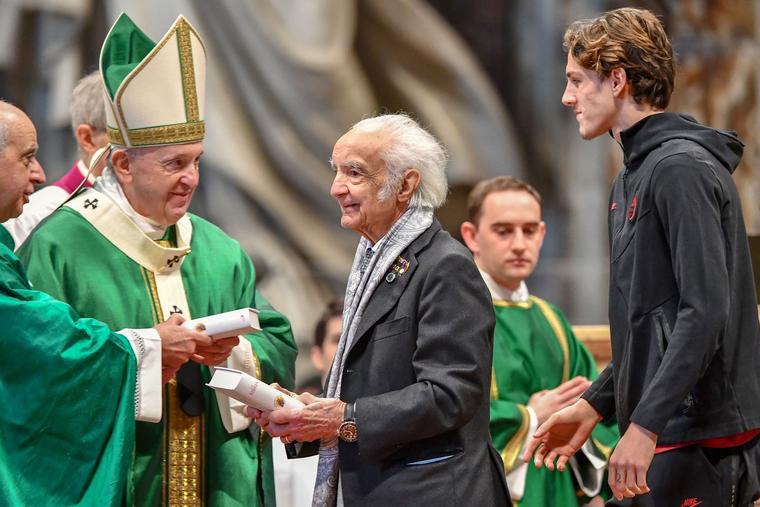
Antonino “Nino” Zichichi, who has died at the age of 96, was not only one of Italy’s most distinguished experimental physicists, but also one of the Holy See’s most respected interlocutors in the challenging dialogue between science and faith.
Over many decades, and especially during the pontificate of Pope St. John Paul II, he helped the Vatican speak credibly to the scientific world, showing that rigorous physics and a robust Catholic faith can illuminate one another.
At the same time, he was not afraid to criticize theories, such as Darwinian evolution and anthropogenic climate change, which he believed lacked scientific rigor.
In a tribute posted online, Italian Premier Giorgia Meloni called him a “giant of our time” who “always claimed that reason and faith are not enemies, but allies — ‘two wings’ to use the words of Saint John Paul II, ‘with which the human spirit rises towards the contemplation of truth.’”
Born in the Sicilian town of Trapani on Oct. 15, 1929, young Nino read physics at the University of Palermo and soon moved into the emerging world of high-energy particle physics, working in the great laboratories of Europe and the United States.
In the 1960s, he worked at CERN, the European Organization for Nuclear Research near Geneva where scientists have studied the fundamental constituents of matter and the forces of the universe, and then at Fermilab, the American flagship national laboratory for particle physics, located west of Chicago. In 1965, he led a team that first spotted a tiny piece of antimatter made from two anti‑particles, the antimatter versions of the proton and the neutron.
“He was a great scientist and a devout Catholic,” Father Paul Haffner, author of The Tiara and the Test Tube. the Popes and Science from the Medieval Period to the Present, told the Register. “Many major projects in international physics are linked to his name.”
Zichichi came from a generation of scientists who had grown up in a world marked by war and nuclear anxiety and therefore acutely felt that science carried a grave moral responsibility — a theme that would later resonate deeply in his conversations with popes and in his long service as a member of the Pontifical Academy of Sciences.
Moreover, it prompted him in 1962 — then only in his early 30s — to found the “Ettore Majorana” Foundation and Centre for Scientific Culture, otherwise known as the “Erice Centre,” whose intent was to give new meaning to science and its culture. It also became a place where leading figures from every scientific field could meet young people selected from around the world, without ideological, political, geographical or racial barriers.
In 1965 he was called to the University of Bologna, where he held a chair in higher physics for decades, but his gaze was already fixed on a wider horizon, in which universities, international laboratories and the Church could collaborate for the good of humanity.
Science for Peace
A lifelong campaigner for peace and nuclear disarmament, in the 1980s he promoted international “Science for Peace” seminars at the Erice Centre, bringing together world-renowned scientists to reflect on the risks of nuclear war and the ethical responsibilities of research. He claimed the 1982 “Manifesto of Erice,” which, in collaboration with John Paul II and signed by 10,000 scientists, called for nuclear disarmament, was a “determinant contribution to the fall of the Berlin Wall.”
In this and similar collaborations, the Holy See welcomed the fact that Zichichi could convene scientists to discuss “planetary emergencies” while remaining open to the Church’s moral teaching. John Paul II visited the Erice Centre in May 1993 and he publicly thanked the professor for his work and praised the center’s work for uniting “a great love for science” with the desire to place it at the service of all humanity. More than 80,000 scientists from 140 countries have taken part in Erice’s activities — “all in the name of science without secrecy and without borders,” Zichichi once pointed out.
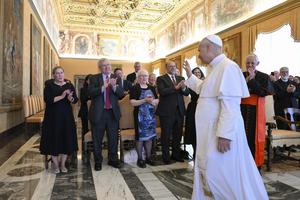
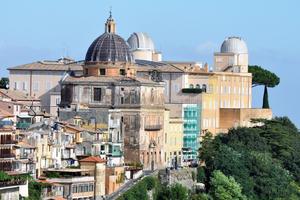
Zichichi’s formal link with the Holy See was sealed in 2000 by his membership in the Pontifical Academy of Sciences, whose headquarters at the Casina Pio IV in the Vatican Gardens became a second home to him. Over the years he delivered numerous interventions at academy plenary sessions on themes ranging from the cultural value of science to complexity in fundamental physics. He consistently pressed the point that authentic science is ordered to truth and therefore has a profound ethical and spiritual dimension.
The Magisterium and the ‘Galileo Affair’
In a 2011 speech to the Pontifical Academy of Sciences, he spoke of science — if the rigorous “Galilean method” is used — as “the queen of all cultural activities,” and he insisted that the method strengthens rather than weakens the believer’s confidence in the Creator.
Indeed, one of the most delicate chapters of his collaboration with the Holy See concerned the Galileo affair, and he played a major role in reflections that paved the way for the Pope’s 1992 address acknowledging “errors” committed in that case.
For Zichichi, Galileo was both a hero of scientific method and a believer whose drama could not be reduced to a simple opposition between science and faith; his writings and lectures often presented the 1992 step as a providential moment in the Church’s reconciliation with the scientific world. In this way he helped many Catholic scientists read the Galileo reevaluation not as a concession to secular pressure but as a deeper return to the truth of both faith and reason.
In prophetic words for today’s AI age, in 2014, he urged the Church and the political world to remember that human beings may perish by misusing technology, but never by discovering the truth — an echo of John Paul II’s trust in the compatibility of genuine science and Christian hope. His language showed how deeply he internalized the magisterium’s teaching on faith and reason and sought to develop it within his own scientific culture.
Under Benedict XVI and into Francis’ pontificate, Zichichi continued to serve the Holy See through the science-focused academy, taking part in plenary sessions on a variety of themes. During these years he also contributed to Vatican-sponsored discussions on climate and development, issuing a damning indictment in 2007 of the U.N.’s Intergovernmental Panel on Climate Change, the body responsible for most of the dire warnings related to climate science. Its models, he said, were “incoherent and invalid from a scientific point of view,” and he contended that it is “plausible that ‘man is not to blame.’”
Darwinian Errors
Zichichi also argued that Darwin’s theory of evolution lacked rigorous scientific, mathematical and experimental validation, adding that it failed to explain why, among millions of species, only human beings are endowed with reason. He frequently asserted that man is not just another animal and that evolution cannot account for this unique quality.
Many of his talks for Catholic audiences, whether in diocesan settings or in interviews for Catholic media, tried to free believers from the fear that science might erode their faith. He returned again and again to the idea that the universe is not the fruit of chaos but of an intelligent design — and that the extraordinary harmony discovered in subnuclear physics points to a Logos rather than to absurdity.
In doing so, he gave countless priests, religious and lay faithful an accessible language in which to articulate confidence in both the Creed and in scientific progress, a contribution that bishops and Vatican officials quietly appreciated when preparing pastoral reflections on science.
His presence at the Casina Pio IV over several decades also affected the internal life of the Pontifical Academy of Sciences itself. The Sicilian professor, a recipient of more than 105 prizes and honorary awards, was emphatic yet courteous, challenging colleagues to express their positions with greater mathematical clarity and to consider the ethical and anthropological stakes of their work.
In the last phase of his life, when physical frailty kept him closer to home, he remained intellectually close to the Holy See through publications and recorded interventions. He would return repeatedly to the words of past popes on the need to heal the split between the Gospel and culture, insisting that physics has a vital role to play in that healing.
After news emerged that Antonino Zichichi had died peacefully in his sleep on Feb. 9, tributes poured in from scientific institutions and from those ecclesial bodies that had come to know him over many years.
For the Holy See, his legacy is not only that of a brilliant scientist, but of a lay Catholic who, with all the limitations of a human life, tried to live out John Paul II’s conviction that science and faith are two gifts of the same God. In an age tempted to place science and faith in conflict, Zichichi showed that the Church can find in the language of physics not a threat but a new grammar in which to proclaim the mystery of creation.

Edward Pentin Edward Pentin is the Register’s Senior Contributor and EWTN News Vatican Analyst. He began reporting on the Pope and the Vatican with Vatican Radio before moving on to become the Rome correspondent for EWTN's National Catholic Register. He has also reported on the Holy See and the Catholic Church for a number of other publications including Newsweek, Newsmax, Zenit, The Catholic Herald, and The Holy Land Review, a Franciscan publication specializing in the Church and the Middle East. Edward is the author of The Next Pope: The Leading Cardinal Candidates (Sophia Institute Press, 2020) and The Rigging of a Vatican Synod? An Investigation into Alleged Manipulation at the Extraordinary Synod on the Family (Ignatius Press, 2015). Follow him on Twitter at @edwardpentin.