Catholic Entrepreneur: The More Powerful AI Becomes, the More People Turn to God
Months after calling for a new order of Christian knights to help the Church navigate the age of artificial intelligence, Catholic tech investor Artur Kluz says Pope Leo’s encyclical has confirmed that the technology world is listening.
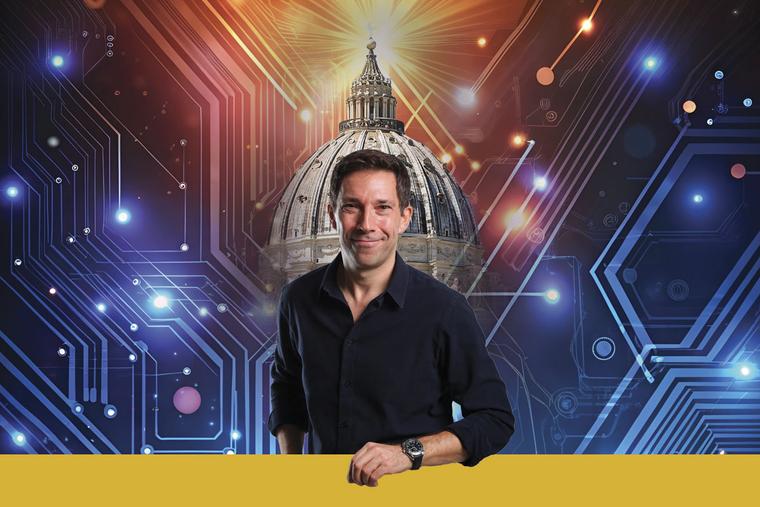
As Pope Leo XIV’s new AI encyclical begins to reverberate across the technology world, a Washington-based Catholic tech investor and entrepreneur with ties to Silicon Valley says many of the people building artificial intelligence are more willing than ever to engage with the Church’s moral vision. Artur Kluz has seen evidence of that shift firsthand.
Last year, he launched through the Register the ambitious idea of creating a new order of Christian “knights” drawn from the worlds of technology, finance and entrepreneurship, ready to help the Church navigate the civilizational challenges and opportunities posed by transformative technologies, including artificial intelligence and space exploration.
What he did not expect was who would call him back. Founders, engineers and venture capitalists — from Silicon Valley to Brussels to Rome, including some non-Catholics — contacted him after reading his appeal and urged him to move faster.
For Kluz, whom the Vatican invited to speak at the United Nations on July 8 on the topics of peace and artificial intelligence, the response revealed an unexpected appetite among technology builders for conversations about the moral and anthropological questions raised by AI.
“The deeper question is not simply who knows more about AI; it is about whom we trust to guide humanity through this technological age,” he told the Register.
This growing rapprochement between the technology world and the Church was recently confirmed by a former Silicon Valley executive-turned-priest. Father Brendan McGuire, pastor of St. Simon Parish in Los Altos, California, told EWTN News Nightly that Anthropic has been engaged in monthly conversations with Church experts more intensely over the last year, adding that technology leaders are actively searching for wisdom as they confront the consequences of the tools they are building.
It was against this backdrop that Pope Leo XIV released Magnifica Humanitas on May 25, the first major papal document devoted to AI and its implications for humanity.
Technology as a Mirror
For Kluz, Magnifica Humanitas does not represent a new direction so much as an institutional confirmation of questions he believes the Church has always been equipped to answer. “The questions may be new, but the underlying moral framework remains the same. Human dignity, the common good, solidarity, subsidiarity, justice and peace remain the foundations of Catholic social teaching.”
Central to his reading of the encyclical is its treatment of truth as a common good — and its insistence that technology is never morally neutral.
“AI, like any technology, is ultimately a consequence of what we are as human beings. Technology and its applications reflect the culture, values and moral condition of those who design, build and use them.”
That is precisely why, he argued, the Church’s voice carries weight in rooms where engineers and investors make decisions that will shape civilization. “I find it difficult to imagine that these people can build truly human-centered AI systems based on moral principles if they do not strive to live according to those virtues themselves. Technology is a mirror of its creators.”
What the current moment demands, he said, goes beyond expertise and calls for more “spiritual intelligence,” in other words, the capacity to “create space where silence, contemplation, prayer and reflection can occur. It is within this space that wisdom emerges.”
Sparking the Deepest Questions
Paradoxically, Kluz believes that the more powerful AI and technology become, the more people seem to recognize its limits, driving a renewed openness to religious questions in parts of the technology world.
Three years ago, he said, discussions about God, the soul and consciousness were relatively uncommon within the technology sector, particularly in Silicon Valley. Today, such conversations are no longer confined to the margins because, in his view, the increasingly disruptive global landscape is forcing many people to confront questions technology cannot answer on its own.
He also noted that a number of Catholic churches in the tech hub of the Bay Area have seen increased attendance among tech workers and AI professionals in recent years.
“What is consciousness? What does it mean to be human? Do we have a soul? Why are we here? What makes human beings unique?” he said, are all questions that are once again coming to the fore in a world that cast aside God and any notion of transcendence decades ago. “Technology can process information, but it cannot replace wisdom. It can generate answers, but it cannot answer the deepest questions of the human heart.”
Pat Dunford, community manager of the faith-based venture network SENT Ventures, sees the same shift. “We have all seen the recent media coverage of the Christian awakening in Silicon Valley, or at least the lessening of the taboo around identifying as Christian in start-up and tech circles,” he told the Register. He believes Kluz’s emphasis on moral formation answers a real need, since technological advancement, in his words, “can only offer us ‘what’ and not ‘why.’”
From Principles to Structures
If Magnifica Humanitas offers moral principles, Kluz believes the next challenge is building institutions capable of embodying them. Through the Kluz Prize for PeaceTech, he has built one of the few systematic mechanisms for identifying technology genuinely directed toward human dignity and flourishing. The prize has attracted more than 350 applications from 82 countries. Its fifth anniversary will be marked in New York in September, during the week of the United Nations General Assembly.
Among the technologies recognized by the Kluz Prize in 2025 are Common Space, which is developing an independent satellite mission for peacebuilding and humanitarian action, and Aerobotics7, whose AI-powered drones help detect and neutralize landmines in conflict zones, including Ukraine.
“One of the most important lessons of the AI era is that trusted information matters enormously. AI systems are only as good as the quality of the information they are built upon.”
For Dunford, initiatives like the Kluz Prize are evidence of the fact that Catholic entrepreneurs are no longer working in isolation. “Catholic entrepreneurs are beginning to unite at scale,” he said, pointing to the Pope’s call for entrepreneurs to take up “their own section of the wall” in building for the common good — a phrase his network has adopted to describe what they call “Saintly Builders.”
Preparing the Church’s Future Advisers
As for the order of Christian technologists he called for last November, Kluz is building it with the same deliberateness he applies to everything else. A first formal gathering is planned for later this year. The circle he envisions would bring together entrepreneurs, technology founders, engineers, investors, academics, policymakers, philosophers and theologians — chosen not for their wealth or public profile but for their conviction, character and expertise.
The initiative and his “VirtueTech” philosophy have already drawn support from SENT Ventures and The David Network, another faith-rooted nonprofit active in the American technology sector.
Kluz said he recently attended a dinner in San Francisco with young Christian professionals working for some of the most influential AI and transformative technology companies — an encounter he described as an opportunity to gauge the mood on the ground and listen to a generation already shaping the future. “It was fascinating to see that many young technology builders are no longer interested merely in discussing a ‘philosophical God’ as an abstract concept. They express a genuine desire to encounter and know the living God.”
Formation is his long-term ambition. He is currently supporting a doctoral candidate in Rome researching theology and quantum physics and plans to offer scholarships to monks, priests, women religious and laypeople — including technology founders, engineers and coders — working at the intersection of Catholic thought and emerging technologies. The goal is to give all of them the opportunity to study at Catholic universities in Rome.
“What I increasingly observe is that many people aspire to become experts in Catholic teaching, AI or technology without deeply understanding both worlds. This is very risky — especially since those people might one day be advisers to the Pope.”
Ultimately, Kluz is convinced that the most profound challenge posed by the encyclical is not directed at Silicon Valley, but at the Church itself, which is called upon to educate people who are wise enough to guide a civilization that creates tools faster than it can figure out what to do with them. “The real race in AI,” he concluded, “will not be between companies or nations, but between wisdom and power.”