What’s the Right Way to Ask for a Miracle?
And don't 'just ask for one miracle — they should ask for five or 10,' Amthony DeStefano advises. 'A new Age of Miracles would show the world, once again, that God is real..'
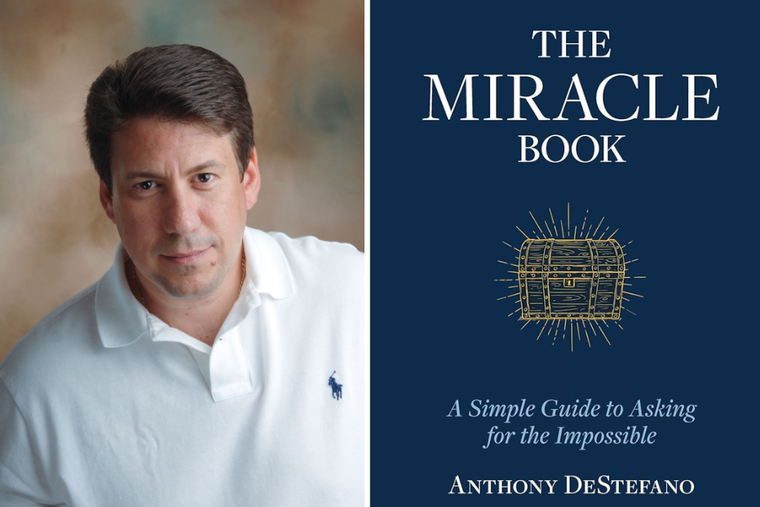
Bestselling author Anthony DeStefano has just released The Miracle Book: A Simple Guide to Asking for the Impossible. It is an inspiring work that deserves a prominent place on every bookshelf and in every reader’s hands. DeStefano, whose books include A Travel Guide to Heaven, Ten Prayers God Always Says Yes To, The Donkey That No One Could Ride, and Our Lady’s Wardrobe (find an array at EWTNRC.com), leads, edifies and encourages everyone to the right ways and whys of praying for what many might think is impossible. But with God all things are possible.
As EWTN’s outgoing president and COO, Doug Keck, wrote in his endorsement: “DeStefano strips away superstition and wishful thinking to present a clear-eyed, compelling case for how prayer can unlock the miraculous. A rare blend of spiritual wisdom and practical guidance.”
The conversational style is also a plus because it makes readers feel as if they are being spoken to personally. DeStefano did the same with the Register as he answered questions about The Miracle Book.
What prompted you to write this book on praying for miracles or an extraordinary answer to prayer?
I think so many people out there are suffering badly — maybe some of the people reading this now — but they don’t know how to go about asking God for help, other than begging him. They beg, they plead, they negotiate, they promise they’ll do absolutely anything, if only God will grant them this one request. Then, if God doesn’t answer their prayer in the way they want, unfortunately they sometimes lose faith or get angry at God or sink into despair. There must be a better way. There must be a method of praying for a miracle that guarantees the best possible chance of God saying “Yes” to us, or at least results in God answering in a way that gives us peace.
I did many years of research on this subject, and I read every single book on miracles out there, and I think I succeeded in finding that better way. I don’t use any gimmicks. I don’t provide any “magic formulas” that guarantee specific results. But I do offer solid, biblically based, theologically sound principles that I believe can dramatically increase your chances of obtaining a miracle.
People in countless situations pray for miracles. Who is your book aimed at?
The book is for people facing any kind of crisis — people who feel they’re at the end of their rope and know they must turn to God for a miracle. The miracle might have to do with their health or their finances or their family problems or just feelings of anxiety or hopelessness. The audience can be Catholic or Christians of any denomination; they can be regular churchgoers or people who haven’t prayed in years. The book might even appeal to skeptics or agnostics who are open to having faith because they’re in serious trouble. As the saying goes, “There are no atheists in foxholes.”
The Miracle Book is obviously not another religious self-help book. How and why is it different?
Jesus said: “If you want to gain your life you first must lose it.” That means the path to your true self — the person God created you to be — begins with dying to your false self. This book is not concerned with self-help techniques; it’s not simply about tweaking a few habits and substituting them with more productive ones. This book is about total transformation. It talks about dying to yourself so that you can live your best self. “Dying to self” essentially means “killing off the worst parts of yourself” with the assistance of God. When you do that, you aren’t destroying your identity; you’re shedding a false version of yourself to make room for the true self to emerge. That’s a heck of a lot more than “self-help” — it’s “God-help.”
Why do you focus on the concept of “paradoxes” as important to obtaining miracles?
Paradoxes are truths that seem to contradict themselves on the surface but actually reveal a deeper kind of truth when you reflect on them. Christianity is filled with paradoxes: The first shall be last, and the last shall be first; God is one, but God is three; Christ is fully God and fully man. These aren’t just poetic ideas — they reflect the reality that God is an infinite being and that we’re just finite creatures. We can only understand bits of God’s infinite truth a little at a time, and sometimes those bits of truth look like they might contradict each other. But, in reality, we just can’t see the whole truth yet.
So, by embracing paradoxes, we can come closer to appreciating the mystery of God. Now, in the Gospels, Jesus makes some pretty powerful promises. He says things like, “Ask, and it will be given to you,” and “If you have faith the size of a mustard seed, you can move mountains.” These are very bold, clear promises — and yet, we know that, many times, even the most faith-filled people don’t receive what they pray for. Why? The reason is that they’re really paradoxes. They involve embracing pairs of truths that seem to contradict each other but are actually meant to be held simultaneously, which can be hard to do.
Please share a sample of examples of the kind of paradoxes you discuss in this book.
In my book, I talk about paradoxes like how we’re called to be self-reliant but also completely surrender to God, how we need to pray persistently but also have decisive faith, and how a personal relationship with Jesus is essential but so is belonging to a community of believers. These seeming contradictions actually work together and help open the door to miracles.
You have an exceptionally beautiful and inspiring section on intercessory prayer and the most important person we should turn to for that. Please share who — and why.
While a personal relationship with God is the very heart of our faith, we’re never meant to walk this path alone. God has given us the whole Body of Christ to be our family — and within this family, the Blessed Virgin Mary stands as the greatest intercessor we can turn to. Intercessory prayer doesn’t diminish our personal relationship with God — it magnifies it. And Mary is that singular creation of God who magnifies him the most. Because of her intimate closeness to Christ, and as the spouse of the Holy Spirit, she pleads for us as a loving Mother. In moments when our own prayers feel weak or uncertain, we can entrust them to her, knowing that her voice carries special power in heaven. Turning to Mary is not a sign of lacking faith in Christ — it’s a profound act of faith in God’s design of family, love and communion.
Why do you tell readers that they should be excited about the prospect of praying for a miracle today? In fact, you say they shouldn’t pray for just one; they should pray for as many as they need.
The so-called “Age of Miracles” occurred 2,000 years ago, during early apostolic times. Back then, bona fide miracles weren’t just exceptions to the rule — they were regular occurrences. Not only Jesus, but the apostles and many of the early Christian leaders, healed the sick, raised the dead, and cast out demons as a normal part of their ministry. That’s why the early Church was able to grow so rapidly, even in the face of terrible persecution.
Now, 2,000 years later, Christianity is being oppressed all over the globe. In the West, it’s being persecuted, not with lions and gladiators, but with ridicule, censorship, legal threats, the cancel culture, and intense propaganda from the media, Hollywood, academia and the political world. To me, it makes perfect sense that God would accompany a renewed effort at evangelization during this time of persecution with a fresh wave of miracles. A new Age of Miracles would show the world, once again, that God is real, that he’s powerful, and that his love is calling us to conversion. So, yes, I tell people they should take advantage of this time of purification and not just ask for one miracle — they should ask for five or 10. Let’s all try to usher in this new age of miracles together!
What are your hopes for this book and for readers of this book?
I have only one hope and one prayer for this book: that the people who read it receive the miracle they truly desire — or at least a powerful answer to prayer that brings them peace, satisfies their soul, and helps them see the loving hand of God at work in their lives. Even if their miracle doesn’t turn out the way they expect, I hope they discover that God’s answers are always wiser, deeper and more beautiful than anything they could have imagined.
For people who truly feel they are at the end of their rope and desperately need a miracle, what’s the most important thing they should do right now?
First, whenever you’re experiencing anxiety, take a breath and try to be calm. As the Psalm (46:10) says, “Be still and know that I am God.” Faith is the most important biblical requirement for a miracle. But instead of getting worked up emotionally, make a decisive act of the will to trust God. Don’t try to feel faith — think faith. Even in turmoil, say with St. Faustina: “Jesus, I trust in you.”
Second, decide to be sorry for all your sins and resolve to become holier. Jesus used miracles to turn sinners around. That’s what he wants most: the transformation of your soul. So, if you need a miracle, ask God’s forgiveness and be willing to change.
Third, be radically open to God’s will. Ask for what you want precisely but then echo Jesus’ words: “Not my will, but yours be done.” That’s the model for all miracle prayers. It gives God permission to act in unexpected and extraordinary ways. Finally, don’t forget to pray for God’s greater glory. When asking for a miracle, also pray that it deepens others’ faith and shows God’s power. Seeking his glory demonstrates humility and a mature faith, making your prayer more worthy of a miraculous answer.
The Miracle Book
A Simple Guide to Asking for the Impossible
By Anthony DeStefano
Sophia Institute Press, 2025
224 Top of Form
pages; $24.95
To order: EWTNRC.com (Item: 4351); or call (800) 854-6316.
- Keywords:
- Anthony DeStefano
- miracles