Political Extremes and the Fate of Religion: What to Do About Emptying Pews — and How to Get People to Care About Faith
Scholar says the decline of moderate religion in the U.S. harms everyone.
On the question of political affiliation — Republican or Democrat, liberal or conservative — how do American Catholics compare with other religious denominations? And what could it mean for the country as a whole when people start choosing churches based on politics instead of faith?
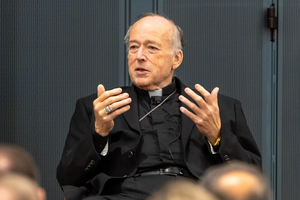
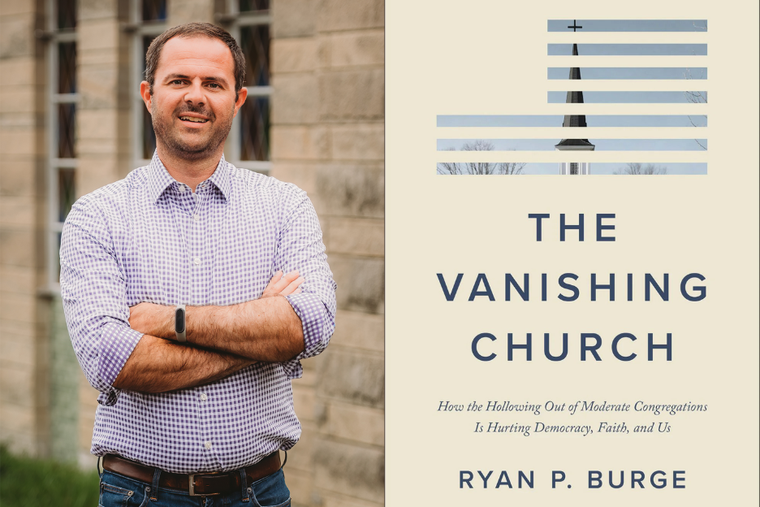
Ryan Burge, a widely-cited researcher of religion and religious trends and a former Protestant pastor in the American Baptist Church, explores these questions and more in his new book, The Vanishing Church: How the Hollowing Out of Moderate Congregations Is Hurting Democracy, Faith, and Us. In it, Burge presents evidence that Americans today — especially Christians — largely prioritize their political parties over their religious denominations, leading to more congregations that are strongly liberal or conservative, and an overall decline in moderate congregations.
The Register spoke with Burge about his book and the trends he has observed in relation to U.S. Catholicism, following a recent EWTN poll that shed light on the political views of Catholic voters.
Although not a Catholic himself, Burge’s research provides insights into how Catholics are being affected by the political landscape in the U.S., especially in comparison with other religious denominations.
Responses have been edited for length and clarity.
What is the topic of this book, and what are your overarching findings?
The book's about polarization. We’re becoming a more religiously polarized country. Religion used to be a great mixing place and meeting place, and now it’s the opposite of that. In many ways, it’s actually accelerated the split between the left and the right in America. And there’s no evidence in the data that it’s going to get better anytime soon. Religious polarization might get much worse in the decades to come.
With Catholic clergy, there has been among younger priests a shift towards being more conservative. Have you found that phenomenon in other denominations’ clergy? Are other denominations also trending a bit more conservative among younger clergy?
If you look at the membership data and voting trends of mainline Protestants, they’re actually very politically divided, if not slightly Republican. In many denominations, it’s slightly leaned to the right. But if you look at clergy in these mainline denominations, they’re overwhelmingly liberal. It’s an interesting fact that there’s this divide happening in the mainline between the folks sitting in the pews and the person standing in the pulpit.
In the case of the Catholic Church, there’s evidence that the priesthood is moving to the right — overwhelming evidence. But if you look in the pews, the average Catholic today is more conservative and more Republican now than they were 20 years ago, too. At least there, the movement is in the same direction. It’s just the intensity of that movement is different.
You conclude that, for many people, their religious belief largely is secondary to their political beliefs — have you found that to be true among the Catholics you studied?
I think Catholicism is a different thing than a lot of these other [denominations]. The only other group that I would put in that category are Jews. A lot of people will say they’re culturally Jewish when they don’t go to synagogue, they don't observe. A lot of people say they’re Catholic when, really, they’re not going to Mass; they don’t really ascribe to the doctrine of the Church.
In a lot of other traditions, if you stop doing that, you just leave. You stop identifying as Baptist or Methodist or Episcopalian or Latter-day Saints. Analyzing Catholics is different because you still have a lot of people in your sample of Catholics who aren’t really [practicing] Catholics.
You’ve opined that, by and large, there aren’t really any church congregations remaining where people of the left and right political persuasion mix together in the pews, adding that many churches’ lack of distinctiveness from the wider culture is partly to blame. Can you expand on that?
When [as a church] you don’t differentiate yourself from the culture, people go, “Why do I need to join you? You’re just like us, or we’re just like you.” Religion does well when it has a clear differentiator from the average American. I think that’s why evangelicals have done relatively well, all things considered, because they managed to do that. They separated themselves from the culture in a way that mainliners just didn’t. They’re actually losing because they won, and now they don’t have any way to separate themselves.
I think this is one of the reasons that people might be drawn to Catholicism, too, because they like the distinctiveness of the whole thing.
People say politics are driving people out of church. Actually, I think in some ways, politics are driving some people into church traditions in a way that would have not been true 20 or 25 years ago.
In general, among many different denominations, not just Catholic, are you seeing this shift to either the more extreme right or the more extreme left? Is this a phenomenon that you’re seeing across almost all denominations and religions in the U.S.?
Yes. Almost every religion now seems like it’s sorted out. You know what you’re getting yourself into when you go to an Episcopal church — you’re going to find a lot of left-wing people. Unitarian Universalists, you know what you’re in for when you get there.
I think in some ways that has actually made it easier — you’re not surprised when you get there. People are choosing religious homes that match their predispositions. You can really just cater your social life and your religious life and your media life to reinforce what you already believe.
People are like, “I'm not even going to walk in the door until I know exactly what I’m getting.”
Even when Catholics are presented with the choice, they would choose to drive a little bit further, maybe, to go to a parish that matches their politics. It’s an endemic thing across all religion, really.
Talk about the concept of “The God Gap.” This refers to the fact that the Republican Party has over a course of many decades become the party of religious people, whereas if you’re in the “nones” or an atheist, chances are, you’re a Democrat. This obviously wasn’t historically always the case.
Yeah, this is a phenomenon that social science really started to identify in the early 1990s when the “nones” started to rise. The nones are not rising equally among Republicans and Democrats, [but rather] rising much faster with people on the left side of the political spectrum than the right side.
And so now, the modern parties have definitely sorted themselves out. The Republican Party is absolutely the party of religious people. Eighty-eight percent of Trump voters are some type of religious person. Among Harris voters, they were only 55%. So 45% of Harris voters were nonreligious, and it was 12% of Trump’s voters. A quarter of all Harris voters were atheists and agnostics, versus 3% of Trump’s voters. Meanwhile, evangelicals were 45% of Trump’s coalition.
The Republican Party has basically become the party of religious people, especially white Christianity. That’s 75% of their coalition. The Democratic Party has become the party of everyone else: nonreligious people, non-Christian people, Muslims, Hindus, Buddhists, Jews. But, also, there’s a smattering of non-white Christians in there, too, including Black Protestants and [some] Hispanic Catholics.
How much of that sorting out do you think is due to the abortion issue?
Not nearly as much as we think it is. If you look at the data around support for Donald Trump among Christians, it actually turns more on views of immigration than it does on issues of abortion. I think abortion became this front-facing issue we all care about, when in reality, if you dig below the surface, I think immigration is one of [the most important issues], if not the most important issue, to Republican voters right now.
Even the Republican Party — and we’ve seen Trump come out and say we’ve got to be flexible on the Hyde Amendment — [opposition to abortion] is not the litmus test for a Republican politician to win elections like it used to be. Or maybe it never was, but it certainly isn’t now.
So where do we go from here, in terms of trying to mitigate some of this polarization and encourage greater unity?
A lot of young people are lonely and they’re looking for something to do. I think there’s always the possibility of maybe some people coming back to church in the future. … “Nothing in particular” is what that group is. They’re just disengaged. But that group actually is amenable to coming back to a religion. They don't hate religion; they’re just apathetic about pretty much everything in their lives.
I do think, too, that a lot of younger people have approached religion without as much baggage as their parents and grandparents did, because they didn’t grow up with religion in their household. You don’t have to try to convince them that religion is good; they just don’t have an opinion either way. They’re neutral, and you’ve got to bring them towards positive. That’s a lot easier to do than trying to bring them from negative to positive.
There are more “nothing in particulars” [in the U.S.] than there are Protestants or Catholics. If you can convince people to care, now you’ve got something. That’s the main challenge of religion going forward, is just getting people to care — and to join.
- Keywords:
- all religions
- political polarization