New Survey on Priests: 8 Key Insights on Well-Being, Opinions and Pastoral Priorities
Interesting details include political affiliation, pastoral desires vs. parish life, synodality, loneliness and more.

A major new study released last week offered further confirmation that U.S. priests ordained in the past 15 years are much more conservative, both politically and doctrinally, than their older counterparts.
But that headline doesn’t tell the entire story. The study also contained interesting revelations regarding priests’ opinions about the role of women in the Catholic Church; the loneliness and burnout that many young priests experience; the surprising priestly response to the phenomenon of “synodality” in the U.S. Church, and the degree to which priests think their diocese or religious order is “flourishing.”
Released on Oct. 14, the “National Study of Catholic Priests” examined a group of roughly 1,200 U.S. priests over the summer, all of whom had participated in a previous 2022 study. That prior study found that despite relatively high levels of personal well-being and fulfillment among priests, a significant percentage of priests have issues with burnout, distrust of their bishop and fears of being falsely accused of misconduct.
The goal of the latest survey, the researchers said, was to see if anything has changed for those priests and to ascertain their pastoral priorities. The survey was commissioned by The Catholic Project at The Catholic University of America and conducted by Gallup.
Here are some of the highlights.
1. Young priests remain conservative … but defy traditional left-right labels.
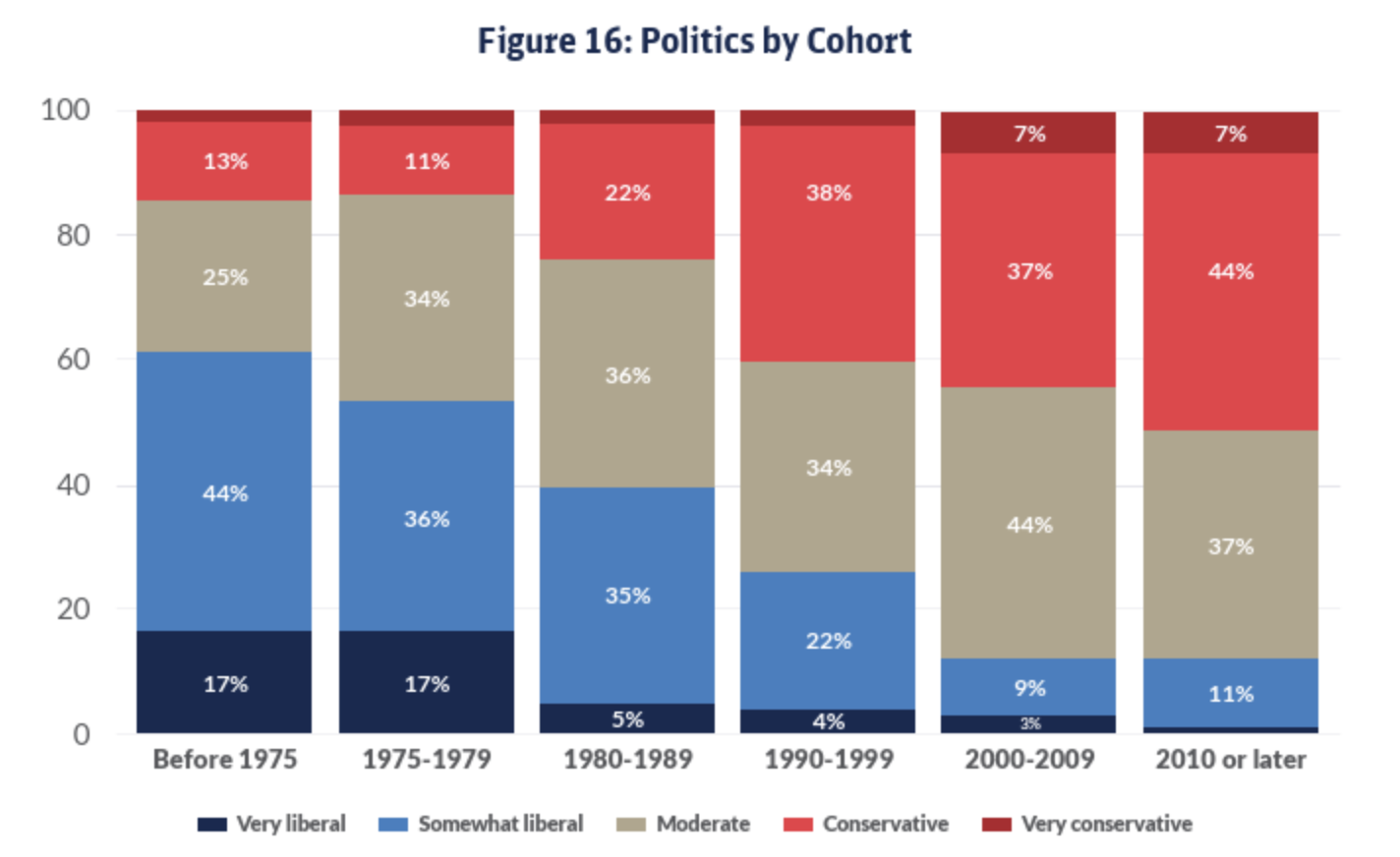
Mirroring the previous study, the latest results show that the more recently a man has been ordained in the U.S., the more likely he is to identify as doctrinally and politically conservative. But the data also paints a nuanced picture of those priests’ conservatism, as a significant percentage of priests, regardless of their political loyalty, expressed concern about the policies of the current presidential administration.
Speaking specifically about political labels, about 51% of the priests ordained in 2010 or later said their political views are either “Conservative” or “Very Conservative.” Another 37% described themselves as moderate, and the remaining 12% were either “Liberal” or “Very Liberal.”
In contrast, when looking at older priests, the numbers essentially flip: About 53% of priests ordained between 1975 and 1979 say they are either “Liberal” or “Very Liberal,” about 34% are moderate and 11% conservative. Even further, about 61% of priests ordained before 1975 said they are “Liberal” or “Very Liberal,” 25% are moderate, and just 13% are conservative.
Looking at theological leanings, about 70% of priests ordained before 1975 called themselves theological progressives, while only 8% of priests ordained 2010 or later described themselves that way. On the flip side, more than 70% of the youngest priests described themselves as either “conservative/orthodox” or “very conservative/orthodox.”
The priests were then asked: “To what extent are you concerned about the policies of the current political administration in the U.S.?” The researchers then categorized the answers to the question according to the priests’ self-identification as conservative or liberal. The results showed that even among those priests who identify as “Very Conservative,” 66% are at least somewhat concerned about the current administration’s policies, with 83% of self-described “conservative” priests at least somewhat concerned. (It’s worth noting that the survey does not elaborate on what policies they are concerned about specifically.)
The researchers concluded that the “nuanced responses indicate that there is concern among priests of all political leanings and that these concerns appear to be driven by something other than mere partisan preference.”
2. Priests are largely flourishing … but don’t think their communities are, at least not to the same degree.
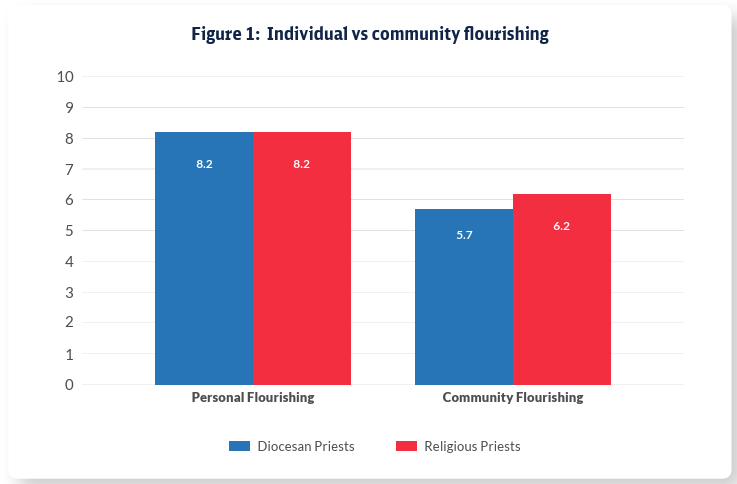
Priests continued to report high and stable levels of personal flourishing — significantly higher levels, in fact, than the general population.
The respondents scored an average of 8.2 out of 10 on the “Harvard Flourishing Scale,” a multidimensional measure of well-being that takes into account mental health, physical health, purpose, character and social relationships. For both diocesan and religious priests, there was no change in the average well-being score the researchers observed in 2022.
However, it was a different story when priests were asked whether their diocese or religious order is flourishing. Both diocesan and religious priests evaluated the flourishing of their respective communities at rates considerably lower than their own personal flourishing: 5.7 out of 10 for diocesan flourishing; and 6.2 out of 10 for religious order flourishing. (The diocese or religious order that each priest belongs to was not recorded in the study.)
3. There’s a notable gap between priests’ stated pastoral priorities and the actual ministries offered at most parishes.
While many priests share a broad, mission-oriented pastoral vision, there’s a notable gap, at least currently, between their stated aspirations and the realization of those aspirations in their parishes.
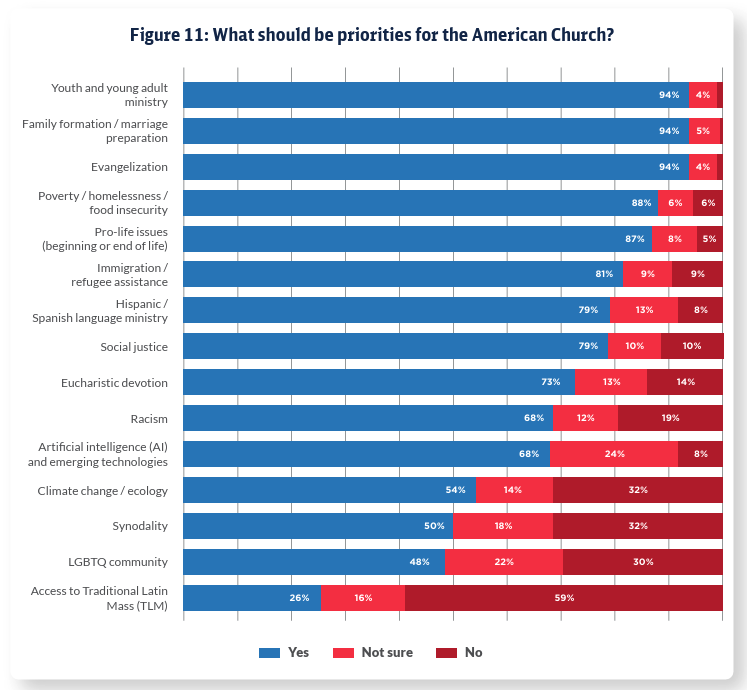
When asked to list what they thought the priorities should be for the Church in the U.S., three issues topped the list, with 94% of priests citing them: youth and young-adult ministry, family formation and marriage preparation, and evangelization.
Of note, “Access to the Traditional Latin Mass” was cited as a priority by only 26% of respondents, and it was the only issue mentioned in the study that a majority of priests (59%) said should not be a priority.
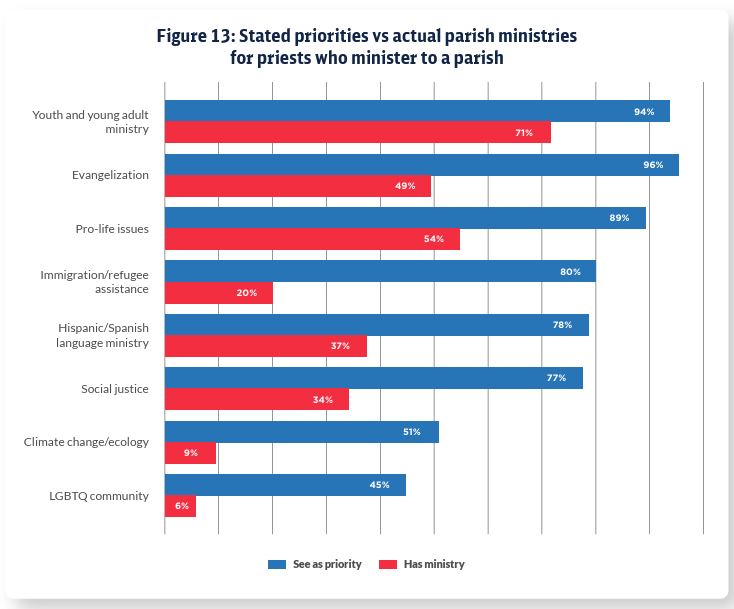
However, the data show that seeing an issue as a priority does not mean a priest’s parish has a ministry dedicated to it.
For example, while 94% of parish priests think youth ministry should be the No. 1 priority, only 71% of them have a dedicated youth ministry in their parish. The discrepancy is even more stark with evangelization, which 94% of priests identified as a priority, but only 49% of parishes offer as a dedicated ministry (though it’s worth noting that the study doesn’t define exactly what might be considered an “evangelization” ministry). The “LGBTQ community,” while cited by 45% of priests, is only addressed as a dedicated ministry in 6% of parishes.
Possible reasons for this disparity, the researchers note, include a general lack of resources; after all, parishes of a higher socioeconomic status are more likely than financially struggling parishes to have dedicated ministries of any kind. It could also be the case that diocesan offices provide support in some of these areas, making parish-level ministries redundant. Furthermore, priests may recognize some concerns, such as climate change, as important, but the parish lacks the ability to take concrete action.
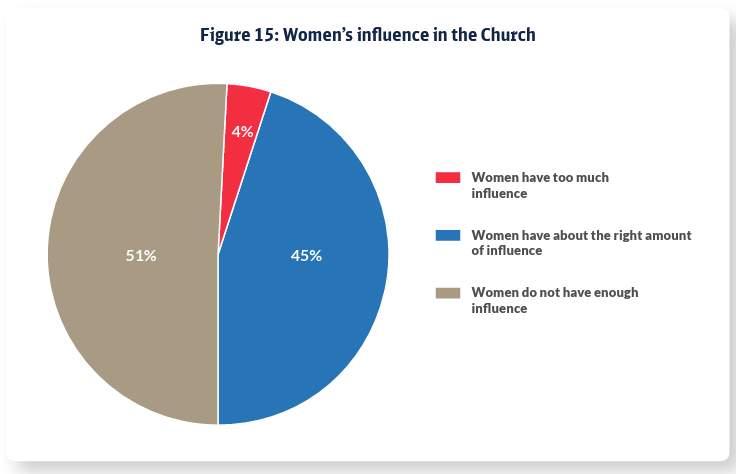
4. When it comes to the role of women in the Church, priests have almost identical opinions as the Catholic population at large.
In assessing priestly attitudes toward the influence of women in the Church, the 2025 survey revealed a strong alignment between their attitudes and the general Catholic population.
Fifty-one percent of priests said they believe that women do not have enough influence in the Church. Forty-five percent said they feel women have about the right amount of influence, while a small minority, 4%, said women have “too much” influence.
The data highlight, according to the researchers, that when it comes to opinions about women in the Church, priests aren’t operating in an echo chamber — rather, their attitudes reflect the sentiment of the population they serve.
5. While priests are generally skeptical of the term “synodality,” they are surprisingly “synodal” in practice.
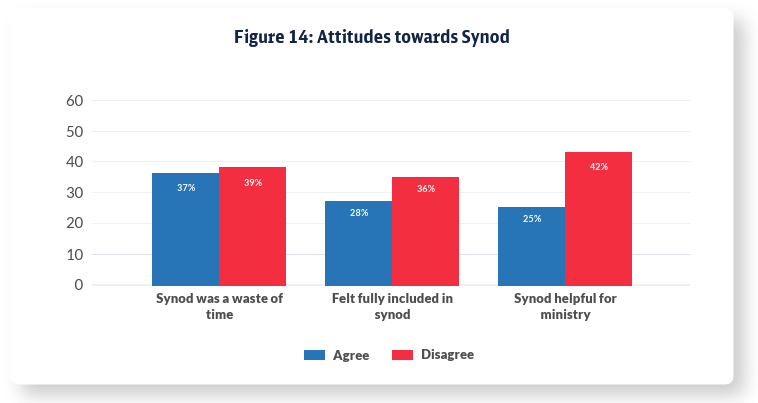
The findings related to the Synod on Synodality, which concluded last year under the late Pope Francis, reveal a complex picture of U.S. priests: While many of them are skeptical of the term and the formal process of “synodality,” many parishes are “surprisingly synodal in practice,” the researchers note.
A significant minority, 37%, said the Synod on Synodality was “a waste of time,” while 39% disagreed. Furthermore, more priests reported feeling “excluded” than “included” when it came to the synod process. In terms of helpfulness, only 25% said they found the synod helpful for their ministry, while between 42% and 43% said it wasn’t.
That said, other results show that many priests already engage with the collaborative spirit of synodality in their parishes, with many parishes involving laypeople in important decisions and projects. As evidence, the researchers note that 85% of parish priests have a pastoral council or similar body that plays an important role in decision-making. Moreover, 75% of priests involve parishioners in prayer and reflection before making significant decisions.
The researchers found that many priests have been doing these things for a long time, suggesting that the synod did not necessarily introduce new practices but rather reaffirmed existing — and effective — ministerial approaches.
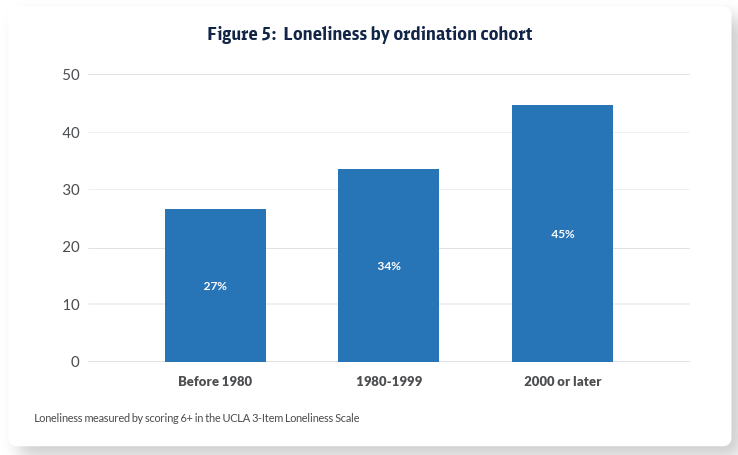
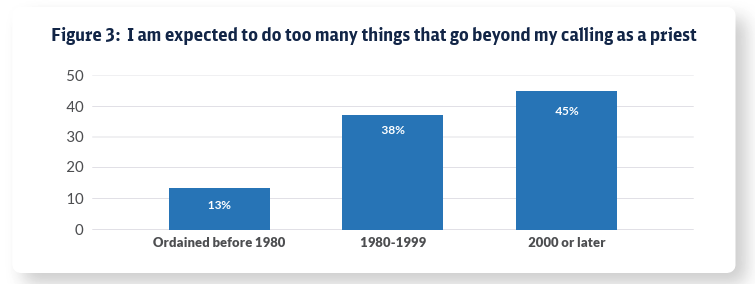
6. Younger priests are more likely to say they are expected to go above and beyond their vocational calling. They’re also lonelier than their older peers.
Younger priests report feeling higher levels of expectation, burnout and loneliness compared with their more senior counterparts. Nearly half of young priests are lonely, based on the scale the researchers used, compared to just 27% of priests ordained before 1980.
Digging further, younger priests are more likely to say they are asked to do things that are above their primary calling as a priest; they are more likely to feel burdened by bureaucratic tasks in the parish, for example, feeling it takes away from their time and energy needed for ministry.
The researchers point to the fact that younger priests are often asked to take on large responsibilities at a younger age than many of their older peers did, such as becoming pastors and sometimes shepherding multiple parishes.
7. The No. 1 predictor of priests’ trust in their bishops may not be what the researchers originally thought.
In their previous study, the researchers concluded that the No. 1 predictor of a priest’s confidence in his bishop was perceived political and theological alignment — essentially, “Does my bishop agree with me?”
However, the researchers tweaked the questions this time around and found something different. This time, the No. 1 predictor of trust is whether priest agrees with the statement: “I feel that my bishop cares about me.” This echoes the consistent finding from previous research that priests look to their bishops to be “fathers” who are personally invested in their well-being.
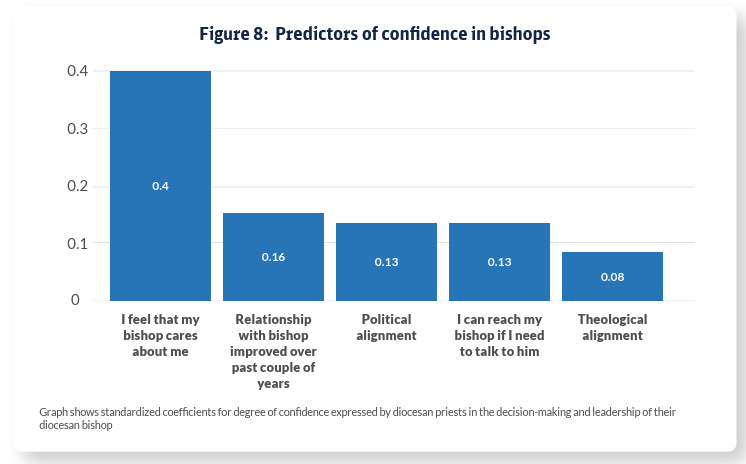
Seventy-two percent of diocesan priests who feel their bishop cares about them expressed confidence in their bishop, while only 10% who do not feel cared for expressed confidence. The feelings of personal attention and support are fundamental for restoring institutional trust, the researchers concluded.
The researchers cautioned, however, that personal care was not the sole predictor of trust, even though it was an important one. Priests still require additional evidence of competence, transparency and other factors to fully extend their confidence to Church leadership, they said.
8. There is a widespread interest among U.S. priests in ongoing formation.
Priests surveyed were interested in growing and learning more about the faith they profess, with 61% saying that they would like more spiritual formation and 55% asking for convocations or retreats.
“American priests recognize that they cannot be stagnant in their spiritual lives. This could be a good reminder to all Catholics, that their priests, too, are on a journey, and they continue to need the laity’s prayers, support, and friendship,” the researchers wrote.
It’s clear that young priests — who are set to take on even more responsibilities as the oldest cohort of priests retires — will need ongoing formation, support and attentive care from their leaders if they are to effectively continue in their ministry.
- Keywords:
- priestly vocations
- synod on synodality