Jesus Will See You Now: Adoration ‘Check-In’ and Scheduling Software a Boon for Parishes
What was once accomplished through clipboards or scribbled notes is now supported by digital tools to ensure there is always someone present with the Blessed Sacrament.
While chatting one day at his local tire shop with an elderly fellow parishioner — who happened to be in charge of coordinating Eucharistic adoration at their parish — Michael Tigue was presented with an intriguing proposition. The man suggested that Tigue create a computer program to assist the parish in scheduling adoration hours.
Tigue, who had founded a Catholic-focused software firm called Parish Solutions Co., was at first skeptical; he mused that such a program might be helpful at his own parish, but likely wasn’t marketable. But he was willing to give it a try.
Thinking all the while that his adoration-scheduling software would be a one-off project, Tigue coded a program that worked like a charm for his parish, Holy Trinity Catholic Church in Peachtree City, Georgia. After that success, he began offering the program to Parish Solutions Co.’s existing customers.
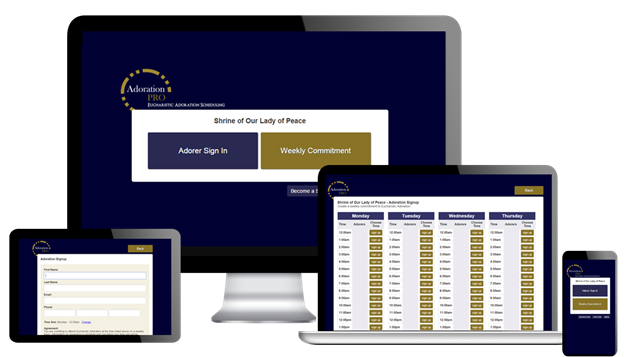
That was a decade ago. Tigue told the Register that the program, “Adoration Pro,” is now used by some 330 customers — mostly parishes, but also shrines, universities and other Catholic organizations — facilitating the scheduling of more than 100,000 adorers and more than 150,000 hours of adoration per month.
Adoration Pro is one of several recent innovations that are helping parishes manage Eucharistic adoration schedules through digital platforms. The other major player in the U.S. adoration-software market is “We Adore Him,” which also boasts more than 300 accounts. Founder Joel Stein, who lives in St. Louis, launched that service in 2018.
As Eucharistic adoration continues to grow across the United States, spurred in part by the recently concluded National Eucharistic Revival, many parishes are looking for ways to sustain, expand or simply manage their adoration schedules. What was once accomplished through clipboards, spreadsheets, scribbled notes or overflowing email chains is now increasingly supported by specialized digital tools, like Adoration Pro, designed specifically to help ensure there is always someone present with the Blessed Sacrament while it is exposed — thereby maintaining reverence for Christ’s True Presence.
Adoration Pro’s customers vary between parishes new to adoration and those that have been doing perpetual adoration for decades and “finally realize they need a better system,” Tigue said, speaking to the Register from his office just outside of Atlanta.
The core features of Adoration Pro focus on simple controls and a web-based interface, keeping in mind the older demographic that still dominates many parishes. Adorers can sign up for available adoration hours online, without the need for usernames or passwords. For the most part, once adorers sign up for a timeslot, they rarely need to interact with the system at all unless they need a substitute, Tigue said.
The software’s built-in system for scheduling substitute adorers is the feature administrators seem to value most, Tigue said. When an adorer can’t make his or her scheduled hour, he or she fills out a quick form and the system instantly sends a text message or email request to the parish’s list of substitutes. Once a sub accepts, the slot is marked as covered — eliminating the long strings of texts, emails or phone calls that once exhausted coordinators.
A lot of first-time customers, Tigue said, are parish volunteers who offer to pay for it out of pocket at the beginning, just to get the parish started with the new software. In many of those cases, he said, the parish ends up deciding to pay for the service once it sees how helpful it is.
Another very common scenario is that a parish adoration coordinator wants to pass the duties on to someone else, but a hand-created scheduling structure, perhaps based on a spreadsheet or notebook, is too bespoke and complicated for another person to understand. With Adoration Pro set up, a parish’s adoration system essentially “runs itself” and can be easily passed on to a new administrator, he said.
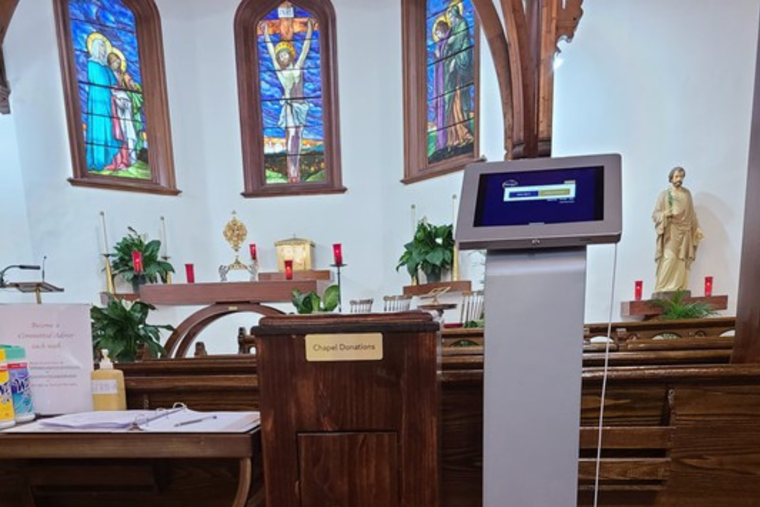
Many parishes add an optional check-in kiosk or iPad station in or outside the chapel, he continued. Adorers “tap” their name upon arrival, allowing administrators to monitor attendance patterns, see which hours are struggling, and address concerns before they get worse.
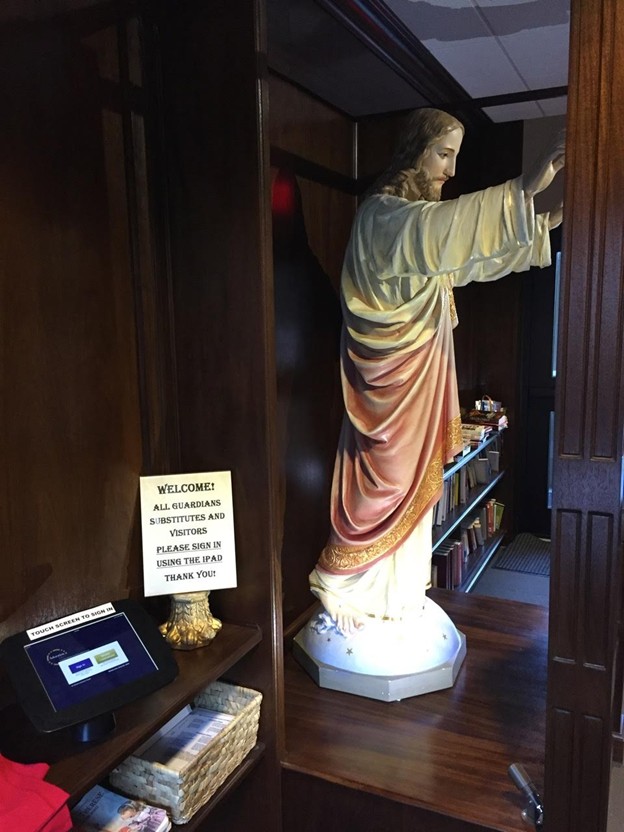
The service costs a parish $60 a month for a regular subscription. There’s also a starter package for $40 a month for parishes offering 30 or fewer hours of adoration a week. For those parishes, though, the subscription includes a “Coming Soon” feature that displays adorations hours that can be signed up for but are not yet active. Allowing parishioners to “sign up” for those hours can help give administrators a sense of what’s possible to fill, Tigue explained.
Tigue said it’s difficult to tell with certainty whether the National Eucharistic Revival has led to a measurable increase in demand for such services, as growth has been steady overall. The largest growth the company has seen since the start of the Revival, however, is among parishes signing up and “starting small” — those that have perhaps never offered Eucharistic adoration before but are wanting to give it a try, starting with a couple of hours a week.
“I suspect those are often part of the Eucharistic Revival,” Tigue commented.
“They weren’t doing anything, and they decide, ‘We’re going to do one day a week, two days a week.’ And so I think that’s a bit of fruit of a new awareness or new attempt to do adoration.”
Stein, the creator of We Adore Him, told the Register that scheduling perpetual adoration is a uniquely complex technological puzzle: It’s non-stop, systems must manage text reminders, track attendance across time zones, handle sudden changes, and remain stable even for parishes with limited technical familiarity. But the results have been deeply rewarding, with many parish customers telling Stein that they “can’t imagine, now, not having We Adore Him.”
Stein said he has also been surprised and edified by how many of his customers — around 80% of the parishes that use We Adore Him — have installed some sort of kiosk outside of adoration chapels to make sign-ins easy.
Amidst the Eucharistic Revival, Stein, echoing Tigue, said growth has remained consistent and steady rather than spiking. But the environment is ripe for that steady growth to continue, he believes.
“A lot of parishes have pain points that might discourage volunteers or pastors from starting or expanding an adoration program … but once a parish [group] has decided they want to do adoration, we can help with the scheduling side,” Stein said.
Tigue’s advice for those parishes wanting to offer adoration for the first time? Start small.
“If you start with six hours, one day a week, and you fill those hours with three or more adorers, your job as an administrator is very easy because that’s a lot of coverage,” he said, “whereas the mistake I see a lot is trying to start with way too many hours, or 24/7, and they struggle to fill [the slots] initially. I see a lot of administrators putting fires out all week long.”
‘Transformative’
For Blessed Trinity Parish in Greenfield, Massachusetts, the benefits of moving to an online scheduling system were dramatic. The parish had maintained a successful legacy of perpetual adoration ever since 1994, but by 2021 attendance had declined, many longtime adorers were aging out, and the complexities of the schedule were overwhelming, Deacon John Leary told the Register.
Deacon Leary stepped into the adoration coordinator role just as the parish confronted its lowest coverage levels; 17 hours were completely uncovered, and overnight safety concerns were rising, he recalled. At that time, adoration schedules were handled through spreadsheets, postal mail, email chains, and “a great deal of manual oversight,” Deacon Leary said.
After consultation with the parish’s adoration chapel focus group, the decision was made to shift from perpetual adoration to a 16-hour schedule, from 6 a.m. to 10 p.m., and the search began for a more effective way to manage adorers and substitutes. After reaching out to Parish Solutions Co. and getting a demo, Deacon Leary was impressed with Adoration Pro’s capabilities.
“Once I was confident with the system, I introduced Adoration Pro to all current adorers. They were able to register with ease, and many willingly signed up as substitutes,” Deacon Leary told the Register in an email.
“The option for parishioners to sign up instantly using a QR code proved transformative,” he added. “It dramatically increased visibility and lowered the barrier to joining the schedule.”
Today, Deacon Leary said, the parish’s chapel hosts 112 weekly hours of adoration, and only seven remain uncovered. The substitute system, once a source of constant frustration, is now automatic.
“It truly could not be more seamless,” Deacon Leary said, calling the program “a reliable, intuitive, and mission-supporting solution.”
“Adoration Pro has revitalized our chapel’s ministry, strengthened communication, expanded participation, and restored stability to a schedule that once felt unmanageable,” he said.
As more parishes discern how to support their parishioners’ devotion to the Blessed Sacrament, tools like Adoration Pro and We Adore Him will likely continue to play a quiet but crucial role in ensuring that everyone wishing to encounter Christ through Eucharistic adoration can do so.
- Keywords:
- eucharistic adoration
- digital age