Can Cinema Itself Be Catholic?
Hollywood’s Golden Age carried a sacramental vision of the world long before the rise of the modern ‘faith-based’ genre

With Mel Gibson now in production on the long-gestating The Resurrection of the Christ, scheduled for a two-part release beginning next year, questions about Christianity and film are again moving toward the center of cultural attention. Part One is slated for May 6, 2027, with Part Two following on Ascension Day, May 25, 2028.
There will be much to say about those films: their expectations, risks, devotional possibilities, artistic choices and inevitable controversies. That discussion deserves its own essay. But Gibson’s return to biblical subject matter also raises a broader question, one that reaches far beyond any single production.
What makes cinema Christian, or Catholic?
Is it the subject matter? The presence of Christ, saints, Scripture, priests, nuns, churches and miracles? Or can cinema itself, even without overt religious content, be shaped by a Catholic understanding of reality?
That question has quietly guided a television series I have been developing for EWTN under the working title Catholic Hollywood — an exploration of the relationship between Catholicism and the American motion picture industry from cinema’s earliest years through the Golden Age and eventual collapse of the studio system.
10 Years in the Making
This project has been nearly 10 years in the making. It began with a simpler question about the relationship between Hollywood’s Golden Age and Catholic cinema.
At first, I thought of it as “Biblical Hollywood.” Later, it became something closer to a Leonard Maltin-style Catholic movie guide — short, accessible capsule reviews of films that deserved renewed attention, an approach I ultimately developed into the still-unpublished manuscript The Catholic Movie Guide. Then it took the shape of a miniseries, almost in the spirit of Siskel & Ebert, built around discussion, recommendation and rediscovery.
Over time, the idea widened. The story was not simply about biblical epics, priests on screen, or films Catholics might approve of. It was about a larger world: motion pictures from their earliest days through the height of the studio system, and finally toward the collapse of the Golden Age itself.
Through that long arc, a particular vision of the human person appeared again and again — an ethos, an intuition, a way of thinking and feeling about the world. Audiences recognized it because they already shared it. They did not need a label for it. They encountered it in theaters, in stories, in stars, in moral conflicts resolved or left unresolved, in moments when suffering remained meaningful and grace still seemed possible.
Why These Films Felt Different
What kept drawing me back was the sense that these films were operating according to assumptions no longer common in contemporary cinema. But not simply moral assumptions. Something deeper and more difficult to define: an understanding of the human person, of suffering, of obligation, of redemption. Even films with no explicit religious content often seemed shaped by a world in which actions carried moral consequence and grace remained possible.
It was a gradual realization. A film like It’s a Wonderful Life was not merely sentimental optimism. John Ford’s rituals and communal life were not merely nostalgic texture. Leo McCarey’s attention to aging, marriage and sacrifice was not simply humanism. Even darker works — films about crime, loneliness, corruption or despair — often retained an underlying belief that the human person possessed dignity and that suffering itself could still reveal meaning.
Again and again, I found myself returning to the same question: Why did these films feel different?
The answer, I increasingly came to believe, had less to do with isolated religious subject matter than with a broader moral and spiritual atmosphere shared by studio, filmmaker, star and audience alike.
Before ‘Faith-Based’ Was a Genre
This was years before the modern “faith-based” genre. Such a genre was not needed.
There was still a common language among studio, filmmaker, star and audience. Each had a role in making such pictures flourish. Moviegoing itself became something of a civic ritual: a communal experience, a kind of secular sacramentality, a gathering in the dark where visible images could disclose invisible truths.
It was Catholic — without always having to say so.
Modern discussions about “Catholic film” often begin and end with content: priests, nuns, saints, biblical spectacles, explicitly religious messages. The modern faith-based category has reinforced this assumption, treating religion less as an artistic worldview than as a market demographic.
Yet the great filmmakers shaped by Catholicism rarely confined themselves to overtly devotional material. Their Catholicism frequently emerged not through sermonizing, but through atmosphere, rhythm, moral imagination and the relation between the visible and invisible.
This distinction becomes especially clear when looking at filmmakers such as Frank Capra, John Ford, Leo McCarey, Roberto Rossellini and Robert Bresson.
These filmmakers were very different from one another. Capra’s populist optimism has little outward resemblance to Ford’s ritualized communities, Rossellini’s postwar ruins or Bresson’s austerity.
Yet they emerged from a broader culture in which Catholicism still shaped assumptions about morality, suffering, marriage, sacrifice, guilt, redemption and the structure of communal life itself. Even when religion was not explicit, the films often reflected a world in which actions carried consequence, forgiveness remained possible, and the human person possessed an inherent dignity not reducible to economics, appetite or ideology.
The Visible and the Invisible
Take Ford. Ford rarely announces theology directly, yet his films are saturated with ritual, memory and communal life. Meals, wakes, dances, funerals, military ceremonies and processions are never incidental details. They form the fabric through which the community understands itself. Ford’s understanding of Catholicism is deeply sacramental: the visible world bearing invisible significance.
In The Fugitive, based on Graham Greene’s The Power and the Glory, a hunted priest moves through a hostile anti-Catholic state. The priest is weak, frightened, compromised. Yet the people continue protecting him because the sacramental life he carries matters more than his own inadequacies. The film does not present holiness as triumph. It presents it as endurance.
Capra approaches similar questions from another direction. His films often ask whether goodness can survive modernity itself. In Meet John Doe and It’s a Wonderful Life, decency is not naïve. It is pressured, manipulated, tested by institutions larger than the individual. The famous prayer scene in It’s a Wonderful Life lands with unusual force because it arrives after exhaustion, humiliation and despair. Grace enters not through spectacle, but surrender.
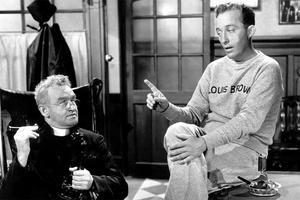
McCarey’s films move even closer to the rhythms of ordinary life. In Going My Way and The Bells of St. Mary’s, parish life is presented not as abstraction, but as something lived communally and imperfectly. Yet some of McCarey’s most deeply Catholic films are not explicitly religious at all. Make Way for Tomorrow confronts aging, filial obligation and human dignity with devastating clarity. Good Sam asks whether charity itself can become disordered when detached from responsibility to one’s own family. The moral drama remains rooted in ordinary life because McCarey understood sanctity not as spectacle, but as fidelity sustained over time.
Rossellini, emerging from the ruins of postwar Italy, carries these concerns into a shattered Europe. In Rome, Open City, the priest Don Pietro becomes the moral center of a civilization collapsing under occupation and violence. Later, in The Flowers of St. Francis, sanctity appears not through grandeur, but simplicity, humility and joy. Even Rossellini’s later films with Ingrid Bergman — works born amid one of the era’s great public controversies — remain deeply concerned with spiritual dislocation and the possibility of reconciliation.
Can Cinema Become Contemplative?
By the time one arrives at French director Robert Bresson, the question becomes more difficult still.
Bresson does not merely ask whether a film can depict religious experience. He asks whether cinema itself can become contemplative.
Watching a Bresson film can feel strangely unfamiliar, even disorienting. The performances are restrained. Silence stretches. Dramatic release rarely arrives when expected. One gradually senses that the films are asking something different of the viewer — not merely attention, but contemplation.
Bresson’s films strip away expressive acting, explanatory dialogue, even conventional notions of genre. The result can initially feel austere, perhaps even alienating. Yet beneath the surface lies an unmistakable spiritual seriousness. Grace, suffering, guilt, redemption, freedom these are not decorative themes in Bresson’s cinema. They are the terrain itself.
To call Bresson merely a “Catholic filmmaker” almost feels insufficient. He belongs equally to Blaise Pascal, Fyodor Dostoevsky, Georges Bernanos, prison narratives, existential modernism and spiritual crisis. His films are not comfortable. Nor should they be.
One does not watch Diary of a Country Priest expecting reassurance. The young priest suffers physically, emotionally, spiritually. Bresson’s camera lingers on hands, doors, footsteps, exhausted faces. Silence itself becomes expressive. At the film’s conclusion comes one of the defining lines of 20th-century spiritual cinema: “All is grace.”
Not certainty or triumph — typical emotions of a Hollywood ending — but grace. Something far more sustaining. And something that, I believe, is the missing factor in making today’s saturated media landscape meaningful on a transcendent level.
Bresson’s films often feel contemplative because they resist the frantic velocity of modern image culture. Contemporary cinema frequently seeks stimulation: movement, explanation, resolution. Bresson instead asks for patience, attention, interior participation. In this sense, his films strangely resemble older forms of spiritual practice: contemplation, monastic silence, lectio divina. The viewer is not overwhelmed with meaning. The viewer is invited into it.
A Way of Seeing
This may ultimately be the deepest contribution Catholicism has made to cinema — not simply religious subject matter, but a way of seeing.
A belief that reality is morally charged. That suffering is not meaningless. That redemption remains possible. That the visible world carries traces of the invisible.
Perhaps this is why the greatest “Catholic” films are not always explicitly religious. Sometimes no church appears at all. Sometimes no priest enters the frame. Yet the films remain haunted by grace, conscience, sacrifice, forgiveness and the dignity of the human person.
That is why Gibson’s return to biblical cinema is worth watching closely, but not in isolation. The question before Catholic viewers, I believe, is not only whether modern filmmakers can tell explicitly religious stories with reverence and power, but whether cinema itself can recover a sacramental way of seeing.
If so, then the answer may lie not merely in stories about belief, but in the mysterious capacity of film itself to slow us down long enough to perceive meaning moving quietly beneath the surface of ordinary life.
- Keywords:
- movies
- catholic movies
- cinema
- faith and hollywood