The Catholic Priest Who Forged a Lifelong Friendship With Harry Truman
During World War I, Father Curtis Tiernan and Capt. Harry Truman discovered they shared the same values — and forged a friendship that endured for the rest of their lives.
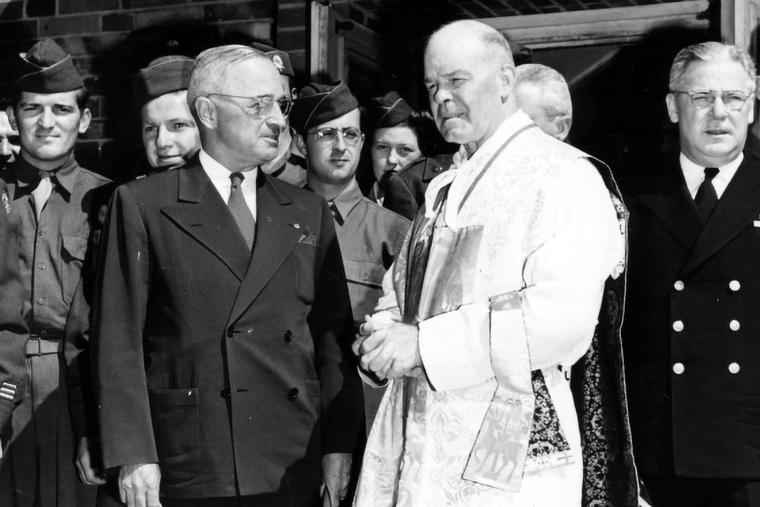
There was no precedent in American history for a close personal friendship between a Catholic priest and an American president until Harry S. Truman succeeded Franklin Delano Roosevelt in April 1945. Although a lifelong Baptist, Truman considered Father Curtis Tiernan to be his best friend.
Curtis Tiernan came from a prosperous Irish family in Kansas City, Missouri. After graduating from St. Louis University, he went to Rome in 1906 to study for the priesthood at the North American College. Four years later, he was ordained at the Basilica of St. John Lateran. He celebrated his first Mass at St. Peter’s Basilica.
When he returned to the United States, Father Tiernan worked at several parishes in western Missouri.
Meanwhile, Harry Truman, born in Lamar, Missouri, lived in Independence and Grandview. He worked on the family farm in Grandview and dabbled unsuccessfully in mining and oil ventures. By 1916, Truman “had begun to think his knack for failure was hereditary,” wrote historian David McCullough.
Neither Father Tiernan nor Truman knew yet that dramatic changes would occur in their lives when the United States got involved in World War I.
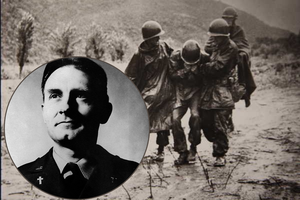
The key to understanding the remarkable friendship between Father Tiernan and Truman was their membership in the 129th Field Artillery Regiment, which was composed largely of Missouri Catholics. Father Tiernan, a warm, likable man, had been asked by young men of the unit to serve as their chaplain. Honored by the request, the priest was eager to serve the soldiers.
Harry Truman began as an enlisted soldier but his leadership skills soon advanced him to the rank of captain in the military unit.
Father Tiernan and Capt. Truman, both in their early 30s and matured by the experiences of life, inevitably gravitated toward each other and began a friendship that matured over a lifetime.
While training at Camp Doniphan, a massive encampment near Fort Sill, Oklahoma, both men discovered that they shared the same values and had enjoyed reading a wide range of books on a diversity of subjects, especially history.
After the 129th Field Artillery Regiment was shipped abroad, both men deepened their friendship during the horrific battles on the Western Front. In their marches from one sector of the front to another, Father Tiernan and Truman had long, often profound, conversations.
“I used to walk at the head of my battery and lead my horses. Father Tiernan would walk with me,” Truman said. “There were only five or six Protestants in my battery and I was one of them. All the rest were Catholics. Father Tiernan and I would walk along and discuss the history of the world and I don’t know what all.”
Testimony to the mutual respect they shared, Truman often brought up controversial subjects like the thorny topic of the Spanish Inquisition. “Father Tiernan always had an answer for me. Of course, it was never the right answer as far as I was concerned,” Truman said laughingly.
Truman admired Father Tiernan so much that he paid him the ultimate compliment, declaring, “If all priests were like him, there would be no Protestants.”
Father Tiernan, known affectionately by the soldiers as “Padre,” and Truman shared a deep loyalty to their men and displayed outstanding courage in battle.
According to historian Robert Ferrell, “Truman turned one dangerous situation around, when shrapnel was raining on the battery, shouting for the men to return, using words they had not heard before.” Father Tiernan was on the scene and observed how extraordinarily effective Truman was as a military officer.
Like other outstanding chaplains in the military, Father Tiernan was in the middle of many bloody scenes of the war, responding to that summons from God that could not be denied. Despite heavy enemy fire during the Meuse-Argonne Offensive, he performed his duties at a dressing station and with a burial squad for two days and nights. He received the Silver Star, one of the highest military decorations for valor in combat.
Throughout the war, Father Tiernan was always available to the soldiers, offering hope to the wounded and dying men of his military unit.
After World War I, Father Tiernan and Capt. Truman returned to civilian life. Father Tiernan, known for his organizational skills, tended to new congregations in St. Louis and the Ozarks. In one remote area of the Ozarks, a place which Father Tiernan especially loved, people came in boat, wagons and horseback to attend Mass.
Meanwhile, Truman opened a haberdashery in Kansas City. A few years later, he wisely turned to politics and became a county judge. He possessed all of the attributes of a good public servant — honesty, fairness, dedication and intelligence.
In 1934, he was elected to the United States Senate, where he won a national reputation as chair of a committee that discovered and eliminated waste and inefficiency in federal government contracts. He did the impossible: winning the respect not only of his Democratic colleagues but also of Republicans.
Although Father Tiernan enjoyed pastoral work, he yearned to be a chaplain again in the United States Army. “When it gets into your blood,” he said, “you cannot get it out.” He returned to military service in 1929.
When the United States entered World War II, Father Tiernan was one of 3,000 Catholic priests who served as military chaplains. According to Lili Shank, an Army efficiency report described her uncle as “a broad-minded Catholic chaplain, loyal and efficient, who takes a keen interest in the affairs of the regiment, whether or not they pertain to the Church.”
As a high-ranking chaplain, Father Tiernan had a jeep and driver at his disposal. But he preferred to pedal his way on a bicycle, complete with a wicker basket to carry his briefcase. His sacrifice endeared him to British locals, whose gasoline was so severely rationed that they had no choice but to walk or ride a bike.
Harry Truman loved his position as a United States senator. That is why he was very reluctant to be the vice-presidential nominee on the Democratic ticket in 1944 that nominated Franklin D. Roosevelt for a fourth term.
No one anticipated that Roosevelt would die only a few months after his inauguration. Truman was with Speaker Sam Rayburn when he was suddenly summoned to the White House. Believing he was going to meet Roosevelt on an important matter, Truman was greeted by Mrs. Eleanor Roosevelt, who told him that her husband had died at Warm Springs, Georgia.
The challenges that faced President Truman were enormous. Not only did he have to steer the American war machine to victory in Europe and Asia, a task yet unfinished, but also to deal with the myriad problems that the United States would inevitably face in the postwar era. No other president before him had so much to accomplish in what remained of a four-year term. As his record proved, Truman was more than up to the task.
No words of encouragement meant more to Truman than those he received from his dear friend, Father Tiernan, now a monsignor, Army colonel and chief of chaplains in the European Theater of Operations. Despite his elevation to monsignor and rank of colonel, Father Tiernan preferred simply to be called “Father” or “Padre.”
Father Tiernan wrote to Truman: “I know I should congratulate you but, knowing your extreme honesty and sincerity, I know a burden has been laid on your shoulders. From now on, Harry, you will have an intention in my daily Mass.”
The priest went on to pray that “Almighty God will enlighten and strengthen you, that you will be, in his Providence, the most powerful agent in establishing a just and lasting peace on earth.”
Truman revealed the depth of his feeling when he replied to “Padre” Tiernan, “I know the reason now that I have been having good luck with the new job. I did not receive a note or letter I appreciated more than yours.”
Truman’s first major foreign policy challenge was the last meeting of the Big Three — Truman, Churchill and Stalin — at Potsdam in July 1945. By then, it was evident that the Soviet dictator had different postwar aims from those of the United States and the United Kingdom, which would result in decades of Cold War.
Significantly, Truman personally invited Father Tiernan to be with him during this extremely difficult and significant time in world affairs.
Truman wrote to his wife Bess and told her that he had attended Protestant church services at 10 a.m. during his second week at Potsdam. He added that he also planned to attend the 11:30 a.m. Mass, offered by Father Tiernan. “I guess I should stand in good with the Almighty for the coming week — and my how I’ll need it.”
Before Mass, he told Father Tiernan, “There’s one thing you’ve got to do. You’ve got to get every Protestant in this outfit to be sure and be at that Mass because if they’re not, they will be in trouble with me!” Mass was well attended. “It was a wonderful service,” Truman related.
Father Tiernan retired from the Army three years later. He and Truman saw each other many times after the war. “Padre” was also a frequent guest at the White House.
Sadly, Father Tiernan’s heart problems led to his death in 1960. He was 75 years old. President Truman was deeply shaken by the loss of his close friend.
Truman’s health began to fail noticeably by the summer of 1972. He died in Kansas City in December of that year. He was 88.
The strong bonds of friendship between Father Tiernan and Harry Truman, who can only be described as extraordinary men, derived from their fundamental goodness. The famous commentator, Eric Sevareid, said that the key to understanding Truman was his character. His words can be applied with equal force to “Padre” Tiernan who, in Truman’s words, “was in a class by himself.”
These men lived their lives summed up in Holy Scripture: “You have been told, O mortal, what is good and what the Lord requires of you: Only to do justice and to love goodness and to walk humbly with your God” (Micah 6:8).
- Keywords:
- harry truman
- military chaplains
- friendship