‘The Face of Jesus’ Movie: A Deep Dive into the Shroud of Turin and Other Divine Images
As devotion to the Holy Face finds renewed interest, a new documentary connects ancient relics, modern miracles, and a timeless longing to see the face of God.

Editor's Note: Due to popular demand, The Face of Jesus returns to theaters for an encore presentation on June 26. Find local theater times and tickets here.
“Your face, O Lord, I will seek. Do not hide your face from me.” This verse from Psalm 27 begins a beautiful film called The Face of Jesus — in theaters June 3 only — that helps to answer that plea as it examines the face of Jesus found on the Shroud of Turin, the Veil of Veronica, the Veil of Manoppello and the original image of the Divine Mercy.
“We experience in Jesus the visibility of the invisible, the face of God and the face of Jesus Christ,” says the story’s narrator.
The investigation begins as the makers of this absorbing and inspiring documentary, an award-winning film in Poland, first drive to Krakow to examine Jesus’ face on the Shroud of Turin during an exhibit there. Viewers are reminded that on his way to the 1978 conclave, St. John Paul II visited the shroud in Turin, calling it “a mirror of the Gospel.”
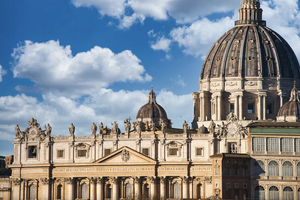
Constantinople comes next, as the film traces from West Asia to Europe the route of the Mandylion of Edessa, with its miraculous image of the face of Jesus. In Rome, the Veil of Veronica and its history is highlighted.
The documentary examines the various features of each image, showing and explaining the particular wounds seen on the shroud, for one example. Experts, including Anna Krogulska, a lay missionary who travels the world speaking about the shroud, point out historical facts and draw spiritual insights from each image. For instance, there is the important revelation that the archetypes of later depictions of the image of Jesus Christ are found in the Mandylion and the Veil of Veronica.
Powerful and Touching
Polish filmmaker Jaroslaw Redziak builds powerfully on each of the steps along the way, not forgetting easily missed revelations found in the original Divine Mercy image and what Jesus is telling us through them.
Although the film is in Polish, the dubbed English translations delivered by different narrators fit each scene in a tailor-made fashion so that the language difference becomes practically unnoticeable.
The film moves briskly, always keeping interest high. Interspersed are related images of Jesus from various periods, such as in a mosaic from the first half of the fifth century, one of the earliest known images of Jesus shown as a mature man with a long beard and long hair. With golden color, it presents Jesus in a resplendent robe as Pantocrator — Ruler of the Universe.
Occasionally, short animated bridges appear to introduce and connect sections. In black and white, they show an artist’s hand erasing simple pictures and quickly drawing new images to introduce the next scene. When, for example, the veil was moved from Constantinople to Rome in the 13th century, the sketch tracing the move resulted in an image of the earliest Vatican basilica and its courtyard. The procession ends in the Church of the Holy Spirit.
Next, the scene changes to the Capuchin church in Manoppello, a two-hour drive northeast of Rome where, in 2006, Benedict XVI became the first pope to visit in 400 years, specifically to venerate the Veil of Manoppello.
The Veil of Manoppello, also known as the Volto Santo (“Holy Face”), made of byssus, an exceptional type of material from the sea, shows the face of Jesus at his Resurrection. The film lingers at this location as it examines the beautiful image of Jesus’ face on this Volto Santo. Because the veil is transparent, light shining from the front reveals a calm, almost smiling Jesus. When illuminated from behind, his face appears wounded and sorrowful.
This section takes on extra meaning with the true stories of a man and a woman whose lives were transformed when they came into contact with the face of Jesus on the veil.
Experts on the veil share precious information. They include Capuchin Father Carmine Cucinelli, former custodian of the Shrine of the Holy Face in Manoppello, who hosted Benedict XVI; Paul Badde, who has researched the veil extensively; and Sister Blandina Paschalis Schloemer, a German Trappist nun and veil expert who, four decades ago, noticed an extraordinary resemblance between Jesus’ face on the Shroud of Turin and the Veil of Manoppello. Visual analysis later confirmed her insight, a finding explored in the film.
Viewers will also hear the story of St. Gertrude the Great and her vision of the face of Jesus. Sister Blandina connects it to the veil. Another sister relates a profoundly moving story of a small boy with a severe handicap, his experience with the veil and how it taught her to deeply contemplate the face of Jesus.
Also recounted: the experience of a priest who as a child was saved by Jesus and how the Veil of Manoppello showed that Jesus is “the Lord and King of this universe and that he will never abandon us. No matter what difficulty we experience, God is with us. He comes with us with this cheerful face to inspire trust in him.”
In addition, the film underscores that St. Thérèse of Lisieux’s official name is St. Thérèse of the Child Jesus of the Holy Face. She painted an image of Jesus’ face and placed the painting in the Carmel’s garden bower, where she prayed and found strength and devotion to the Holy Face.
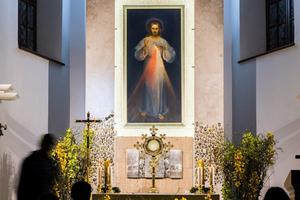
Joining these images and icons — believed not to have been made by human hands but to have appeared in miraculous, unexplainable ways — is the only one now considered in this category that was painted with human hands: the original image of the Divine Mercy, painted by Eugeniusz Kazimirowski under the direction of St. Faustina’s spiritual director, Blessed Michael Sopocko, according to the instructions she received from Jesus.
In the image’s depictions of Jesus’ eyes, face and gaze, the film underscores that we see a Person of mercy who listens to us and cares deeply about what happens in our hearts. The film even finds elements in this image that connect it to the Shroud of Turin and the Veil of Manoppello.
Added Bonus Material
This movie’s debut appears providential. The election of Pope Leo XIV brings to mind the last Leo (Leo XIII) who, in 1885, exactly 140 years ago, established devotion to the Holy Face of Jesus and an archconfraternity for it. In that very year, St. Thérèse and her entire family became early members of this confraternity.
The bonus content following the main feature sheds light on this devotion to the Holy Face. First, Father Lawrence Carney, who served as chaplain of the Benedictines of Mary, Queen of Apostles, and knew Sister Mary Wilhelmina Lancaster, now promotes this devotion. He highlights how, from 1843 to 1848, in visions to Carmelite Sister Mary of St. Peter, Our Lord revealed the devotion to the Holy Face of Jesus to heal the injuries inflicted upon him — especially of blasphemies by communists and enemies of him and the Church. Adoration of his Holy Face in reparation would be the same as Veronica wiping his Holy Face on his way to Calvary.
This devotion would serve as a powerful remedy against (and in reparation for) the offenses committed against Christ. This vision and many miracles that followed the spread of the devotion prompted Leo XIII to establish the archconfraternity and give permission for the Face of Jesus scapular to help make up for all the outrages to his face during the Passion.
Father Robert Altier, a priest of the Archdiocese of St. Paul-Minneapolis and author of God’s Plan for Your Marriage, then describes what happened in 1849, when the Veil of Veronica was displayed and a piece of plain silk was placed in front of it.
“Our new Pope and the spirituality that is ‘Leonine’ could truly inspire a new generation and many moviegoers to better understand why this devotion is so important, even in our modern times,” he said. “It’s so wonderful to see the spiritual thread from Pope Leo XIII, who first approved the devotion to the Holy Face, as revealed to Sister Mary of St. Peter, to today with Pope Leo XIV, and to consider the resurgence of devotion to the Holy Face that can become a reality. I hope that Pope Leo XIV will see our movie!”
WATCH
Due to popular demand, The Face of Jesus will have an encore presentation June 26 in selected theaters; advance tickets are available at Fathom Entertainment.
- Keywords:
- divine mercy
- the holy veil of manoppello
- veil of manoppello
- holy shroud of turin
- shroud of turin
- Veil of Veronica
- catholic movies