Mary as Medium and Model
COMMENTARY: The Blessed Mother introduces God to the world.
Nathaniel Hawthorne, one of America’s most outstanding novelists, had a deep respect for the Catholic Church, although he never became a Catholic. He did have a strong influence on his daughter Rose, who not only embraced the Church but also founded what has come to be known as the Dominican Sisters of Hawthorne. In her religious life, she is presented as the Venerable Mother Mary Alphonsa. Her cause for canonization was opened in the year 2003.
Hawthorne’s Blithedale Romance was published in 1852. Its setting is a utopian socialist farming commune based on Brook Farm, of which Hawthorne was a founding member. The conversation among three people concerning the place of women could have been just as well written in 2026. The issues concerning women are strikingly similar, and the conflicting opinions remain without resolution.
Zenobia is a staunch, angry feminist. She decries the “injustice which the world did to women, and equally to itself, by not allowing them, in freedom and honor, and with the fullest welcome, their natural utterance in public. ... If I live another year, I will lift up my own voice in behalf of woman’s wider liberty.” She likens the mistrust and disapproval of women by the “vast bulk of society” with “two gigantic hands at our throats!”
Hollingsworth, a former blacksmith-turned-obsessive-philanthropist, takes strong exception to Zenobia’s remarks. He maintains that God has endowed women with a religious disposition of “utmost depth and purity.” Then he says something that in all probability reflects the mind of Hawthorne himself:
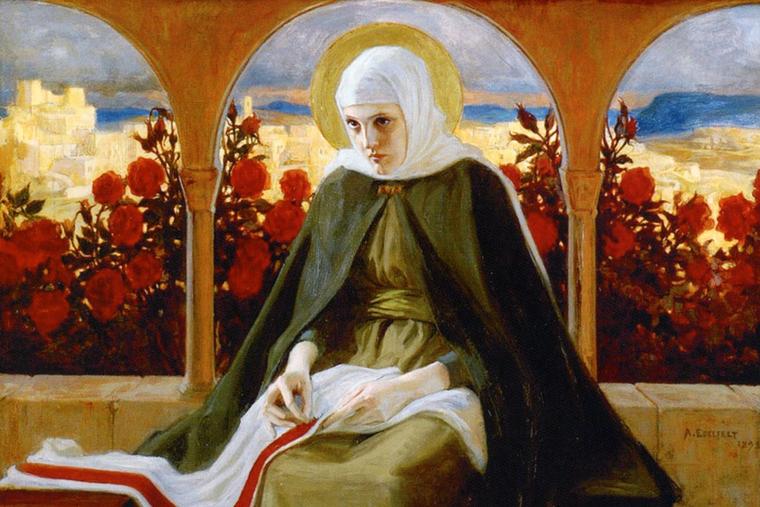
I have always envied the Catholics their faith in that sweet, sacred Virgin Mother, who stands between them and the deity, intercepting somewhat of his awful splendor, but permitting his love to stream upon the worshipper more intelligibly to human comprehension through the medium of a woman’s tenderness.
Hollingsworth, however, may not fully appreciate the depth of what he articulates.
It was a most eloquent sentence, indeed, but it received no affirmation from Priscilla, a frail, mysterious seamstress.
“I cannot think that this is true,” she said, showing “great disapproving eyes. … And I am sure I do not wish it to be true.”
She found no practicality in what Hollingsworth had said. His attitude, for Priscilla, distracts men from tending to women’s rights.
Hollingsworth has much more to say in an attempt to refine his position and save face. “She is the most admirable handiwork of God, in her true place and character. Her place is at man’s side.” Then he adds: “Man is a wretch without woman; but woman is a monster — and, thank Heaven, an almost impossible and hitherto imaginary monster — without man as her acknowledged principal!” This is not a position that will win the support of his antagonists.
How should Hollingsworth’s position be evaluated? Is it sheer masculine egoism? Does it not rob a woman of her soul? On the other hand, can Zenobia’s feminism, which blames men for denying their rights, be conciliatory toward men?
The entire matter was left up in the air; the disputants got up and left. Surely there was much more to be said. But how would it ever be possible to harmonize such widely discordant thought? Their utopia could be only a dream.
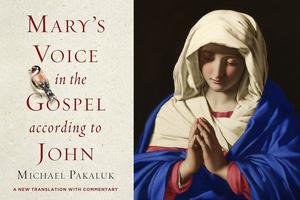
What Hollingsworth said about Mary is worth further explication. Mary is a medium, a role that the Ven. Fulton J. Sheen elucidates with a fine poetic analogy.
“On dark nights,” he states, “we are grateful for the moon; when we see it shining, we know there must be a sun. So in this dark night of the world when men turn their backs on Him who is the Light of the World, we look to Mary to guide their feet while we await the sunrise.”
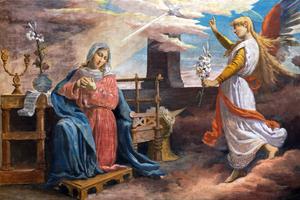
Mary introduces God to the world.
Archbishop Sheen and Hollingsworth both see Mary as a medium (or Mediatrix) who assists in transmitting the word of God to mankind. The importance of this role is difficult to dispute. Hollingsworth’s mistake lies elsewhere in his insistence that women are the subordinates of men. Neither Hollingsworth, Zenobia nor Priscilla has a comprehensive view of either women or Mary the mother of God. They have their opinions and cling to them with tenacity without wedding them to a higher truth.
Mary is also a model. She is concerned with the moral behavior of her children. This generic term — children — indicates that her concern is equally directed to both men and women. She does not see them as subordinated to each other. However, she sees them as complementing each other in many ways.
Just as in today’s society, the characters in Blithedale Romance fail to find a way in which men and women can be at peace with each other. Pope St. John XXIII put it neatly when he said that “Men and women are equal in dignity, complementary in mission.”
The great paradox between the sexes is how men and women can be true to their respective destinies without trampling on each other’s rights. Mary — as a medium, dispatching the Word of God, and as a model, having motherly concern for all her children — is an answer to this enigma. That men and women are equal and complementary rests in their ability to give without suffering any loss. This is the heart of Mary, who continues to give without ever diminishing herself.