Mary Is the Model of Joy for All Her Children
COMMENTARY: With St. Luke’s account of the Annunciation, we behold joy as the response to the unexpected grace of the Lord’s presence.
Among the Synoptic Gospels, St. Luke emphasizes joy as the distinguishing characteristic of discipleship.
Joy runs like a golden thread through the Gospel of Luke. Read alongside the repeated confusion and bewilderment of the disciples in Mark or their eager but doubting attentiveness in Matthew, Luke’s focus on joy catches the eye. It is in Luke that we behold joy as the response to the unexpected grace of the Lord’s presence and to the beauty of his words.
Perhaps only the marvelous Christological statements of Jesus in John’s Gospel rival Luke here — “Abraham your father rejoiced to see my day; he saw it and was glad” (8:56) and “Until now you have not asked anything in my name; ask and you will receive, so that your joy may be complete” (16:24).
Nevertheless, the distinctness of the Gospel of Luke lies in the emphasis on joy as a response to the Lord. And in Luke’s Gospel, the Blessed Mother is held up as a supreme example of joy.
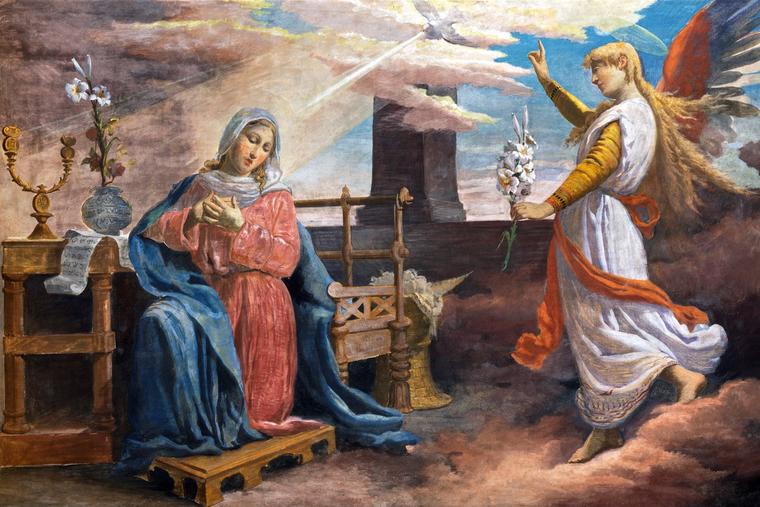
We first see the joy of Mary in the Annunciation scene in Luke 1:26-38. Luke tells us:
In the sixth month, the angel Gabriel was sent from God to a town of Galilee called Nazareth, to a virgin betrothed to a man named Joseph, of the house of David, and the virgin’s name was Mary (1:26-27).
However, before looking at the joy of Mary in this scene, it will be helpful to briefly canvass this great theme in the Gospel as a whole.
Joy in Luke’s Gospel
Before his being sent to Mary, Gabriel is sent to Zechariah to announce to him that, despite their old age, Zechariah and his wife Elizabeth would conceive a son, John the Baptist. In a threefold repetition, Gabriel announces to Zechariah the joy that John will bring:
Your wife Elizabeth will bear you a son, and you shall name him John. And you will have joy and gladness, and many will rejoice at his birth (Luke 1:13-14).
They will rejoice because, with the birth of John, the Savior is at hand. The theme of joy is predominant in Luke’s Infancy Narrative.
Joy is thematic especially in Luke 15, which bids us to rejoice because what was dead has come to life, and what was lost has been found. Joy also concludes the Gospel. The very last verses of Luke read:
They did him homage and then returned to Jerusalem with great joy, and they were continually in the temple praising God (Luke 24:52-53).
Joy, then, is a central theme in Luke.
However, the Blessed Mother is the clearest example of joy in the Gospel, and for this reason, she is also the model of discipleship. We see her joyful faith especially in the Annunciation and the Visitation scenes in Luke.
The Joy of Mary
That joy suffuses the entire scene of the Annunciation we know already from the very first word of the angel to Mary. His first word to her is chaire, a Greek word in the imperative that means, “Rejoice!” When Gabriel sees Mary, he tells her to rejoice, using a word that appears some 12 times throughout the Gospel as a whole.
Furthermore, and most importantly, in the Septuagint (the Greek Old Testament) chaire appears as the first word in three hymns of the Prophets, each of which speak of the imminent arrival of the Messiah, and so bid God’s people to rejoice. Here is the first verse of each of the three hymns that, in Greek, start with chaire:
- Zephaniah 3:14 — Shout for joy, daughter Zion! sing joyfully, Israel! Be glad and exult with all your heart, daughter Jerusalem!
- Joel 2:23 — Children of Zion, delight and rejoice in the LORD, your God! For he has faithfully given you the early rain, sending rain down on you, the early and the late rains as before.
- Zechariah 2:14 — Sing and rejoice, daughter Zion! Now, I am coming to dwell in your midst.
Speaking of these three hymns of the Old Testament in relation to Mary, Cardinal Joseph Ratzinger (Pope Benedict XVI) wrote:
Mary is shown by the angel’s greeting to be both daughter Zion in person and the place of God’s inhabitation, the holy tent, upon which the cloud of God’s presence rests.
This observation of Ratzinger’s is justified by the rest of the angel’s greeting: “Rejoice, full of grace, the Lord is with you.” In telling her that the Lord is with her, the angel calls to mind a host of verses that speak of the presence of the Lord, most powerfully his presence in the temple. The word translated as “full of grace” (in Greek, kecharitomene), is a perfect passive participle, which might be translated as, ‘Rejoice, one who has been fully or most perfectly graced.’ In employing this word, notes Dominican Father Thomas Joseph White, “The angel acknowledges that she is holier than he is.”
The angel bids Mary to rejoice, and we see her joy manifest in her response to him. She gives her fiat: “May it be done to me according to your word” (Luke 1:38). What is striking about this verse is again the first word that Mary uses, in Greek, genoito, translated as “may it be.” It is a verb in the optative mood, a grammatical form in Greek that is rare in the New Testament.
In Greek, the optative form is used to express a wish. The Blessed Mother’s use of this word shows that she is expressing a desire, a wish — one that is not yet factual but is nonetheless certain. Mary’s words reveal her trust in the word of the angel, and therefore her unshakable faith in the Lord God, whose handmaid she has just declared herself to be: “Behold, I am the handmaid of the Lord.” In this way, Mary echoes but also surpasses the great women of the Old Testament, such as Hannah, who in 1 Samuel 1:18 also calls herself the handmaid of the Lord.
But there is a further element that is conveyed by Mary’s words. That element is Mary’s joy. Mary’s words express a wish that is certain to come into being, since it depends upon the unshakable word of God. Therefore, it is a wish suffused with joy. Hence her use of the optative form of the verb, genoito. Mary is a woman of faith, but her faith is perfectly formed by joy, and in this way, she comes to our aid, since our faith (like the disciples in Mark) is often mixed with uncertainty and fear.
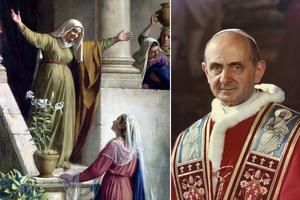
Mary’s joyful response of faith is displayed for us in the very next scene in Luke’s Gospel. She goes in haste to visit her kinswoman, Elizabeth, and in this marvelous scene we behold for the first time the very beginning of Gospel joy, that is, of the joy brought by the nearness of the Lord Jesus. And Luke shows us this Gospel joy in the uncontainable rejoicing of two unexpectedly pregnant women.
But, of the two, the Blessed Mother is the greater. While the miracle of Elizabeth’s pregnancy has precedent in the Old Testament, the miracle of Mary’s pregnancy is altogether new and marvelous. And in the joy of the Visitation, we see Mary as the perfect missionary and model disciple. She brings her Son with her and makes him present wherever she goes. She does so in a surpassingly perfect way, since she carries the Son of God in her virginal womb. Again, Father White comments:
The visitation of the Virgin Mary to Elizabeth is a supernatural mystery, because the mere presence of the Virgin Mary (who bears the God-man in her womb) makes another person aware (by the grace of faith) that Jesus is Emmanuel, God with us.
The presence of Mary makes us aware of Jesus. That is, Luke shows us that the Lord comes near to us, but that he does so through others, and preeminently through his Mother. Without the Mother of God, the Lord would not have been born among us. The awareness in faith of the presence and identity of the Child she bears is a unique gift of his Mother. For this reason, she is the model disciple and missionary in the Gospel of Luke. She does perfectly what all other disciples and missionaries are to do, as Luke describes for us in the Lord’s sending of the 72 missionary disciples (see Luke 10:1-20).
With reason then, in the verses following Mary’s fiat of 1:38, and upon visiting Elizabeth, in whose womb John leaps for joy before the hidden presence of the Christ, Mary’s spirit rejoices as she magnifies the Lord, thus completing the fervent wish she spoke to the angel.
Father Michael Johns is a priest of the Diocese of Little Rock, Arkansas.
- Keywords:
- joy
- annunciation
- blessed virgin mary
- gospel of luke