Hidden in Plain Sight: Mary’s Voice in St. John’s Gospel
COMMENTARY: St. John and Our Lady lived together for 30 years. How did those years leave their mark on the Fourth Gospel?
In The Hound of the Baskervilles, Sherlock Holmes observed: “The world is full of obvious things which nobody by any chance ever observes.”
What if this were true about St. John’s Gospel?
What if that account was heavily influenced by one person, hiding in plain sight — namely, the Blessed Virgin Mary?
And, if so, where are the clues that suggest this?
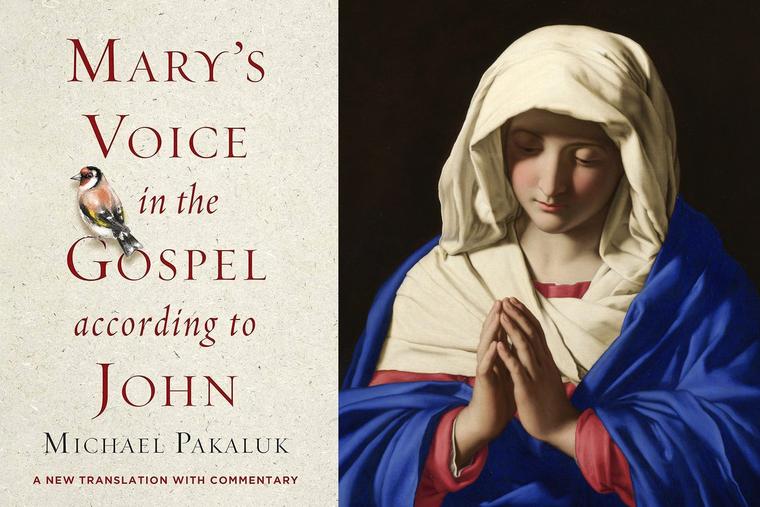
That is the intriguing premise Michael Pakaluk explores in his book Mary’s Voice in the Gospel According to John.
Speaking to the Register from his home in Maryland, Pakaluk explains that his book is the first systematic study of Mary’s influence on the distinctive characteristics of St. John’s Gospel. His earlier book on St. Mark’s Gospel covered similar territory; in that instance, Pakaluk used the relationship between Sts. Peter and Mark to show how that Gospel came to be written. And, as “a natural development,” just as St. Peter was the “voice” behind that Gospel, so Pakaluk sees Mary as “the person behind” St. John’s.
His approach is to perceive Mary’s background voice — what he describes as an “oversound” — running throughout the sacred text.
“John and Mary lived together for 30 years in Jerusalem and Ephesus,” says Pakaluk. “I know that if I spent a day with Mary talking about the life of Christ, it would change my thinking forever. But 30 years?”
An expert in ancient philosophy, Pakaluk is a professor of ethics and social philosophy in the Busch School of Business at the Catholic University of America in Washington, D.C., and a member of the Pontifical Academy of St. Thomas Aquinas. He earned his undergraduate and doctoral degrees at Harvard and studied as a Marshall Scholar at the University of Edinburgh. The account of his conversion and life with his late wife, now Servant of God Ruth Pakaluk, is found in the best-selling book The Appalling Strangeness of the Mercy of God.
Taking Pakaluk’s idea of looking for “the person behind,” one wonders: What was the most surprising thing he discovered reading St. John’s Gospel through that lens?
“The most surprising thing did not make it into the book,” he says, “because I discovered it after the book was published. It concerns when John and Peter run to the tomb, and John reports that only upon seeing the linen cloths did he believe in the resurrection, because ‘as yet they did not know the Scripture, that he must rise from the dead.’ However, someone would write something like that, in a self-deprecating way, only if he had in mind someone who, in comparison, did not need to see the linens, and did not even need to go to the tomb, because this person was already fully convinced that the resurrection was going to take place. And this person is Mary.”
Sticking with the events of Easter, Pakaluk makes this observation: “When Our Lord’s body was wrapped in the shroud, everyone else would have seen just a shape. If they had imagined anything, it would have been Our Lord’s ripped-up body after it was scourged. But Mary, his mother, would have ‘seen’ his integral, untouched body — as if foreseeing, through the shroud, how it was to look in his resurrection. It’s just like the famous story of the mother who identified the fourth soldier raising the flag on Iwo Jima, because she could ‘see through’ the clothing to the shape of her son’s back … ‘I know it’s my boy.’”
Quoting St. Jerome — namely, that “ignorance of Scripture is ignorance of Christ,” Pakaluk says Mary’s Voice is both a new Gospel translation as well as a commentary.
“I want my fellow Christians really to love the Gospels,” he says. “I strive to offer fresh translations, as though you are reading them for the first time, accompanied by commentaries which come from a fresh point of view.” The essence of this “freshness” is to treat the Gospels as historically true —that is, to treat them as eyewitness accounts.
A New Translation
Prior to embarking on this translation and commentary, Pakaluk had read the Gospels every day in ancient Greek for more than 20 years. Then, proceeding with what he describes as “reverence and prayer,” his work on this translation became a response to what he describes as other translations that “often left out nuances in the Greek, while inadvertently adding meanings which were not there.”
He laments that many New Testament translations are lacking “the freshness and immediacy” that the original Greek demands. That said, his translation is of an inspired text and, therefore, a text that “belongs” to the Church, he says, and so he ensured that the translation was submitted “to censors for ecclesiastical approval.”
So, was his desire to make Mary’s presence in the Gospel better known, or was it something that gradually became the focus of his work with the sacred text?
Pakaluk says it was Pope St. John Paul II who taught him about what he sees now as the deep connection between Mary and St. John’s Gospel. He shares a quote from the pontiff’s 2002 apostolic letter Rosarium Virginis Mariae: “The memories of Jesus, impressed upon her heart, were always with her, leading her to reflect on the various moments of her life at her Son’s side. In a way those memories were to be the ‘Rosary’ which she recited uninterruptedly throughout her earthly life.”
So, did writing this deepen the author’s own appreciation of Mary? “I came to see clearly that love of Mary is part of the warp and woof of the Gospel from the very beginning,” he says. “It’s simply false that Marian devotion is something superadded to the Gospel, perhaps centuries after Christ. The reason [for this] is that our love for Mary is inseparable from Mary’s love for Christ, and from our own love for Christ. We love her as loving him. John invites us to contemplate Christ with Mary.”
Pakaluk then postulates that his work on Mary’s Voice helped him to see “better that there is a distinctively ‘feminine’ or ‘women’s’ reception of the Gospel, and that, through the maternal love of Mary, even a man can receive the Gospel in that way. This is a real gift of Mary’s maternal love.”
- Keywords:
- gospel of john
- blessed virgin mary
- michael pakaluk