The Church Fathers Explain Why Union With Rome Is Essential
COMMENTARY: The threat facing the Church is not about liturgical preference, but about something older, more beautiful and far more costly to lose: communion with Peter.
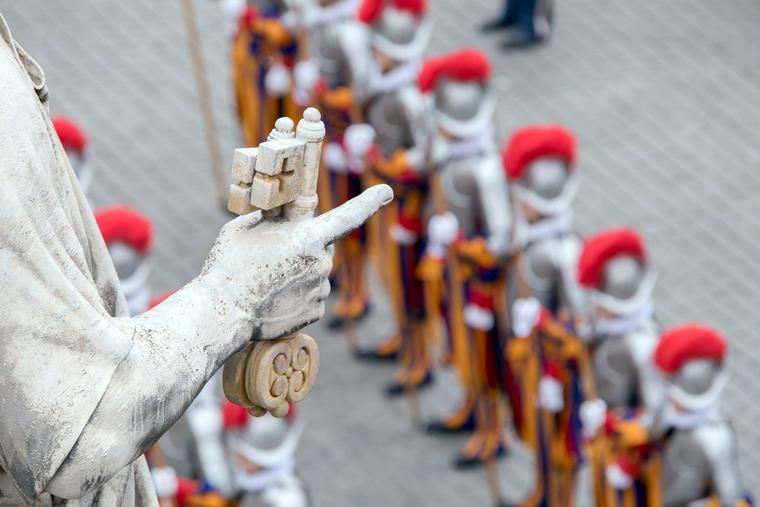
As an Eastern Catholic deacon, I will be the first to admit that we don’t always show forth our love and appreciation for our union with Rome.
Too often we minimize our union and make jokes about Rome being the “home office,” as if we are merely a branch of a larger multi-national corporation. In conversation we can quickly enumerate the abuses that we’ve suffered because of our union with Rome, yet we cannot name the benefits (both practical and spiritual) of our communion with the Holy See.
This is an impoverishment we cannot afford — especially now.
Yet again in history, we find the threat of schism looming large. The episcopal consecrations planned by the SSPX on July 1, without papal mandate, are not a canonical technicality — they are a wound to the Body of Christ. I have dear friends who are nourished by the Traditional Latin Mass, and I understand that love. As an Eastern Catholic, I know what it means to cherish a liturgical and theological tradition as the very air we breathe. But this is also true: no liturgical tradition, however ancient and beautiful, is worth severing the communion that is the Church.
What is at stake here is the very essence of the Church, rooted not in liturgical preference but in the words of Our Lord himself, “that they may all be one” (John 17:21). If we cannot articulate why union with Rome matters — not just legally, but spiritually — we will be unable to defend it when it is threatened. This is an attempt to recover what union with Rome actually means, and what we stand to lose.
At its heart, union with Rome means three things: protection, fullness and healing. These three facets of union are rooted in the Lord’s own heart for his Church and attested to by the patristic and magisterial witness.
Protection
The Church Fathers understood that communion with Peter is where the flock is kept safe from error and division. To them, union wasn’t bureaucratic oversight — it was pastoral care written into the very nature of the Church. This carried with it both theological and spiritual benefits.
In the third century, St. Cyprian of Carthage grounded the need for episcopal unity in the Lord’s promise to Peter in his treatise On the Unity of the Church: “Assuredly, the rest of the apostles were also the same as was Peter, endowed with a like partnership both of honor and power; but the beginning proceeds from unity.” To Cyprian, this unity of the episcopacy with Peter is no mere bureaucratic arrangement — it was safety and security within the ark of the Church. Cyprian witnessed his own Church being torn apart by schism and he wrote from within that wound. Fragmentation within the Church is an enemy to the good of souls.
Fullness
In the late second century, St. Irenaeus of Lyon opposed the Gnostics, who claimed a superior and hidden tradition unavailable to most believers. He writes in Adversus Haereses III.3.2: “It is a matter of necessity that every Church should agree with this Church [Rome], on account of its preeminent authority.” Any claim that another group has possession of a “true tradition” that Rome has lost or obscured flies in the face of Irenaeus. One need not look far to find such claims being made today.
In the early second century, St. Ignatius of Antioch wrote seven epistles to seven Churches on his way to martyrdom. In his letter to the Church of Rome, he famously referred to Rome as the Church that prokathemene tes agapes — “presides over love.” That word, agape, carries tremendous weight. Ignatius is not primarily interested in the jurisdictional authority of Rome. Rather, he points to Rome as presiding over the very lifeblood of the Body of Christ — love. To break from that presidency is not to escape institutional control. It is to remove yourself from the center of the Church’s charity, the place where the love that holds the whole Body together is most fully expressed and safeguarded.
This is not a minuscule detail; it is central to the good of souls. To be in union with Rome, in love, is to be immersed in the lifeblood of the Body of Christ.
Healing
St. Augustine, in On Baptism, Against the Donatists, argues that sacraments received validly, yet outside the communion of the Church, do not heal — they actually deepen wounds. He writes:
What will it then profit a man that he has sound faith, or perhaps only soundness in the sacrament of faith, when the soundness of his charity is done away with by the fatal wound of schism, so that by the overthrow of it the other points, which were in themselves sound, are brought into the infection of death?
For Augustine, soundness in faith and sacramental integrity, exercised outside the bounds of charity with the Church, are not efficacious for healing. Only a sacramental life within the Church can bring the healing that the sacraments were meant to bring.
The Gift of Communion
The Fathers did not write in peaceful times. They wrote in times of martyrdom, doctrinal confusion, fragmentation and societal collapse. Despite these terrible circumstances, they all wrote in one direction — toward union, toward charity, and toward the healing that only communion makes possible. Their words and examples are not museum exhibits. They are precisely the medicine that is needed now.
Eastern Catholics know something about the cost of separation and the cost of return. Our unions with Rome were never easy. They were achieved through great sacrifice — through misunderstandings, through pressure, through the difficult work of theological reconciliation. Yet we do not regret the work. We only regret that we have not always fully treasured what they mean. Union with Peter is participation in the love that holds the Body of Christ together — the same love that Ignatius pointed to, and the same charity that Augustine called the medicine for the wound of schism.
To those who love the traditional liturgy, we say this with fraternal tenderness: The tradition that you cherish is not at odds with Rome. It belongs to Rome, and Rome belongs to it. What is being risked at this moment is not liturgical preference — it is something older, more beautiful, and far more costly to lose. The mercy of God, as Augustine reminds us, never stops working through the unity of the Church so that the wounded may come and be healed. That door remains open. Come through it.
- Keywords:
- schism
- sspx
- church fathers
- unity
- communion