How Have the Popes Treated the SSPX?
COMMENTARY: As the Society of St. Pius X is again on the brink of schism, perhaps a more traditional approach from the Holy See would serve the universal Church — and the adherents of the SSPX — better.
Is it time to treat the self-styled “traditionalist” Society of St. Pius X (SSPX) in a more traditional manner?
The Holy See has attempted for nearly 40 years to accommodate the SSPX with highly untraditional innovations, some of them canonically peculiar, to no avail. Now that the SSPX has confirmed its intention to ordain bishops this summer without the required papal mandate, perhaps a more traditional disciplinary approach would serve the Church — and the adherents of the SSPX — better?
Feb. 22 marked Pope Leo XIV’s first feast of the Chair of St. Peter as pope, though liturgically the first Sunday of Lent took precedence. The Chair of St. Peter is the sign of the Holy Father’s mission and authority as universal pastor of the Church, a mission given first by Christ himself to St. Peter. That mission and authority serve the unity of the Church, sometimes through necessary discipline, sometimes through patient indulgence.
Consider the various measures, all highly unusual, that successive popes have attempted to bring the SSPX into the heart of the Church.
In 1988, when Archbishop Marcel Lefebvre, founder and superior of the SSPX, announced that he would consecrate bishops to succeed him without the necessary mandate of the Holy Father, he was warned that he and the bishops he ordained would suffer the automatic penalty of excommunication. Archbishop Lefebvre had already been ordaining priests for years despite being suspended from doing so by the Holy See, so he had long become accustomed to defiance.
Nevertheless, Pope St. John Paul II asked Cardinal Joseph Ratzinger to work out an agreement with Archbishop Lefebvre, if possible, securing his doctrinal adherence to Vatican II, and providing a new bishop for the SSPX.
Archbishop Lefebvre agreed and signed an agreement with Cardinal Ratzinger, but reneged upon it the next day. He ordained four new bishops despite a direct papal directive not to do so, and therefore he, his co-consecrating bishop, and the four new bishops were all excommunicated, formally declared by Pope John Paul for committing a “schismatic act.”
Despite the clarity of what Archbishop Lefebvre did, the Holy See for years has refrained from using the term “schism” — even though used by John Paul in an authoritative document — in order not to offend SSPX sensibilities.
Then, immediately after the excommunication of Archbishop Lefebvre and his accomplices, John Paul created a religious order — the Priestly Fraternity of St. Peter (FSSP) — out of whole cloth as a new home for SSPX priests who desired to remain in communion with Rome, but maintaining their SSPX customs. Religious orders are not created by papal fiat; they organically emerge when founders propose a new charism and, after years of testing, are recognized at the diocesan level first, and then by the Holy See.
The process takes decades, not just a few weeks. A foundational criterion for approval is specifying the charism of the new order. What is the charism of the FSSP? Offering Mass according to the 1962 Missal cannot be a charism by itself, much less not celebrating the Missal of Paul VI.
Nevertheless, Pope John Paul and Cardinal Ratzinger set the usual process aside in order to fashion an ecclesial home for those who did not wish to follow Archbishop Lefebvre in his “schismatic act.” They chose generosity when severity was also an option, indeed a deserved one.
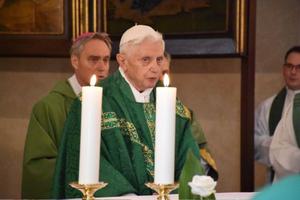
When Pope Benedict XVI was elected, the SSPX asked for greater permission to be given throughout the Church for the Tridentine Mass — what Pope Benedict would call the “extraordinary form” — as well as the lifting of the excommunications of 1988. Pope Benedict granted both requests.
In 2007 with Summorum Pontificum, Pope Benedict did something that may never have been done in liturgical history, giving priests the right to celebrate Mass — the “extraordinary form” — without the permission of their bishops. Indeed, out of goodwill toward the SSPX, he effectively granted all priests greater rights regarding the “extraordinary form” than the “ordinary form.” There was nothing at all traditional about that.
In 2009, Pope Benedict then lifted the penalty of excommunication as an act of personal mercy, despite the offending SSPX bishops not expressing any regret for their illegitimate consecration. As excommunications are usually lifted discreetly, without global press attention, it is not possible to know how often they are lifted for those entirely unrepentant. But it would be unusual. Two of the bishops who had their 1988 excommunications lifted in 2009 have apparently opted to be excommunicated again this year for the same canonical offense. Their contumacy is not only a provocation today, but an act of towering ingratitude toward Benedict XVI and an insult to his memory.
Despite lifting the excommunications in 2009, absent any contrition or purpose of amendment, Pope Benedict underscored the very grave and potentially sinful situation of the priests of the SSPX.
“As long as the Society does not have a canonical status in the Church, its ministers do not exercise legitimate ministries in the Church,” Benedict wrote. “There needs to be a distinction, then, between the disciplinary level, which deals with individuals as such, and the doctrinal level, at which ministry and institution are involved. In order to make this clear once again: until the doctrinal questions are clarified, the Society has no canonical status in the Church, and its ministers — even though they have been freed of the ecclesiastical penalty — do not legitimately exercise any ministry in the Church.”
Pope Benedict thus extended two significant olive branches — olive orchards, to be more precise — to the SSPX. What then would they do in return, to remove themselves from the situation in which every act of their ministry — every Mass they offer — is illegitimate?
Nothing.
Pope Benedict then tried a third time, with intense dialogues culminating in 2012 with the offer of a “personal prelature” — a nonterritorial diocese — to the SSPX, if it would affirm the doctrinal teaching of Vatican II, the Catechism of the Catholic Church and the magisterium of the Church subsequently. Having been offered more than could reasonably be demanded, the SSPX refused. Again.
Pope Francis was even more generous still.
Demanding nothing of the SSPX, he granted them, on his own personal authority, “jurisdiction” for validly hearing confessions and witnessing marriages. Some sacraments, like the Holy Eucharist, are valid even if the priest does not have the proper jurisdiction (permission or “faculties” from a bishop). It would be sinful for the priest to offer Holy Mass without such permission, but it would still be a valid Mass.
Confession and holy matrimony require jurisdiction to be valid. Thus, decades of penitents who confessed to SSPX priests did not receive valid absolution from them, as they lacked jurisdiction. Likewise, their marriages were invalid, and so they were, unwittingly or not, cohabiting outside of marriage.
Pope Francis remedied this by providing that jurisdiction himself, precisely because the SSPX has no canonical status, and thus no capacity to confer jurisdiction itself. For this remarkable act of mercy, Pope Francis asked nothing from the SSPX in return.
The Holy Father can grant jurisdiction himself, but it was highly peculiar — and most untraditional — for him to do so. Priests who, by law, had no legitimate ministry could somehow hear confessions validly. No priest outside the SSPX would ever be suspended from ministry and also be given permission to hear confessions.
All these initiatives have not borne the desired fruit of reconciliation. It would not be unreasonable to conclude that perhaps the SSPX is not interested in being reconciled with the Church.
Pope Leo XIV is the fifth pope to have to deal with the intransigence of the SSPX. Perhaps he might be the first simply to take “No” for an answer and let the traditionalists deal with the traditional consequences, rather than launching ever more novel, wholly unreciprocated, initiatives.
The more traditional approach would be to declare the excommunications and make clear that the SSPX is in schism, given that is what is wrought by repeated schismatic acts. Further, in the traditional course of things, the Holy See would clarify that the SSPX’s sacramental acts are illegitimate and therefore should be avoided by the faithful. Perhaps canonical penalties might achieve what pastoral concessions did not.
The Holy See has not chosen that path, with eminent goodwill, for decades. The SSPX, in choosing the path of excommunication again, may be inviting the Holy See to try the traditional path with them now.
- Keywords:
- sspx
- sspx-vatican dialogue
- society of st. pius x
- schism